Two different technologies are both being called "solid-state"
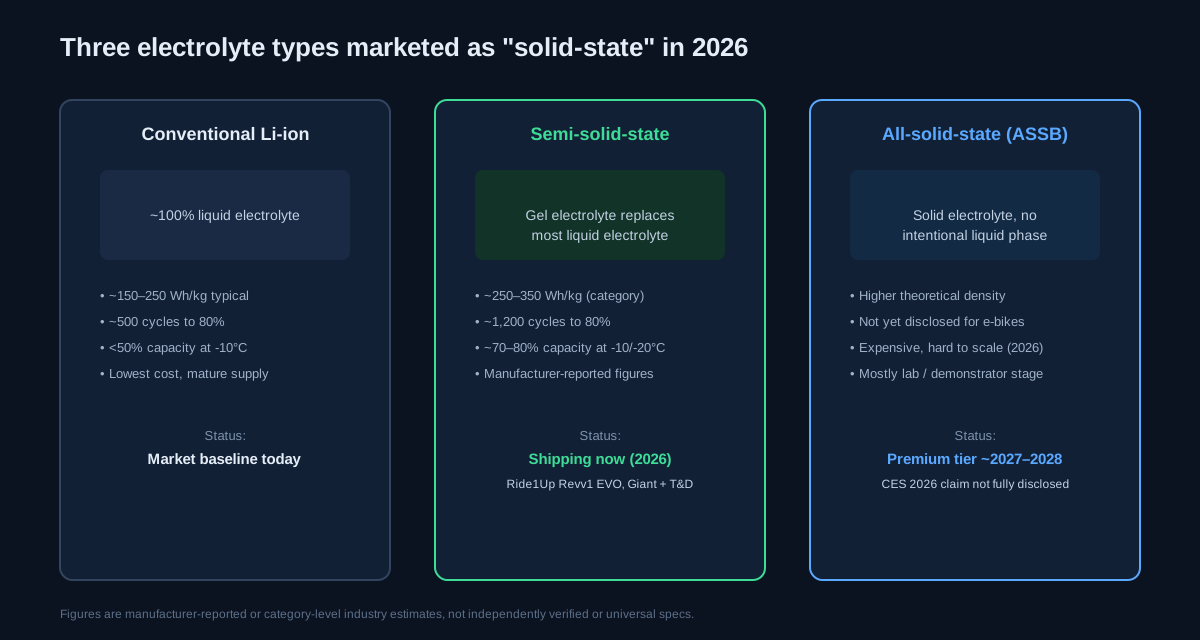
E-bike marketing in 2026 uses "solid-state" loosely, and that loose usage is the single biggest source of buyer confusion. There are two genuinely different things on the market: all-solid-state batteries (ASSB) use a solid electrolyte with no intentionally added liquid phase, and semi-solid-state batteries replace most - not all - of the liquid electrolyte with a gel-like material.
All-solid-state remains largely a lab-and-demonstrator technology outside the premium motorcycle segment, expensive to manufacture and difficult to scale. Semi-solid is a real, shipping bridge chemistry: Ride1Up's own description of its Revv1 EVO pack states that "fully solid-state batteries are still largely in development and remain expensive and difficult to scale. They exist, but pretty much just in the laboratory," positioning semi-solid as the technology "available now at a consumer-friendly price point."
That distinction is the entire premise of this article. When a buyer or brand asks "should we wait for solid-state," the honest answer depends on which of the two chemistries they actually mean - and, as of today, only one of them is buyable.
The clearest semi-solid commercial case: Ride1Up Revv1 EVO
Ride1Up's Revv1 EVO, launched in the US in May 2026, is the clearest example of a semi-solid-state e-bike battery reaching an ordinary consumer at a mainstream price point rather than a lab bench or a five-figure prototype.
Battery: 52V 20Ah (roughly 1 kWh), semi-solid-state chemistry using a gel-like electrolyte in place of most of the liquid electrolyte found in a standard lithium-ion pack. Price and availability: launched at $2,395; pre-orders opened May 4, 2026, with shipping beginning in August 2026. Motor: 750 W Bafang hub motor, 100 Nm torque, up to 60 miles of claimed range on a single charge.
Manufacturer-reported performance: more than 1,200 charge cycles before capacity drops to 80% of original (compared with roughly 500 cycles for a typical lithium-ion e-bike pack, per the manufacturer's own comparison); a full charge in about two hours on a 9A charger without the heat penalty that usually accompanies fast-charging a liquid-electrolyte pack; and roughly 70% capacity retention at -20°C (-4°F). These are manufacturer-reported figures, not independently retested numbers, but they are attached to a real, shipping, individually priced consumer product - a materially stronger evidence class than a roadmap or trade-show demonstrator.
The mainstream-brand case: Giant and T&D
The second concrete 2026 case comes from a mainstream bicycle brand rather than a direct-to-consumer startup. Giant Manufacturing has partnered with T&D - an electric-mobility company spun out of e-bike motor and component maker Bafang, founded by Bafang co-founder Sunny He - to supply a semi-solid-state battery for what Giant describes as the industry's first e-bike built around this chemistry.
Per the April 2026 reporting reviewed here, the T&D-supplied pack is reported to deliver, at the same energy capacity as a conventional lithium-ion pack: roughly 20% lower weight; cold-weather retention of about 80% of capacity at -10°C, compared with under 50% for a typical lithium-ion pack at the same temperature; and a cycle life of roughly 1,200 cycles versus roughly 600-800 cycles for a conventional pack. Separately, industry commentary on semi-solid-state e-bike chemistry generally puts the energy-density range for these newer cells at roughly 250-350 Wh/kg, against roughly 150-250 Wh/kg for most e-bike batteries on the market today - useful category-level context rather than a disclosed spec for the Giant pack specifically.
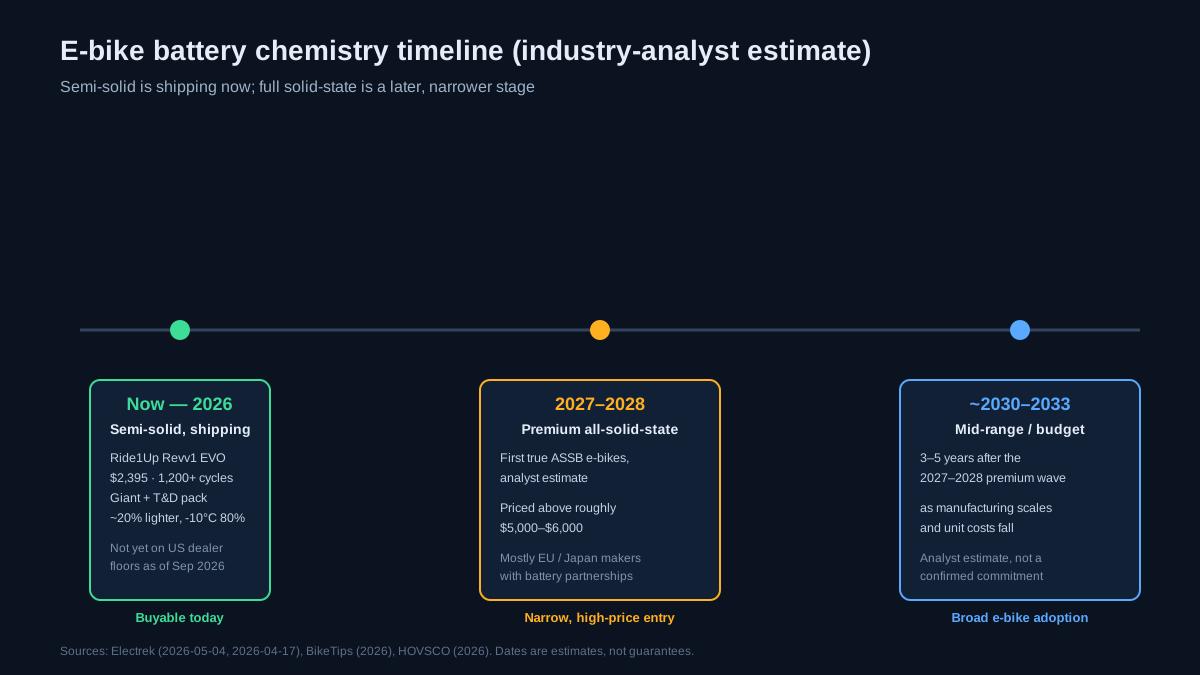
As of September 2026, the Giant/T&D battery had not yet reached US dealer floors, and separate industry reporting from the same month puts semi-solid batteries reaching mainstream e-bike price points broadly at "at least 2-3 years out at scale." Read the announcement as a strong signal that a major, non-startup bicycle brand is committing resources to semi-solid chemistry - not as evidence that the average buyer can walk into a shop and buy one today.
What CES 2026 actually showed, and what it did not
At CES 2026 in January, coverage described the debut of what was billed as the "world's first solid-state battery electric bike" - a production-ready machine with claimed range configurations of up to roughly 350 km on a mid-size pack and up to roughly 600 km on a larger pack. Those are large numbers, and the framing explicitly ties the announcement to solid-state chemistry moving "from labs to production lines."
Two qualifications matter before treating this as proof the wait for true solid-state is already over. First, the reviewed coverage does not disclose enough cell-level chemistry detail - solid electrolyte composition, liquid-electrolyte fraction, or independent verification - to confirm all-solid-state construction rather than a semi-solid or hybrid design marketed under the solid-state label, the exact labeling ambiguity described above. Second, the same coverage frames current costs as a barrier that still needs to "scale down" before the technology filters into mainstream e-bikes, which is inconsistent with a fully commercialized, buyer-ready product today.
Treat the CES 2026 debut as a genuine signal of momentum, not as evidence that a verified all-solid-state e-bike battery is now broadly available to buy. This is also why this article does not lean on the CES demonstrator as its primary evidence: the two production cases with disclosed pricing, shipping dates and manufacturer specifications (Ride1Up and Giant/T&D) are stronger evidence than a show-floor claim with limited public chemistry disclosure.
The realistic 2026-2028 timeline
Putting the commercial evidence and the industry-analysis evidence together produces a timeline with three distinct stages, not one single "solid-state arrives" moment.
Now (2026): semi-solid-state batteries are real, shipping and buyable in e-bikes and micromobility, from consumer-direct pricing ($2,395 for the Revv1 EVO) up toward premium mainstream-brand pricing once Giant's pack reaches dealers. 2027-2028: industry analysis reviewed here expects the first genuinely premium e-bikes with true solid-state (all-solid-state) cells to appear in this window, priced above roughly $5,000-$6,000 and concentrated among European and Japanese manufacturers with established battery-technology partnerships - a narrow, high-price entry point, not a mass-market launch. Roughly 2030-2033: the same analysis expects true solid-state chemistry to filter down into mid-range and eventually budget e-bike models over a further three to five years, as manufacturing scales and unit costs fall.
None of these figures are guarantees; they are industry-analyst expectations as of the most recent reporting reviewed, and timelines in battery manufacturing have historically slipped. The practical takeaway is the same either way: a buyer or brand deciding between "wait for solid-state" and "buy semi-solid now" is choosing between a real, present-day product and a premium product that, on the best available evidence, is still at least a year or two away and initially priced well above typical e-bike budgets.
Why this is a different power class and regulatory category than electric motorcycles
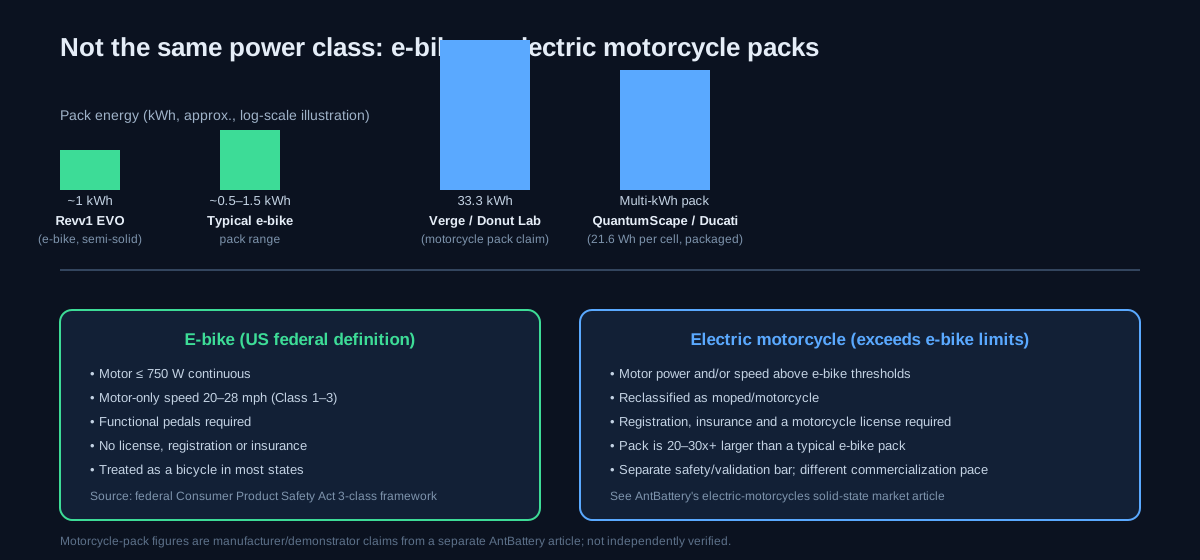
Solid-state battery coverage frequently blurs e-bikes and electric motorcycles together, but they sit in genuinely different power, energy and regulatory categories, and that difference matters for anyone sourcing a pack.
In the US, a pedal-assist e-bike is capped, under the federal Consumer Product Safety Act's three-class framework, at a 750-watt continuous motor and a motor-only top speed of roughly 20-28 mph depending on class; a bike meeting those limits and retaining functional pedals is treated as a bicycle - no license, registration or insurance required in most states. A vehicle exceeding those thresholds is reclassified as a moped or motorcycle, which brings registration, insurance and licensing requirements. That threshold roughly tracks the pack sizes discussed in this article: the e-bike and micromobility packs above run from about 0.5 kWh up to roughly 1 kWh (Revv1 EVO) at 52V.
AntBattery's companion article on solid-state batteries in electric motorcycles covers a materially higher power and energy class - for example, the QuantumScape/PowerCo cells demonstrated in a modified Ducati race motorcycle are disclosed at roughly 21.6 Wh per packaged cell and would be assembled into a much larger multi-kWh pack, and the Verge/Donut Lab production claim centers on a 33.3 kWh pack, more than 30 times the size of the Revv1 EVO's battery. Motorcycle-class packs also answer a different regulatory and safety-validation bar, since the vehicle itself requires licensing and registration. If a supplier or roadmap discussion conflates "solid-state is coming to two-wheelers" without separating e-bike-class packs from motorcycle-class packs, ask which power and energy class the claim is actually about - the timeline, cost structure and validation requirements are not the same.
What a buyer or brand should verify before committing either way
Whether the decision is "spec a semi-solid pack now" or "wait for full solid-state," the questions to put to a supplier are largely the same.
- Chemistry disclosure: ask for the explicit electrolyte classification (all-solid-state vs semi-solid vs conventional liquid) and, where possible, the liquid-electrolyte fraction - do not rely on the word "solid-state" alone.
- Test conditions behind every figure: cycle-life, cold-weather-retention and energy-density numbers are only comparable when the temperature, discharge rate, cycle-to-failure definition (typically 80% of original capacity) and pack configuration are disclosed alongside the number.
- Independent verification status: distinguish a manufacturer-reported figure from an independently retested one; neither the Ride1Up nor the Giant/T&D figures cited in this article have yet been independently reproduced in public testing.
- Production status vs demonstrator status: a CES debut, a trade-show prototype or a company roadmap is not the same evidence class as a priced, shipping consumer product with a stated ship date.
- Power and energy class fit: confirm the pack's energy, voltage and continuous power figures against the vehicle's regulatory class (e-bike vs moped vs motorcycle) rather than assuming a motorcycle-class solid-state roadmap timeline applies to an e-bike-class program.
- Total delivered cost, not just cell chemistry: a semi-solid pack available today may already meet a program's safety and cold-weather requirements at a materially lower cost and shorter lead time than waiting for a 2027-2028 premium solid-state cell.
Talk to AntBattery with your power class and timeline in mind
AntBattery works with e-bike, light-EV and micromobility programs evaluating semi-solid and solid-state cell options across the sub-2 kWh pack range this article covers. Review the battery product families for format and voltage context, then use the sample RFQ / technical contact path to request cells or a technical conversation - state your target energy density and basis (gravimetric or volumetric), your cold-weather and cycle-life requirements, and whether your program needs available-now semi-solid chemistry or is planning around a 2027-2028 premium solid-state timeline.
No single cross-chemistry cycle-life, cold-retention or cost figure is implied or guaranteed by this article; AntBattery can discuss a project-specific evidence package.
FAQs
Is a "solid-state" e-bike battery on the market today actually all-solid-state?
No commercially shipping e-bike battery reviewed here uses a true all-solid-state (solid-electrolyte-only) chemistry. Every current commercial case - Ride1Up's Revv1 EVO and the Giant/T&D pack - is semi-solid, meaning most but not all of the liquid electrolyte has been replaced. Marketing sometimes uses "solid-state" loosely to describe either chemistry, so ask for explicit electrolyte disclosure.
Should an e-bike buyer wait for full solid-state batteries?
Based on the evidence reviewed here, most buyers should not wait. Semi-solid packs already deliver the thermal-stability, cold-weather-retention and cycle-life advantages most buyers associate with "solid-state," and they are available now at consumer prices. Industry analysis expects true solid-state e-bikes only in a narrow premium tier starting around 2027-2028, priced above roughly $5,000-$6,000.
When will solid-state e-bike batteries reach mid-range and budget bikes?
Industry analysis reviewed here estimates a further three to five years after the initial 2027-2028 premium wave, putting mid-range and budget availability at roughly 2030-2033. These are analyst expectations, not confirmed manufacturer commitments, and battery-manufacturing timelines have historically slipped.
What is the difference between a semi-solid-state and all-solid-state e-bike battery?
An all-solid-state battery uses a solid electrolyte with no intentionally added liquid phase. A semi-solid-state battery replaces most of the liquid electrolyte with a gel-like material but is not a fully solid electrolyte. As of 2026, semi-solid is the commercially shipping bridge chemistry in e-bikes; all-solid-state remains largely a lab and premium-demonstrator technology outside the motorcycle segment.
Are e-bike solid-state battery programs the same as electric motorcycle solid-state battery programs?
No. E-bike and light-micromobility packs in this article run roughly 0.5-1 kWh at federal e-bike power limits (750 W continuous motor, 20-28 mph motor-only speed). Electric motorcycle programs, covered in AntBattery's companion article, involve materially larger multi-kWh packs and a different vehicle-licensing and regulatory category. Treat their commercialization timelines as separate.
Did CES 2026 prove that all-solid-state e-bike batteries are already commercially available?
Not conclusively. A CES 2026 e-bike was promoted as the "world's first solid-state battery electric bike" with large claimed range figures, but the coverage reviewed here did not disclose enough cell-level chemistry detail to confirm true all-solid-state construction, and it separately noted that costs still need to fall before the technology reaches the mainstream. Treat it as a momentum signal, not confirmed proof.
Sources and further reading
- Ride1Up Revv1 EVO semi-solid-state battery specifications and pricing - Electrek (2026-05-04)
- Ride1Up - Introducing the Revv1 EVO and the Semi-Solid State Battery (accessed 2026-09-14)
- Giant and T&D (Bafang spinoff) semi-solid-state e-bike battery - Electrek (2026-04-17)
- Giant Set to Launch Industry's First Semi-Solid-State E-Bike Battery - BikeTips (accessed 2026-09-14)
- Solid-State Batteries Could Transform E-Bikes: Here's What's Coming - BikeTips (accessed 2026-09-14)
- World's First Solid-State Battery Electric Bike Debuts at CES 2026 - HOVSCO (accessed 2026-09-14)
- California E-Bike Classifications (federal Class 1/2/3, 750 W threshold) - CalBike (accessed 2026-09-14)
- U.S. Electric Bike Laws by State (federal 750 W / 20-28 mph threshold) - Velotric (accessed 2026-09-14)
Related Blogs
Learn More About Battery
Related Products
Related product
Pouch Cell Series
AB-50AH Semi Solid Pouch Cell
- Energy Density
- 320 Wh/kg
- Nominal Voltage
- 3.7 V
Cylindrical Series
AB-21700 Semi Solid Cylindrical Cell
- Energy Density
- 300 Wh/kg
- Nominal Voltage
- 3.7 V
Prismatic Series
AB-100AH Semi Solid Prismatic Cell
- Energy Density
- 285 Wh/kg
- Nominal Voltage
- 3.65 V