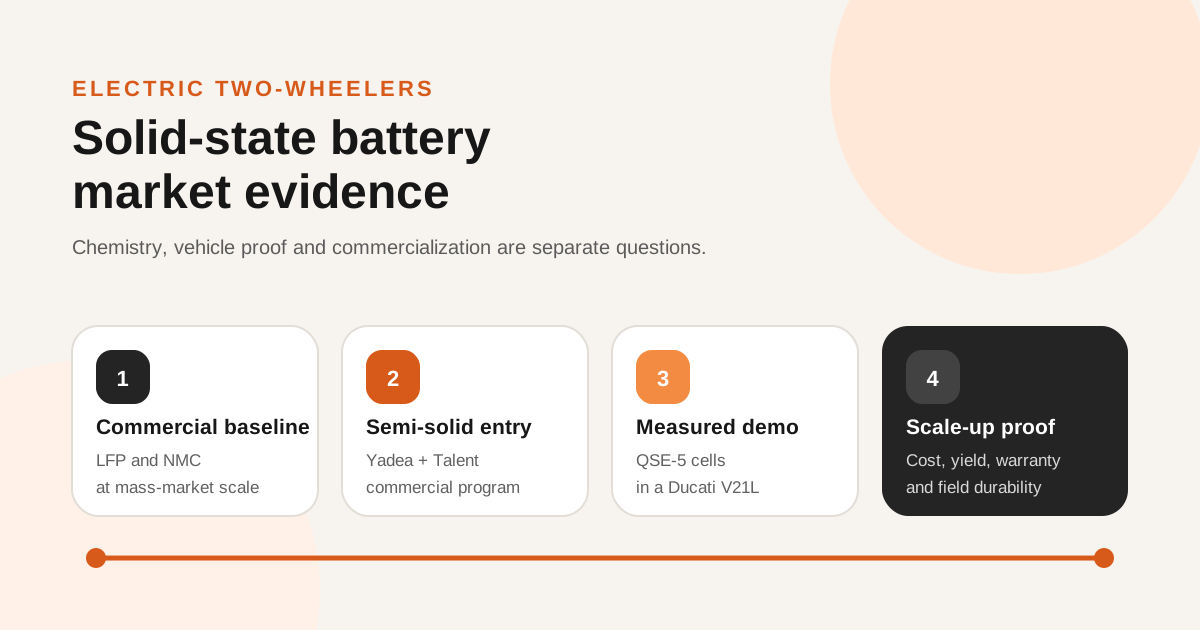
What the global two-wheeler news shows
Electric two-wheelers are scaling faster than the solid-state batteries often associated with their future. The International Energy Agency Global EV Outlook 2026 reports that global electric two- and three-wheeler sales reached about 11 million in 2025, representing around 15% of the segment. China, Türkiye, India and Viet Nam together accounted for about 95% of electric two- and three-wheeler sales.
The supplied WeChat Channels preview highlighted rapid electric two-wheeler growth in India, increased battery-swapping activity in Kenya and expansion in Vietnam and the Philippines. Those developments show where vehicles, batteries and swapping stations are scaling. They do not prove that solid-state batteries are already deployed in those markets.
Most commercial electric motorcycles and scooters still use conventional lithium-ion batteries, especially LFP and NMC. The two-wheeler boom creates a future market for safer, lighter or higher-capacity packs, but a chemistry change must still beat mature batteries on cost, warranty, serviceability and field reliability.
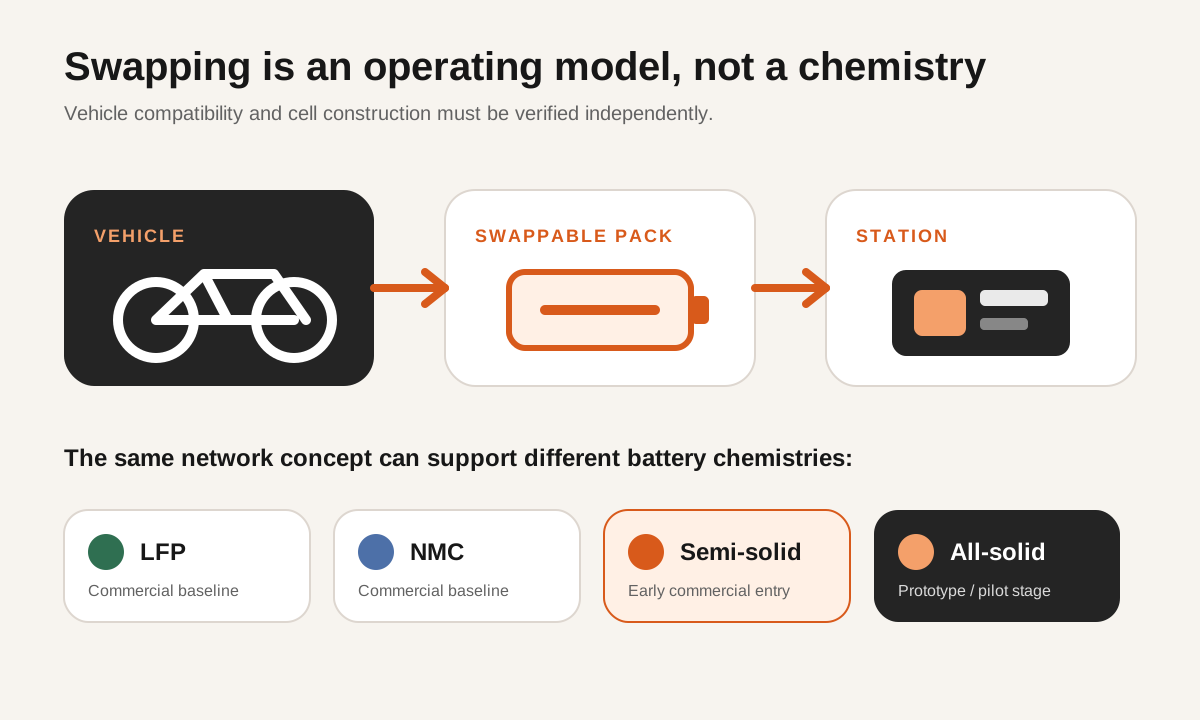
Keep all-solid-state, semi-solid and conventional batteries separate
An all-solid-state cell contains a solid electrolyte and no intentionally added liquid electrolyte. Semi-solid or solid-liquid hybrid cells retain a liquid or gel phase. Company-specific labels such as condensed-state do not automatically map to either category. Conventional LFP and NMC lithium-ion cells normally use liquid electrolyte and remain the commercial baseline.
A peer-reviewed National Science Review analysis warns that public communication often uses semi-solid, quasi-solid and solid-state inconsistently. Classification should follow disclosed cell construction, not the shortest marketing label.
Solid-state also should not be described as impossible to ignite. Reducing flammable liquid may lower ignition or propagation risk in some designs, but electrodes, interfaces, electrical faults and pack components still require system-level safety validation.
Yadea and Talent New Energy: the clearest commercial semi-solid case
In March 2026, Yadea and Talent New Energy announced a high-end electric motorcycle equipped with a mass-produced semi-solid battery. The World Intellectual Property Organization describes it as the first two-wheeled vehicle equipped with a mass-produced semi-solid battery and says the launch marked scaled application in the segment.
Chinese reporting identifies the model as the Yadea Guanneng Starship II-200L and describes a 72 V, 109 Ah system developed with Talent New Energy. The nameplate capacity is approximately 7.85 kWh. Reported range and cycle-life figures should remain attributed to the companies until full protocols and independent results are available.
This is the strongest near-term commercial case in the evidence set, but it must be classified correctly. The battery is semi-solid or solid-liquid hybrid, not all-solid-state. The architecture may offer a faster production path, yet the label alone does not establish liquid content, pack safety, energy density or cost.
QuantumScape, PowerCo, Audi and Ducati: the strongest measured demonstration
In September 2025, QuantumScape and PowerCo demonstrated QSE-5 solid-state lithium-metal cells in a modified Ducati V21L electric race motorcycle. Audi designed the battery system, and PowerCo is QuantumScape's industrialization partner.
This is the strongest public operating-motorcycle demonstration reviewed because the supplier disclosed measured cell conditions. QuantumScape reported approximately 5 Ah and 21.6 Wh per fully packaged cell, with 301 Wh/kg gravimetric energy density and 844 Wh/L volumetric energy density measured at C/5, 25 degrees Celsius, 100% state of charge and below 3.4 atmospheres of operating pressure.
The limits matter as much as the headline. The motorcycle was a modified demonstrator using B-sample cells, not a homologated retail Ducati. No production model, certified range, price, pack warranty or customer-delivery date was announced.
- Strong evidence: a running motorcycle and disclosed cell-level measurement conditions.
- Still missing: production pack, homologated vehicle, price, warranty and delivery schedule.
- Editorial status: credible demonstration, not proof of motorcycle mass production.
Verge and Donut Lab: the most visible and most disputed claim
Verge Motorcycles announced in January 2026 that its TS Pro would use an all-solid-state battery from sister company Donut Lab. The companies promoted 400 Wh/kg cell-level specific energy, charging in minutes and a design life of up to 100,000 cycles. Those figures would represent a major breakthrough if independently reproduced at production scale.
The public evidence remains contested. IEEE Spectrum and later technical coverage questioned the absence of a complete cell specification and standardized third-party disclosure. A review summarized by Battery Technology reported behavior consistent with familiar NMC and graphite components and calculated a lower specific energy than the advertised figure.
Verge's product page lists later delivery windows for several regions than the original launch messaging. The responsible description is therefore a claimed all-solid-state production program with unresolved chemistry, validation and customer-delivery questions. A motorcycle leaving a line is not the same as independently verified series volume.
Gogoro and ProLogium: the strongest swappable solid-state prototype
Gogoro and ProLogium unveiled a solid-state lithium-ceramic battery prototype for two-wheeler swapping in March 2022. The prototype was designed to fit Gogoro's existing vehicles and swapping network.
The companies estimated that the same form factor could increase capacity from 1.7 kWh to 2.5 kWh. That is approximately 47% more capacity, not 140% more. Backward-compatible packaging is strategically important because a network operator could introduce a new chemistry without replacing every vehicle and station at once.
Centralized ownership could also support state-of-health tracking, controlled charging, quarantine and field-data collection. The original announcement still calls the pack a prototype, and the reviewed evidence did not confirm large-scale deployment across the Gogoro network.
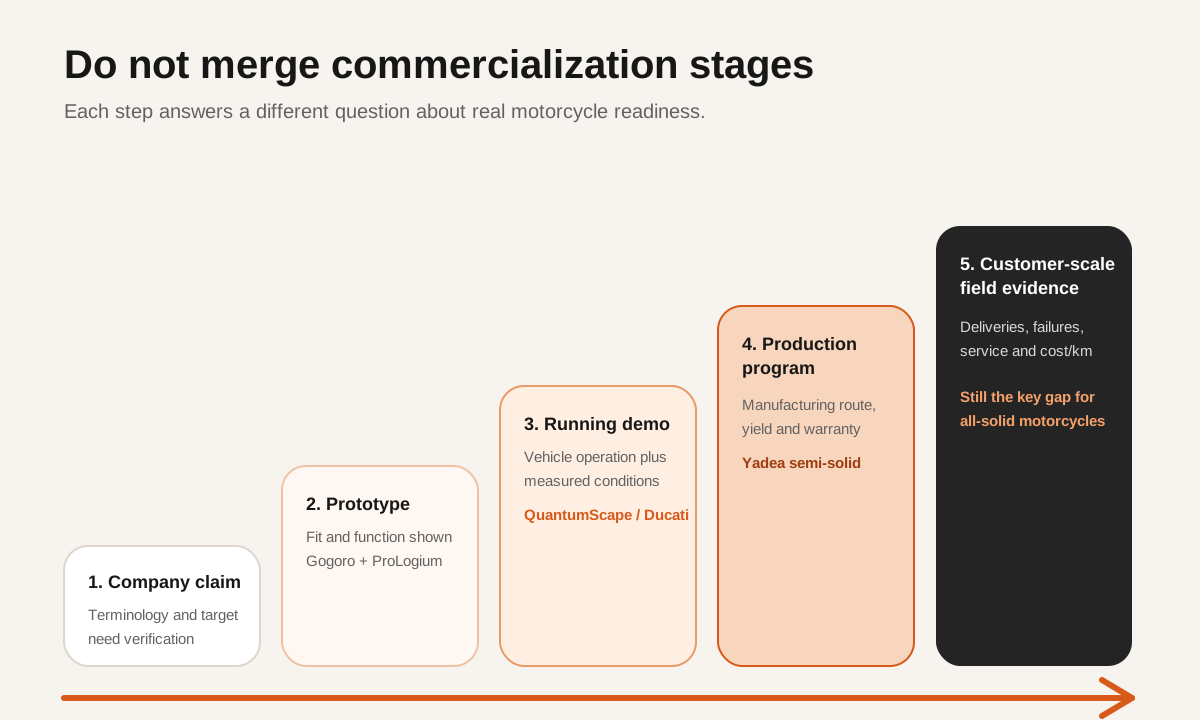
Honda and VinFast show why company roadmaps need product-level proof
Honda unveiled a demonstration production line for all-solid-state batteries in November 2024. The company says the program covers automobiles, motorcycles and aircraft and targets application to electrified products in the second half of the 2020s. Honda has not identified a production motorcycle, pack specification, launch market or customer-delivery date. This is a credible industrial roadmap, not a current product.
VinFast invested in and partnered with ProLogium for solid-state battery development, but that corporate relationship does not identify the chemistry in today's scooters. VinFast's 2026 Philippine Evo, Feliz II and Viper use removable 1.5 kWh LFP batteries. Each motorcycle can carry two packs, and V-Green is deploying the swapping stations.
Vehicle claims must follow the battery installed in the named vehicle. A manufacturer can finance a solid-state developer while continuing to commercialize LFP or NMC products.
Where solid-state batteries could create the most value
Premium long-range motorcycles are a plausible first market because lower weight or more usable energy can command a higher price. High discharge demand also rewards cells that can demonstrate power without excessive heat, pressure hardware or rapid degradation.
Battery-swapping fleets may be an even more controlled entry point. The operator owns the packs, standardizes charging and monitors health across a fleet. Higher capital cost can be amortized over many swaps if service life and utilization are genuinely better.
Commercial delivery fleets care less about the word solid-state than uptime and total cost per kilometer. Mass-market commuter scooters are the hardest segment because mature LFP already offers strong safety, long service life and low cost.
- Premium motorcycles: pay for verified range, weight or charging advantages.
- Swap networks: centralize charging, monitoring, maintenance and ownership.
- Delivery fleets: evaluate uptime, usable throughput and total cost per kilometer.
- Commuter scooters: require cost convergence with mature LFP and NMC systems.
Market outlook: commercialization will arrive in stages
The market opportunity is real, but it is easy to overstate. A motorcycle pack must survive vibration, weather, frequent charging, irregular user behavior and tight packaging. Cell energy density alone does not predict vehicle range or commercial success because thermal management, compression hardware, enclosure, electronics, reserve capacity and safety margins reduce pack-level performance.
Cross-platform manufacturers such as Honda may have an advantage because automotive battery investment can be shared with motorcycles. Swap operators could also introduce a chemistry gradually through controlled packs. Neither advantage removes the need to prove yield, cost, field durability and serviceability.
There is no verified cross-industry timetable for these steps. Treat a prototype, a pilot fleet and a customer-delivered production pack as different evidence stages, and ask the supplier which stage its named product has actually reached.
What an OEM or fleet operator should verify
A buyer should begin by identifying whether the proposed cell is all-solid-state, semi-solid, almost-solid or conventional lithium-ion. Ask for the liquid fraction or an explicit disclosure that no liquid electrolyte is intentionally added. Then compare the complete operating boundary rather than one best number. For a vehicle-program starting point, review AntBattery's electric-vehicle application boundary before defining sample and pack evidence.
Use AntBattery's 10-point solid-state claim checklist to separate measured evidence from marketing, and compare the baseline chemistry with the solid-state versus LFP and NMC guide.
For swapping, verify mechanical fit, electrical interface, communications, cooling, station charging profile, state-of-health rules, fire containment and degraded-pack handling. Chemistry compatibility does not guarantee station qualification.
- Exact chemistry and electrolyte classification.
- Cell and pack energy density under disclosed test conditions.
- Charge rate, temperature, pressure and cycle-life boundary.
- Independent test reports, sample count and failure disclosure.
- Pack safety, abuse testing, vibration and environmental validation.
- Manufacturing yield, warranty terms and replacement obligations.
- Vehicle or swap-station compatibility and degraded-pack workflow.
- Total cost per kilometer compared with a qualified LFP or NMC baseline.
Market verdict
Solid-state batteries have a credible future in electric motorcycles, but the market is not yet broad or mature. Yadea and Talent New Energy provide the strongest commercial semi-solid case. QuantumScape, PowerCo, Audi and Ducati provide the strongest measured operating-motorcycle demonstration, but it remains a B-sample program. Gogoro and ProLogium show why higher-capacity packs could matter in a swapping network, but their pack remains a prototype.
Honda provides a credible industrial route. Verge and Donut Lab provide the most ambitious all-solid-state claim, but unresolved validation and delivery questions make it unsuitable as proof that mass commercialization has arrived. VinFast demonstrates real swapping scale with LFP rather than solid-state batteries.
For the next several years, the decisive competition will be one qualified pack versus another on cost, usable energy, safety, warranty, production yield and total cost per kilometer. Solid-state systems will earn adoption only where verified pack-level advantages are worth more than the manufacturing and integration premium.
FAQs
Are solid-state batteries already used in production electric motorcycles?
The strongest current commercial evidence is a semi-solid motorcycle program from Yadea and Talent New Energy. Public evidence reviewed here does not yet establish independently verified, customer-scale all-solid-state motorcycle production.
Which solid-state electric motorcycle demonstration has the strongest technical evidence?
The modified Ducati V21L using QuantumScape QSE-5 cells provides the strongest measured operating-motorcycle evidence reviewed. It used B-sample cells and was not a retail production motorcycle.
Can solid-state batteries work in battery-swapping networks?
Yes in principle. Gogoro and ProLogium demonstrated a 2.5 kWh solid-state lithium-ceramic prototype designed for the existing Gogoro form factor, but large-scale network deployment was not verified in the reviewed sources.
Do VinFast's current battery-swapping motorcycles use solid-state batteries?
No. VinFast's current Philippine swapping motorcycles use removable 1.5 kWh LFP packs. A corporate solid-state partnership does not change the chemistry in a named production vehicle.
When will solid-state batteries become common in commuter scooters?
There is no reliable universal date. Broader adoption depends on production yield, pack-level cost, safety, serviceability and total cost per kilometer converging with mature LFP and NMC systems. Premium motorcycles and controlled fleets are more plausible early markets.
Sources and further reading
- International Energy Agency — Global EV Outlook 2026, electric two- and three-wheelers
- WIPO — Talent New Energy solid-state lithium battery story
- iChongqing — semi-solid batteries in China's two-wheeler market
- QuantumScape and PowerCo — QSE-5 cells in a Ducati demonstrator
- QuantumScape — QSE-5 B-sample measurements
- ProLogium — Gogoro swappable solid-state battery prototype
- Honda — demonstration line for all-solid-state batteries
- Verge Motorcycles — solid-state battery announcement
- Donut Lab — all-solid-state battery announcement
- IEEE Spectrum — solid-state battery controversy
- Battery Technology — Donut Lab battery testing questions
- VinFast — battery-swapping e-motorcycles in the Philippines
- ProLogium — VinFast solid-state battery partnership
- TVS Motor — iQube NMC battery chemistry
- Ola Electric — 4680 Bharat Cell platform
- National Science Review — from all-solid to almost-solid batteries
Related Blogs
Learn More About Battery
How to Verify Solid-State Battery Claims: A 10-Point Reality Check
Solid State Battery vs LFP vs NMC: A 2026 Head-to-Head Comparison
Solid-State Battery for E-Bikes and Micromobility: The Real 2026-2028 Timeline
Related Products
Related product
Prismatic Series
AB-100AH Semi Solid Prismatic Cell
- Energy Density
- 285 Wh/kg
- Nominal Voltage
- 3.65 V
Pouch Cell Series
AB-50AH Semi Solid Pouch Cell
- Energy Density
- 320 Wh/kg
- Nominal Voltage
- 3.7 V
Cylindrical Series
AB-21700 Semi Solid Cylindrical Cell
- Energy Density
- 300 Wh/kg
- Nominal Voltage
- 3.7 V