"Solid-state drone battery" means three different things in 2026
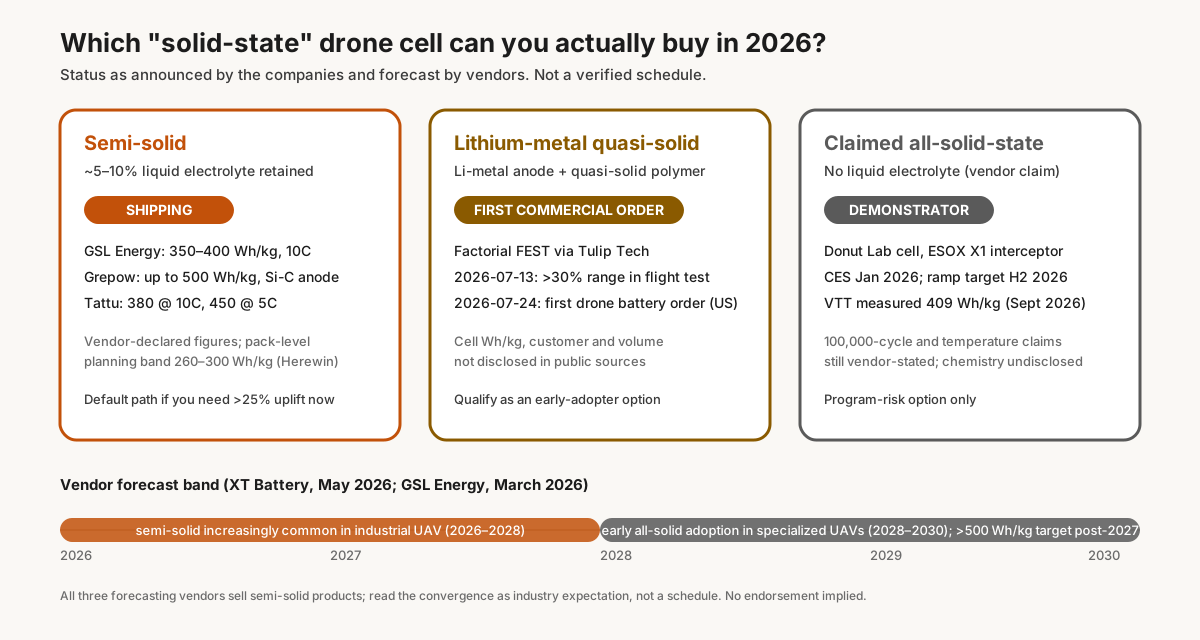
If you have three quotes on your desk that all say "solid-state", there is a good chance they describe three different cell architectures. Herewin's 2026 engineering guide draws the line the way most integrators now do: a semi-solid cell is a hybrid that keeps a small liquid fraction, around 5–10%, to maintain interfacial wetting, and is built on modified lithium-ion manufacturing; that is the tier shipping in industrial UAV packs today from vendors such as GSL Energy, Grepow and Tattu. All-solid cells eliminate the liquid entirely and, in Herewin's assessment, remain in pre-commercial or pilot use in 2026, largely defense pilots and technology demonstrators. Between those two sits a third tier the drone market has only recently met: lithium-metal quasi-solid cells. Factorial's FEST platform combines a lithium-metal anode with a quasi-solid polymer electrolyte, is the platform Factorial lists for aviation and drone applications, and is the technology behind the company's first commercial drone battery order announced in July 2026. Factorial's separate Solstice platform is its sulfide-based all-solid-state material, listed for electric vehicles, consumer electronics and energy storage rather than for drones. The fourth name you will hear, Donut Lab, describes its cell as all-solid-state; ESOX Group is integrating it into defense drone demonstrators, and how much of that has been independently measured is covered below.
The label also does not fix the anode. Grepow's semi-solid UAV packs, for example, use a silicon-carbon anode, and the company states a 30% endurance increase and more than 700 cycles to 90% of initial capacity for them. So when a supplier says "semi-solid", you still need to ask what the anode is, what the electrolyte is, and what liquid fraction remains. Those three answers place the quote in the right tier before any number is compared.
The Wh/kg baseline you are actually comparing against
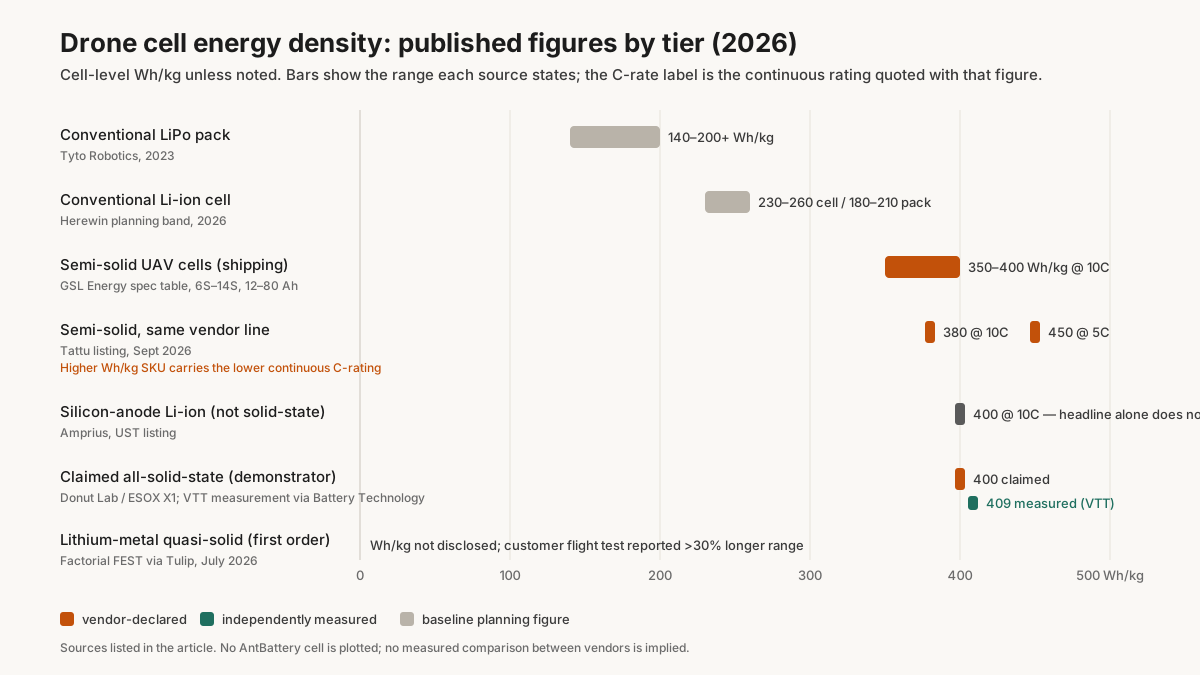
A 400 Wh/kg headline only means something against the pack you fly today. A conventional LiPo pack sits at roughly 140–200+ Wh/kg by weight, according to Tyto Robotics' battery guide, and a conventional lithium-ion drone cell at roughly 230–260 Wh/kg cell-level and 180–210 Wh/kg pack-level in Herewin's 2026 planning bands; Amprius characterises conventional UAS batteries as generally below 300 Wh/kg. Write down your current pack's real number, whether it is cell-level or pack-level, and at what C-rate and ambient you measured it, because vendor figures for the new tiers are almost always cell-level "up to" values. If the difference between gravimetric and volumetric, cell and pack, or lab coupon and production cell is not already second nature, AntBattery's guide on how to read a solid-state battery energy-density number covers those labels so this article does not have to.
One more baseline point matters for drones specifically. Amprius markets a 400 Wh/kg silicon-anode lithium-ion cell rated at 10C for UAV and eVTOL use, with no solid electrolyte at all. A 400 Wh/kg number therefore does not tell you whether you are being offered a semi-solid, a solid-state or a high-silicon liquid-electrolyte cell. The chemistry has to be stated in writing; the Wh/kg alone does not reveal it.
What shipping semi-solid UAV cells promise, and the C-rate trade-off
The shipping tier is easy to find and its numbers are consistent across vendors, provided you read the conditions. GSL Energy's semi-solid UAV spec table lists 6S to 14S packs from 12 Ah to 80 Ah, all rated 10C, at 350 or 400 Wh/kg depending on the model; a 6S 22 Ah pack, for example, is listed at 1.4 kg and 400 Wh/kg. Grepow lists 4S to 24S semi-solid packs up to 500 Wh/kg, and Tattu lists 380 Wh/kg and 450 Wh/kg SKUs with a stated ceiling of 500 Wh/kg and 107 Ah. Herewin's planning band, which is not tied to any one vendor's catalog, is 330–350 Wh/kg at cell level (vendor-announced up to about 400) and 260–300 Wh/kg at pack level once housing, BMS and thermal overhead are added. Every one of these is a vendor-declared figure; none of the sources reviewed for this article includes an independent measurement.
The trade-off that most quotes leave out is visible inside a single vendor's line. In Tattu's current listing, the 380 Wh/kg packs are rated 10C while the 450 Wh/kg packs are rated 5C. Within the same product family, the higher-specific-energy SKUs carry a lower continuous discharge rating. That is not a criticism of the vendor; it is the physics of how the extra energy is obtained, and it is exactly why a program that needs burst current for climb-out, gust response or heavy-lift take-off cannot pick a cell by Wh/kg alone. The number you need is the Wh/kg your platform can actually use at its peak C-rate, not the catalog maximum.
Temperature and cycle figures deserve the same scrutiny. GSL's product page states an operating range of -40 °C to 75 °C and 1,000+ cycles with over 80% capacity retention, while GSL's own March 2026 article gives -20 °C to 60 °C stable operation and 800–1,000 cycles at 80% for semi-solid cells. Two ranges from the same vendor are not a scandal; they are a reminder that a temperature or cycle number without its test protocol, depth of discharge and preheat assumption is not yet a specification you can design against.
Lithium-metal and all-solid-state drone programs to watch
Two named programs define the upper tiers in 2026, and they are at different points. Factorial Energy announced on July 13, 2026 a strategic partnership with Tulip Tech Group B.V., a Netherlands-based UAV pack maker, to commercialize solid-state and lithium-metal batteries for drones, reporting that initial customer flight testing delivered more than a 30% increase in flight range before any engineering optimization. On July 24, 2026 Factorial announced its first commercial drone battery order from a U.S. drone manufacturer, under which it supplies high-energy-density lithium-metal cells to a U.S.-based pack integrator. That followed a March 2026 strategic investment from IQT aimed at drones, UAVs and mobile robotics. What Factorial has not published in the sources reviewed here is the drone cell's Wh/kg, the customer's identity or the order volume, so treat the 30% range gain as a company-reported result from one customer test, not a datasheet value.
ESOX Group announced at CES in January 2026 that it will deploy Donut Lab's solid-state battery under a defense licensing agreement in uncrewed platforms, presenting the X1 interceptor drone and the X2 ground-vehicle testbed as integration demonstrators. E-Mobility Engineering reported the vendor-stated figures: 400 Wh/kg, up to 100,000 charge cycles, and over 99% capacity retention at both -30 °C and above 100 °C, with final testing under way and production ramp-up targeted for the second half of 2026. Those are claims, and they drew public skepticism. Battery Technology's September 2026 report is the first independent-validation reporting found for this cell: the research organization VTT measured the cell at 409 Wh/kg and 805 Wh/L, while the Intertek nail-penetration report on a solid-state pouch cell lists the chemistry as "not given by the manufacturer". In plain terms, the energy density has now been independently measured; the cycle-life and charging claims, and the exact chemistry, remain undisclosed in that reporting. For a drone program that is a useful, honest status: one number verified, the rest still vendor-stated.
Maturity map: buyable now, first orders, or demonstrator
Put the three tiers on one map and the 2026 picture is consistent across otherwise competing sources. Herewin describes semi-solid as the shipping mainstream for industrial UAVs and all-solid as pilot or demonstrator use. XT Battery, another vendor, forecasts semi-solid becoming increasingly common in industrial drones in 2026–2028, with early all-solid adoption in specialized UAV platforms in 2028–2030. GSL Energy places fully solid-state cells post-2027 with a target above 500 Wh/kg and calls semi-solid the current commercial optimum for industrial drones. All three publish semi-solid products, so read the convergence as industry expectation rather than a verified schedule; but no source reviewed here places all-solid drone cells in volume supply this year, and the only all-solid program with a public drone platform is still in demonstrator stage.
That leads to a practical decision rule, adapted from Herewin's selection thresholds and consistent with the roughly 30% gains reported by both Factorial and Grepow: if your program needs more than about 25% endurance uplift over its conventional Li-ion or LiPo baseline at its design ambient, semi-solid is the default path to validate this year. Treat all-solid-state as a program-risk option that enters a schedule only when the program explicitly accepts pilot risk and longer design and production validation cycles. If you have watched the same semi-solid-first pattern play out on the ground, AntBattery's article on solid-state batteries in electric motorcycles is the sibling case: a different power class and regulatory setting, the same order of arrival.
A seven-point supplier verification checklist
Send all seven requests before samples ship. A missing answer is a finding in itself. The documentation items are adapted from Herewin's 2026 procurement guidance; the validation and chemistry checks come from the failure modes in the sections above.
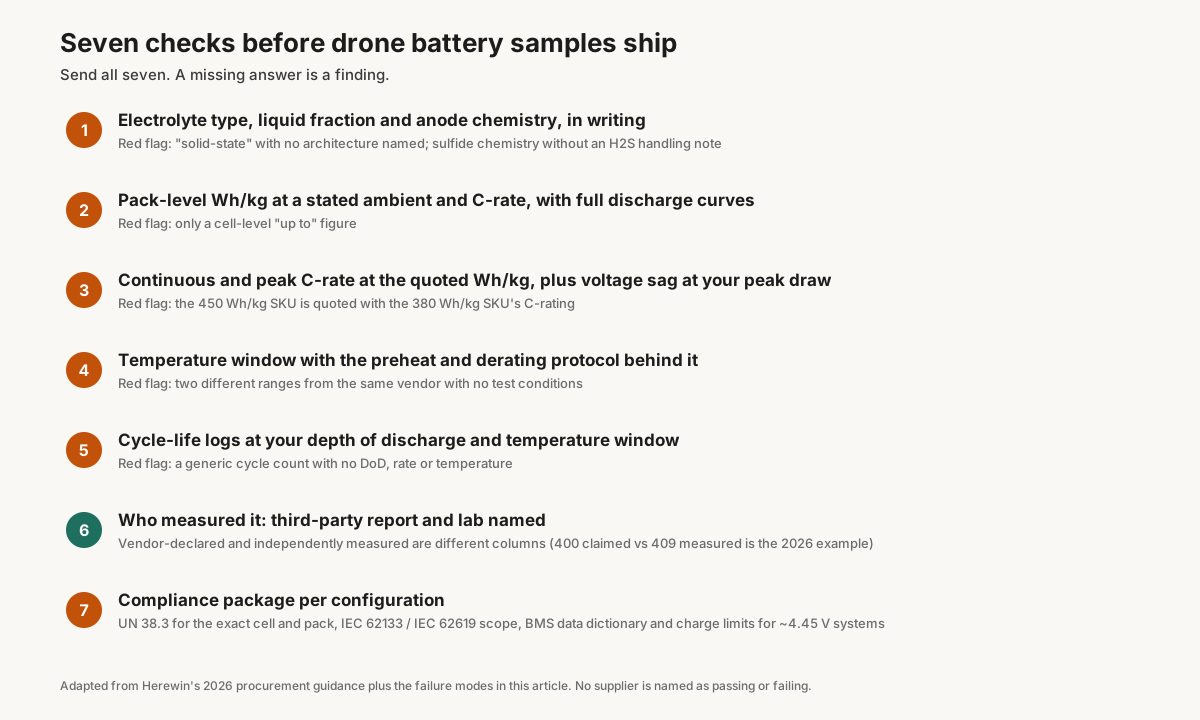
- 1. Electrolyte type and liquid fraction, in writing. Semi-solid, lithium-metal quasi-solid or all-solid, with the anode chemistry stated. A quote that will not name the architecture cannot be placed in a tier. Ask also whether the electrolyte is sulfide- or oxide-based: Herewin notes that sulfide electrolytes can generate toxic H2S gas on moisture exposure, which is why oxide-based semi-solid architectures are favoured for rugged field use.
- 2. Pack-level Wh/kg at a stated ambient and C-rate, with full discharge curves. Cell-level "up to" figures are not the number your airframe carries.
- 3. Continuous and peak C-rate at the quoted Wh/kg. Remember the Tattu pattern: 380 Wh/kg at 10C, 450 Wh/kg at 5C. Ask for voltage sag at your own peak draw.
- 4. Operating-temperature window with the preheat and derating protocol behind it. Request -20 °C capacity retention with and without preheat, and reconcile any two ranges the same vendor publishes.
- 5. Cycle-life logs at your depth of discharge and temperature window, not a generic cycle count.
- 6. Who measured it. Vendor-declared and independently measured are different columns. The Donut Lab case shows the difference: 400 Wh/kg claimed, 409 Wh/kg measured by VTT, cycle life still unverified. Ask for the third-party report and the lab.
- 7. Compliance package per configuration. UN 38.3 test reports for the exact cell and pack configuration, IEC 62133 or IEC 62619 safety test scope, and the BMS data dictionary with charge-algorithm limits for any high-voltage (about 4.45 V) cathode system.
Where this article stops: passenger eVTOL is a different category
Everything above concerns unmanned drones and UAVs. In the United States the FAA treats unmanned aircraft operations, for example Part 107 for certificated remote pilots and commercial operators, and Urban or Advanced Air Mobility air taxis as separate regulatory tracks within the FAA's unmanned aircraft systems framework and its air-taxi program. A certified passenger or cargo eVTOL program faces a different certification pathway, a different safety-validation bar and a different timeline, and the solid-state evidence from that category does not transfer to an unmanned program or vice versa. AntBattery covers the passenger and cargo eVTOL story, and why aviation programs may reach solid-state milestones before cars do, in a separate article; this one stays on the UAS side of that line.
Start a drone battery sample RFQ with AntBattery
AntBattery supplies semi-solid and solid-state cells for programs where mass, discharge behaviour and pack consistency decide mission time. If the checklist above is your next step, start from the drones and UAV application page and request a sample quote with your pack configuration (S count, capacity and target mass), your continuous and peak C-rate from the platform's thrust and current data, your operating-temperature window and preheat capability, your target cell-level and pack-level Wh/kg, and the documentation you require: UN 38.3 test summary per configuration, discharge curves at your C-rate and ambient, and cycle logs at your depth of discharge. We can review that configuration against our cell options and put together a project-specific evidence package before samples ship; the same request can also be sent through the contact page.
No specific energy density, discharge rating, temperature range or cycle life is promised in this article. Those figures come from the project-specific datasheet and the test conditions we agree with you, which is the same standard this article asks you to apply to every other supplier.
FAQs
Is a semi-solid drone battery a solid-state battery?
Not in the strict sense. A semi-solid cell keeps roughly 5–10% liquid electrolyte and is built on modified lithium-ion manufacturing, which is why it is the tier shipping in industrial UAV packs in 2026, while all-solid cells eliminate the liquid entirely and remain in pilot or demonstrator use. The label also does not fix the anode: Grepow's semi-solid UAV packs, for example, use a silicon-carbon anode. Ask for the electrolyte type, liquid fraction and anode chemistry in writing.
What energy density can I expect from a solid-state drone battery in 2026?
Against a conventional LiPo pack at roughly 140–200+ Wh/kg or a conventional lithium-ion cell at roughly 230–260 Wh/kg, shipping semi-solid UAV cells are marketed at 350–400 Wh/kg (GSL Energy, 10C), with Grepow and Tattu listing SKUs up to 450–500 Wh/kg. All of those are vendor-declared cell-level "up to" figures; Herewin's pack-level planning band is 260–300 Wh/kg. In Tattu's listing the 450 Wh/kg packs are rated 5C against 10C for the 380 Wh/kg packs, so the usable number depends on your peak discharge rate.
Can I buy an all-solid-state drone battery today?
Not in volume, based on the sources reviewed here. The only all-solid program with a public drone platform is ESOX Group's X1 interceptor demonstrator using Donut Lab's cell, with vendor-stated 400 Wh/kg and up to 100,000 cycles, final testing under way and a production ramp targeted for the second half of 2026; VTT has independently measured the cell's energy density at 409 Wh/kg, while the cycle-life and charging claims remain vendor-stated. Vendor forecasts place early all-solid adoption in specialized UAVs around 2028–2030.
Has Factorial actually delivered solid-state drone batteries?
Factorial announced its first commercial drone battery order on July 24, 2026, from a U.S. drone manufacturer, supplying lithium-metal cells to a U.S.-based pack integrator, after a customer flight test with Tulip Tech reported more than a 30% range increase. That is a first commercial order following a flight test, not evidence of volume deliveries; the cell's Wh/kg, the customer and the order size were not disclosed in the sources reviewed.
How do I verify a supplier's Wh/kg claim before ordering samples?
Ask for pack-level Wh/kg at a stated ambient and C-rate with full discharge curves, the continuous and peak C-rating at that Wh/kg, and the name of whoever measured it. A 400 Wh/kg headline does not identify the chemistry, because Amprius sells a 400 Wh/kg silicon-anode lithium-ion cell rated at 10C with no solid electrolyte, and higher-Wh/kg SKUs in the same product line can carry lower C-ratings, as Tattu's 380 Wh/kg at 10C versus 450 Wh/kg at 5C shows. Vendor-declared and independently measured figures belong in different columns.
Sources and further reading
- Herewin - Solid-State Drone Batteries: Engineering Guide for Mission-Critical UAVs (2026-03-05)
- GSL Energy - Semi-Solid State UAV Battery Manufacturer, 350-400 Wh/kg spec table (accessed 2026-09-25)
- GSL Energy - Top 10 Solid-State Battery Companies 2026 & The Rise of Semi-Solid Batteries for Industrial Drones (2026-03-25)
- Grepow - NMC Semi-Solid State Battery product page (accessed 2026-09-25)
- Tattu - High Energy Density Semi Solid State UAV LiPo Battery listing (accessed 2026-09-25)
- Tyto Robotics - A Guide to Lithium Polymer Batteries for Drones (2023-11-13)
- Amprius - Energy Density in Unmanned Aerial Systems (modified 2025-04-20)
- Unmanned Systems Technology - Amprius 400 Wh/kg Li-Ion Battery listing (modified 2026-05-06)
- DroneLife - New Factorial-Tulip Flight Test Shows 30% Gain for Solid-State Batteries (2026-07-13)
- Factorial Energy via GlobeNewswire - Factorial Secures First Commercial Aerospace Order for Advanced Battery Cells (2026-07-24)
- Factorial Energy via Business Wire - Factorial Drives Solid-State Battery Expansion to Drones and Robotics with IQT and Strategic Partners (2026-03-10)
- Factorial Energy - Technology: FEST and Solstice platforms (updated 2026-06-18)
- E-Mobility Engineering - ESOX integrates Donut Lab solid-state batteries in X1 drone and X2 defence UGV demos (2026-01-08)
- Battery Technology (Informa) - Results of Donut Lab's Nail Penetration Safety Test (2026-09-09)
- XT Battery - Future of Solid State Batteries in the Drone Industry, 2026-2030 Outlook (2026-05-19)
- FAA - Unmanned Aircraft Systems (UAS) hub (accessed 2026-09-25)
Related Blogs
Learn More About Battery
Related Products
Related product
Prismatic Series
AB-100AH Semi Solid Prismatic Cell
- Energy Density
- 285 Wh/kg
- Nominal Voltage
- 3.65 V
Pouch Cell Series
AB-50AH Semi Solid Pouch Cell
- Energy Density
- 320 Wh/kg
- Nominal Voltage
- 3.7 V
Cylindrical Series
AB-21700 Semi Solid Cylindrical Cell
- Energy Density
- 300 Wh/kg
- Nominal Voltage
- 3.7 V