Start with the cathode identity, not the solid-state label
Before choosing a solid-state battery cell, ask for its cathode active material, the surrounding electrode design, and evidence that matches the proposed cell. “Solid-state” does not identify one cathode chemistry. NMC and LFP can appear in solid-state development, while an LNMO research result describes a different material and a specific tested configuration—not an interchangeable product option.
A useful shortlist therefore needs more than a chemistry acronym. You need to know what was tested, under which conditions, and whether those results describe the model you could actually evaluate. The checks below are a screening aid for that conversation, not a certification or a substitute for application testing. For the broader mechanism, see how solid-state batteries work.
What NMC, LFP and LNMO actually tell you
Start by separating material identity from performance. QuantumScape’s technology description names nickel manganese cobalt (NMC) and lithium iron phosphate (LFP) as cathode chemistries its platform is designed to accommodate. That is a manufacturer’s description of its platform—not evidence that every supplier offers both, or that two cells with the same cathode name perform alike.
| Cathode name | What the name establishes | What to clarify for the proposed cell |
|---|---|---|
| NMC | A nickel–manganese–cobalt cathode family | The specific composition or grade, electrode design, voltage window and model-specific data—not just “NMC” |
| LFP | Lithium iron phosphate | The actual cell architecture and test conditions; do not transfer a familiar conventional LFP cell’s results to another design |
| LNMO | The lithium nickel manganese oxide material in the cited thin-film research | Whether the evidence concerns that laboratory configuration or the actual proposed cell; cobalt-free does not mean nickel-free |
The LNMO distinction is worth making explicit. The Shimizu and co-authors’ research abstract concerns LNMO with LiPON and lithium metal in a thin-film battery. LNMO contains nickel even though that formula contains no cobalt. A “cobalt-free” description therefore cannot answer a nickel-exclusion requirement.
Use these names to ask better questions, not to select a universal winner. This article does not rank the materials by safety, life, cost or energy density: those conclusions would need evidence for the complete cells and operating conditions being compared.
Ask what is inside the composite cathode
The active material is only one part of the cathode description. JEOL’s solid-state battery overview illustrates a cathode containing active material, conductive additives and solid electrolyte. A label such as “NMC cathode” does not tell you how those components are arranged or how much active material the electrode contains.
Scroll the diagram horizontally to read every label.
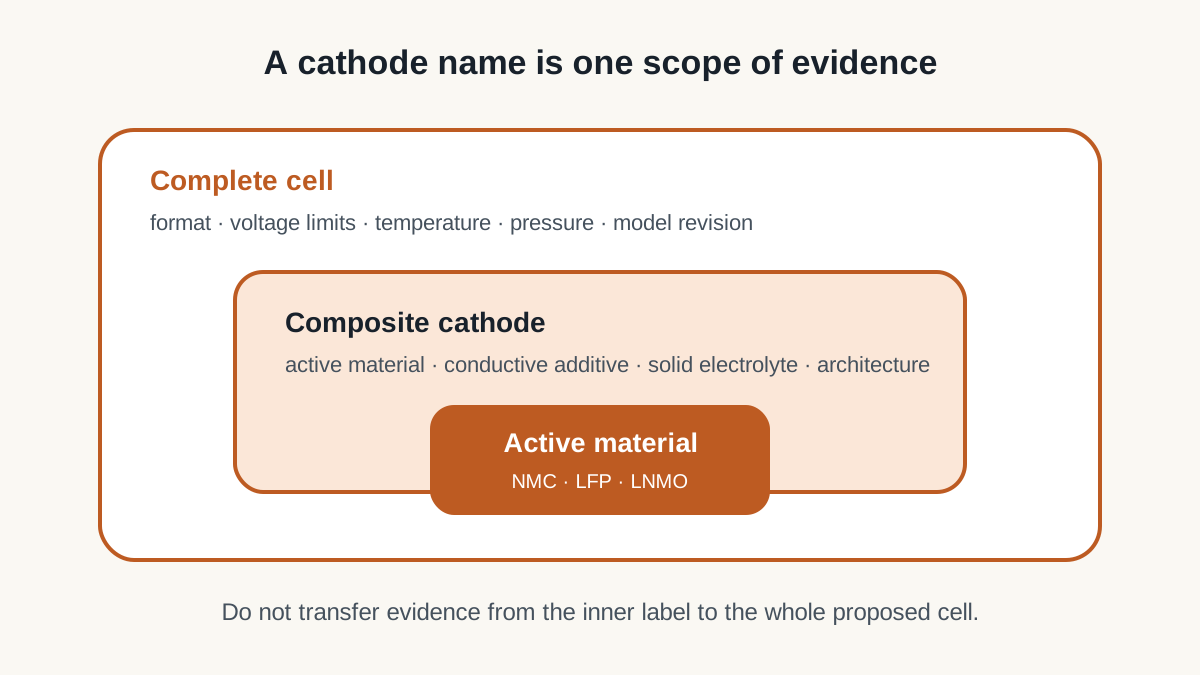
Ask which material carries ions within the cathode and whether a liquid catholyte is present. QuantumScape, for example, explicitly describes an organic liquid catholyte on the cathode side of its solid ceramic separator. That example shows why a solid separator alone cannot tell you the state of every material elsewhere in a cell. Keep the architecture description attached to the named product; do not generalize one manufacturer’s design to all solid-state batteries.
The way the components meet also matters. Berkeley Lab’s solid-state research overview identifies contact, chemical stability, mechanical degradation and high-loading cathodes as research challenges. In its oxide-electrolyte example, a porous LLZO scaffold is infiltrated with active material and other components. The lab contrasts that approach with simply mixing powders to obtain suitable contact. It is an example of a processing problem, not a required recipe for every cell.
For your comparison, request the available electrode description, active-material loading or capacity per area, and the conditions under which the reported result was obtained. If a detail is proprietary or unavailable, record it as a limitation rather than filling in a likely value. The separate guide to solid-state battery electrolyte types covers the electrolyte-family decision; here, the question is what surrounds the cathode material in the proposed cell.
Read the evidence at the same scale as the proposed cell
A material study can establish something useful without establishing that a production cell is ready for your application. Keep the evidence’s scale and configuration visible: a thin film, an electrode experiment and a named complete cell are different objects of evaluation.
The ORNL-hosted publication abstract on high-voltage NMC cathodes makes a useful distinction. In the NMC622/LiPON thin-film system studied, interface stabilization did not by itself resolve structural degradation in the cathode. The practical question is not simply “Is the interface stable?” Ask whether the available evidence also addresses the cathode material over the claimed operating window. This experiment does not establish that every NMC solid-state cell has the same failure behavior.
Likewise, the LNMO thin-film demonstration is a reason to examine a particular material–electrolyte combination. It is not proof of a purchasable large-format cell, nor proof that another electrode formulation will reproduce the result. Both research examples here are used qualitatively from their accessible abstracts; no experiment-level performance figure is being offered as a buying specification.
Scroll the diagram horizontally to read every label.
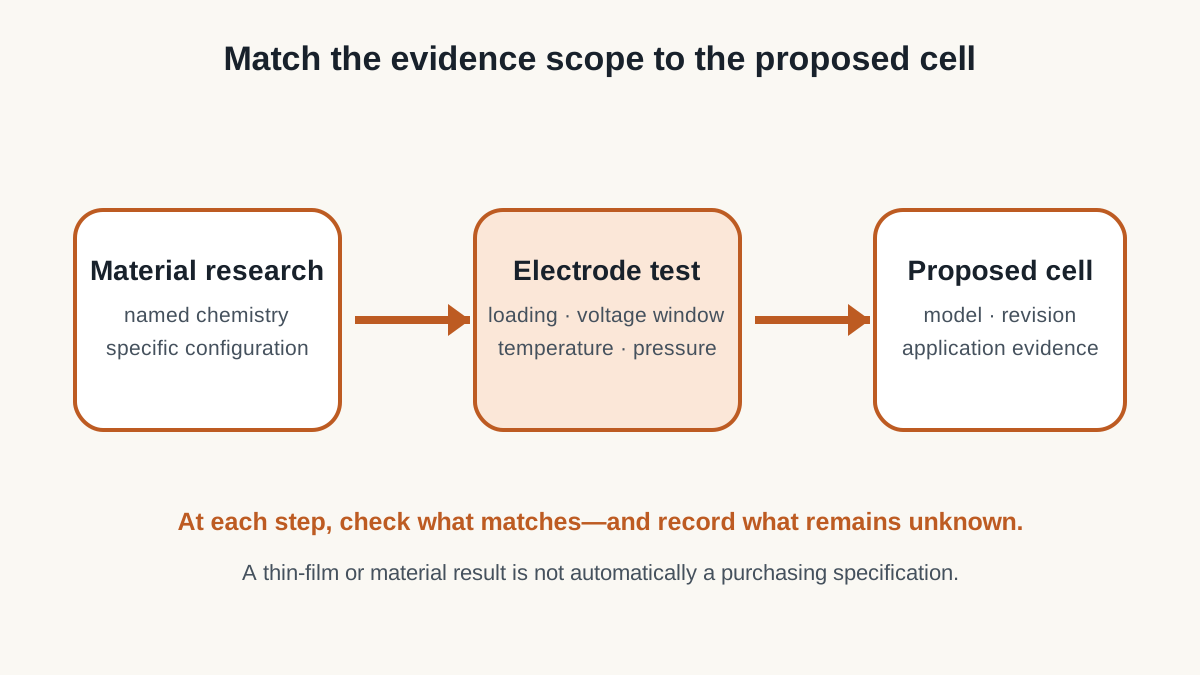
When a supplier sends a graph or paper, write down the tested cathode, electrolyte or catholyte, cell format, voltage limits, temperature and any stated pressure or conditioning. Then mark which of those match the proposed model and which remain unknown. A mismatch is a question to resolve—not a reason to silently transfer the result to the new cell.
Use a cathode-specific document checklist
The following is an editorial screening method derived from the distinctions above. It is not an industry acceptance standard, and it deliberately stops short of a general supplier RFQ or sample-test protocol.
| Check | Record for the proposed model | Follow-up when the answer is incomplete |
|---|---|---|
| Material identity | Cathode family and available composition or grade information | Ask what the chemistry label includes; state any cobalt or nickel exclusion requirement explicitly |
| Electrode and catholyte | Available description of the composite electrode and whether liquid is present on the cathode side | Ask whether the source describes the cathode, separator or complete cell |
| Loading and operating window | Available loading or capacity-per-area information and charge/discharge voltage limits | Ask whether the comparison uses the same electrode and voltage range |
| Conditions behind the result | Temperature, rate, pressure and conditioning where applicable and reported | Mark missing conditions; do not assume a headline graph represents your operating case |
| Evidence scale and identity | Paper/test-report reference, tested format, model and revision | Ask which results belong to this model and which are background research |
| Remaining uncertainty | Missing documents, changed configuration and unavailable proprietary details | Agree what must be clarified before further application evaluation |
For example, imagine one candidate is described only as an “NMC solid-state cell,” while another comes with a model reference and a report identifying its cathode and operating window. The second has a more traceable evidence package; that alone does not prove it is the better-performing cell. For the first, the immediate action is to request the missing identity and configuration information—not infer performance from the NMC name.
Keeping an “unknown” column is useful. It separates information that was supplied from assumptions a reader may have made, and makes a follow-up request much more specific than “Please send more battery data.”
Decide what is ready—and what still needs clarification
Use the document comparison to choose a next action, not to pronounce a cell qualified. Proceed to further application evaluation when you can identify the proposed model and understand which evidence applies to it. Seek clarification when chemistry, architecture or test conditions are missing. Hold a comparison when its headline depends on transferring a material or thin-film result to a different cell without an explanation.
No cathode acronym removes the need for that judgment. The useful outcome is a shortlist with traceable evidence and visible uncertainties, rather than a list ordered by unverified claims about the “best” solid-state material.
Sources and research limits
References
- QuantumScape, Solid State Battery Technology: manufacturer-specific cathode flexibility and catholyte description; not a claim about other suppliers’ products.
- JEOL, Solid-state battery: technical illustration of cathode components, not a cell-qualification report.
- Berkeley Lab, Solid-State Batteries: research challenges and composite-electrode processing example, not a qualification standard.
- ORNL publication record, Structural Degradation of High Voltage NMC Cathodes in Solid-State Batteries: qualitative use of the research abstract, limited to the studied configuration.
- Shimizu and co-authors, arXiv:2204.02510: author-posted thin-film research abstract; not commercial availability evidence.
Ask about the cathode in the proposed cell
Review AntBattery’s semi-solid cell range and use the existing product enquiry path to ask which cathode identity and available documents apply to the model under discussion. Include the model reference, application, required voltage window, operating temperature and load, plus the missing information from your comparison.
The materials discussed here are not a statement that AntBattery supplies every chemistry listed. Confirm the composition and available supporting information for the particular cell before moving to application evaluation.
Review the semi-solid cell range