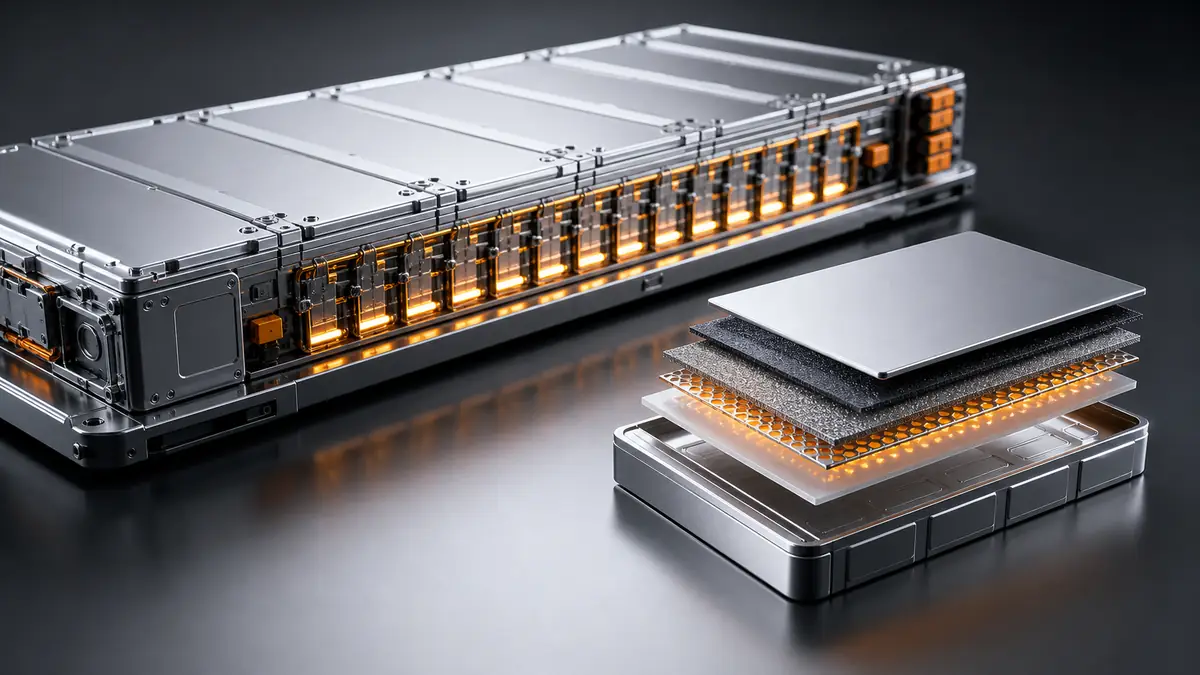
How a solid-state battery works in one sentence
A solid state battery works by moving lithium ions from the cathode to the anode during charging, and back again during discharge, through a solid electrolyte that replaces the liquid electrolyte and separator used in a conventional lithium-ion cell.
That basic description is consistent across editorial explainers such as Murata, Qurator, and Flash Battery. The deeper technical literature says the same thing, but adds the part most search results skip: once every active layer is solid, ion transport, interfacial resistance, mechanical stress, and manufacturability become tightly coupled problems rather than separate ones.
- Ion path: lithium ions move through the solid electrolyte.
- Electron path: electrons still move through the external circuit, not through the electrolyte.
- Separator role: the solid electrolyte also keeps the electrodes apart to avoid a short.
- Engineering catch: the solid layers have to stay chemically compatible and physically touching while the cell cycles.
The working principle looks familiar, but the separator changes jobs
At the reaction level, a solid-state cell does not break battery physics. You still have a cathode, an anode, and lithium ions moving between them. What changes is the middle layer. In a conventional lithium-ion battery, the separator is mostly a porous insulator soaked with liquid electrolyte. In a solid-state battery, that middle region becomes a solid ion conductor that must transport lithium ions while blocking electrons and mechanically separating the electrodes.
That sounds cleaner on a slide than it feels in production. Famprikis et al. in Nature Materials describe the electrolyte as the heart of the solid-state battery concept because its transport, electrochemical behavior, and mechanical properties all influence practical cell performance. Zhao et al. in Nature Reviews Materials make the same point more bluntly: a good solid electrolyte is not just ionically conductive. It also has to survive poor contact, interfacial resistance, and stability limits that appear once the whole stack is solid.
| Layer or job | Conventional lithium-ion | Solid-state battery | Why it matters |
|---|---|---|---|
| Electrolyte | Liquid or gel carries ions | Solid material carries ions | Transport and stability now depend on solid-state chemistry and contact quality |
| Separator | Porous film plus liquid electrolyte | Usually merged into the solid electrolyte layer | One layer now has to insulate, conduct ions, and stay mechanically intact |
| Anode design | Often graphite-based | May use lithium metal in advanced designs | This is where much of the energy-density upside comes from |
| Failure mode | Leakage, flammable solvent risk, SEI growth | Interface resistance, voids, fracture, lithium penetration | The risk profile changes rather than disappearing |
The core electrochemistry stays recognizable. The difficult part is that solid layers are less forgiving than liquid-filled ones.
What the solid electrolyte actually does
A solid electrolyte has three jobs at once. It must let lithium ions move quickly, stop electrons from crossing internally, and remain chemically and mechanically stable against both electrodes. The literature usually groups solid electrolytes into sulfides, oxides, and polymers, with composites sitting between those families.
The review by Famprikis et al. is useful here because it frames the trade-off cleanly: no single family wins every category. Sulfides can offer very fast ion transport and easier densification, but they can be moisture sensitive and interface-reactive. Oxides can be more robust chemically, but they are typically harder and less forgiving at solid-solid contact points. Polymers are easier to process, but their room-temperature conductivity and high-voltage stability can be limiting.
That trade-off matrix is the part most basic blog posts leave thin. Search pages like Murata and Flash Battery tell you the electrolyte is solid. The academic reviews explain why the type of solid matters, because each class changes pressure requirements, coating strategy, manufacturability, and whether lithium metal is realistic or just aspirational.
| Electrolyte family | Why researchers like it | What usually goes wrong | Commercial reading |
|---|---|---|---|
| Sulfides | High ionic conductivity and good particle contact | Moisture sensitivity and interface reactivity | Promising for high performance, but process control is demanding |
| Oxides | Good chemical robustness and wide stability interest | Rigid contact, brittleness, higher interfacial resistance | Often strong on paper, but harder to integrate without contact engineering |
| Polymers | Flexible and easier to process into thin layers | Lower room-temperature conductivity and stability constraints | Useful in some formats, but not a universal EV answer |
| Composites | Can balance transport and flexibility | Added complexity in phase distribution and interface control | A practical bridge route when one material family alone is not enough |
Why lithium metal is the real prize, not just the word solid
Many non-specialist articles imply that the performance gain comes from the electrolyte becoming solid. That is incomplete. A large part of the long-term excitement comes from the possibility of pairing a solid electrolyte with a lithium metal anode instead of a graphite-dominant anode. That can raise energy-density potential because lithium metal stores far more lithium per mass than graphite.
This is one reason the phrase solid state battery technology creates so much noise in search results. The chemistry headline and the business headline are not identical. A cell can use a solid electrolyte without yet delivering a commercially mature lithium-metal architecture. Janek and Zeier argued years ago that solid-state batteries were attractive because they could support safe, stable, high-energy storage. Their later review in Nature Energy made the harder point: high-performance anodes and protection concepts are still central bottlenecks, and lithium-based solid-state batteries may not all converge on one final design path.
That is also why buyers should separate architecture from sales language. If you want the baseline terminology first, our solid state battery meaning guide explains the naming. If you want the commercialization filter, our solid state battery companies guide shows why shipping proof still matters more than branding.
Where the real engineering trouble starts: interfaces
The simplest mental model is this: ions do not care that your PowerPoint slide is smooth. They care whether the cathode, electrolyte, and anode actually touch each other in the right way at the microscopic scale. In all-solid-state batteries, every active region is a solid-solid interface, so even a chemically strong electrolyte can struggle if the contact becomes patchy, resistive, or reactive.
Tan et al. reviewed these problems at the nanoscale and highlighted poor interfacial stability, scalability challenges, and production safety as barriers to practical adoption. Zhao et al. similarly emphasized that poor ionic conductivity is not the only enemy. High interfacial resistance can erase the gains of a promising bulk electrolyte long before the chemistry reaches pack level.
This is where our main opinion sits: the industry does not suffer from a shortage of solid-state headlines. It suffers from too many explanations that treat the interface as a detail. That is backwards. In practice, the interface is the battery. If the contact fails, the architecture fails. The phrase is dramatic, but the literature supports it.
- Chemical instability can create resistive interphases at the cathode or anode boundary.
- Mechanical mismatch can open gaps during cycling, especially near lithium metal.
- Local inhomogeneity can concentrate current and push lithium where you do not want it.
- A strong bulk electrolyte does not rescue a weak interface by itself.
Why pressure and mechanics matter more than most explainers admit
The mainstream web results mostly stop at chemistry. The academic literature does not. The 2023 Science review on mechanics argues that solid-state batteries with lithium metal anodes demand mechanical analysis, not just electrochemical optimization. During plating and stripping, lithium changes shape, voids can form, and stress can concentrate at defects. A solid electrolyte can be safer than a flammable liquid, but it can also crack, lose contact, or enable unwanted lithium penetration if the stack is poorly designed.
This is why some all-solid-state cells need externally applied stack pressure or elaborate interlayers. The cell is not only moving ions. It is also constantly negotiating contact. That is a less glamorous sentence than "future battery breakthrough," but it is the one engineers have to ship.
A recent benchmarking study by Randau et al. is useful here because it reduced the cell to a minimal reference system and showed that high energy, high power, and practical performance still need to be balanced rather than assumed. In other words, the best lab number is not the same thing as the best battery.

- Lithium plating and stripping can create voids that raise local resistance.
- Rigid electrolytes can fracture if stress is poorly managed.
- Soft layers can improve contact, but may sacrifice other properties.
- Cell pressure, layer thickness, and current density are design variables, not afterthoughts.
How solid-state differs from semi-solid and today's lithium-ion
A conventional lithium-ion battery normally uses a liquid electrolyte and a separate porous separator. A semi-solid battery keeps part of the liquid-phase behavior or uses gel-like pathways to reduce risk while staying closer to current manufacturing practice. A true all-solid-state battery tries to replace that central liquid role with solid ion-conducting materials throughout the cell stack.
That distinction matters commercially. Semi-solid routes can reach the market earlier because they demand less of a manufacturing reset. Full all-solid-state designs may still win the long game in some segments, but they ask much more from interfaces, anodes, pressure control, and quality consistency. If your team is comparing near-term supply rather than pure research potential, start with our semi solid state battery overview and then read the solid-state safety article to see why reduced-liquid architectures often get procurement attention first.
| Route | Electrolyte picture | Why people like it | Reality check |
|---|---|---|---|
| Conventional lithium-ion | Liquid electrolyte plus separator | Mature manufacturing and known cost base | Still dominant because production scale is real |
| Semi-solid | Partly solidified or gel-assisted transport path | Bridge between current lines and next-generation safety goals | Often more practical in the near term than full all-solid-state |
| All-solid-state | Solid electrolyte handles ion transport and separation | Long-term safety and energy-density potential | Still constrained by interfaces, mechanics, and scale-up |
What buyers should ask before treating solid-state as commercial fact
If you are evaluating a supplier, the right follow-up is not "Is it solid-state?" The better question is "Which solid-state route, with which electrolyte family, with what anode, under what validation conditions?" That is slower, but it keeps the conversation attached to engineering reality.
Ask what the electrolyte family is. Ask whether the anode is lithium metal or something more conservative. Ask whether the reported result comes from a coin cell, a multilayer pouch, or a development vehicle. Ask what pressure, cycle condition, and temperature were required. Ask what was measured after the headline cycle count, not only at the start. Battery marketing already has enough charge. It does not need extra current from vague wording.
That is the practical value of answering how a solid state battery works with academic evidence instead of marketing shorthand. Once you understand the ion path, the interface, and the mechanics, it becomes much easier to separate a real development platform from a recycled buzzword.
- What electrolyte family is being used: sulfide, oxide, polymer, or composite?
- Does the cell rely on lithium metal, and if so, what protection concept is used?
- What format produced the result: lab coin cell, multilayer stack, pouch prototype, or vehicle test?
- How much pressure was needed to maintain contact and cycling stability?
- What evidence exists for manufacturability, not just one-off cell performance?
FAQs
How does a solid state battery work in simple terms?
It works by moving lithium ions between the cathode and anode through a solid electrolyte instead of a liquid one. During charging, ions move to the anode. During discharge, they move back to the cathode and the external circuit delivers power.
Is the solid electrolyte also the separator?
Usually yes, at least functionally. In many solid-state designs, the solid electrolyte both transports ions and keeps the electrodes physically apart so they do not short internally.
Do all solid-state batteries use lithium metal anodes?
No. Lithium metal is a major long-term target because it can improve energy density, but not every solid-state design uses it in a commercially mature way today. Some architectures stay more conservative to manage stability and manufacturability.
Why are interfaces such a big issue in solid-state batteries?
Because every active layer touches another solid layer. If those interfaces become resistive, chemically unstable, or mechanically separated, ion transport slows and the battery loses performance even when the bulk materials look strong on paper.
Are solid-state batteries automatically safer than lithium-ion batteries?
They can reduce some risks associated with flammable liquid electrolytes, but they are not automatically risk-free. Solid-state cells still face lithium penetration, fracture, poor contact, and other failure modes that must be engineered carefully.
How is a semi-solid battery different from a full solid-state battery?
A semi-solid battery keeps part of the liquid-phase or gel-like transport behavior and is often closer to current production methods. A full all-solid-state battery aims to make the ion-transport path solid throughout the core cell stack, which is more demanding technically.
Why are solid-state batteries still hard to mass-produce?
The challenge is not just making ions move. Producers also have to maintain stable interfaces, enough physical contact, acceptable pressure, good yield, and repeatable multilayer fabrication. That is why lab promise has not yet translated into universal high-volume supply.
Sources and further reading
- Janek and Zeier, Challenges in speeding up solid-state battery development (Nature Energy, 2023)
- Famprikis et al., Fundamentals of inorganic solid-state electrolytes for batteries (Nature Materials, 2019)
- Zhao et al., Designing solid-state electrolytes for safe, energy-dense batteries (Nature Reviews Materials, 2020)
- Tan et al., From nanoscale interface characterization to sustainable energy storage using all-solid-state batteries (Nature Nanotechnology, 2020)
- Randau et al., Benchmarking the performance of all-solid-state lithium batteries (Nature Energy, 2020)
- Kalnaus et al., Solid-state batteries: The critical role of mechanics (Science, 2023)
- Janek and Zeier, A solid future for battery development (Nature Energy, 2016)
Related Blogs
Learn More About Battery
Related Products
Related product
Pouch Cell Series
AB-50AH Semi Solid Pouch Cell
- Energy Density
- 320 Wh/kg
- Nominal Voltage
- 3.7 V
Prismatic Series
AB-100AH Semi Solid Prismatic Cell
- Energy Density
- 285 Wh/kg
- Nominal Voltage
- 3.65 V
Cylindrical Series
AB-21700 Semi Solid Cylindrical Cell
- Energy Density
- 300 Wh/kg
- Nominal Voltage
- 3.7 V