The short answer: there is no universal best electrolyte
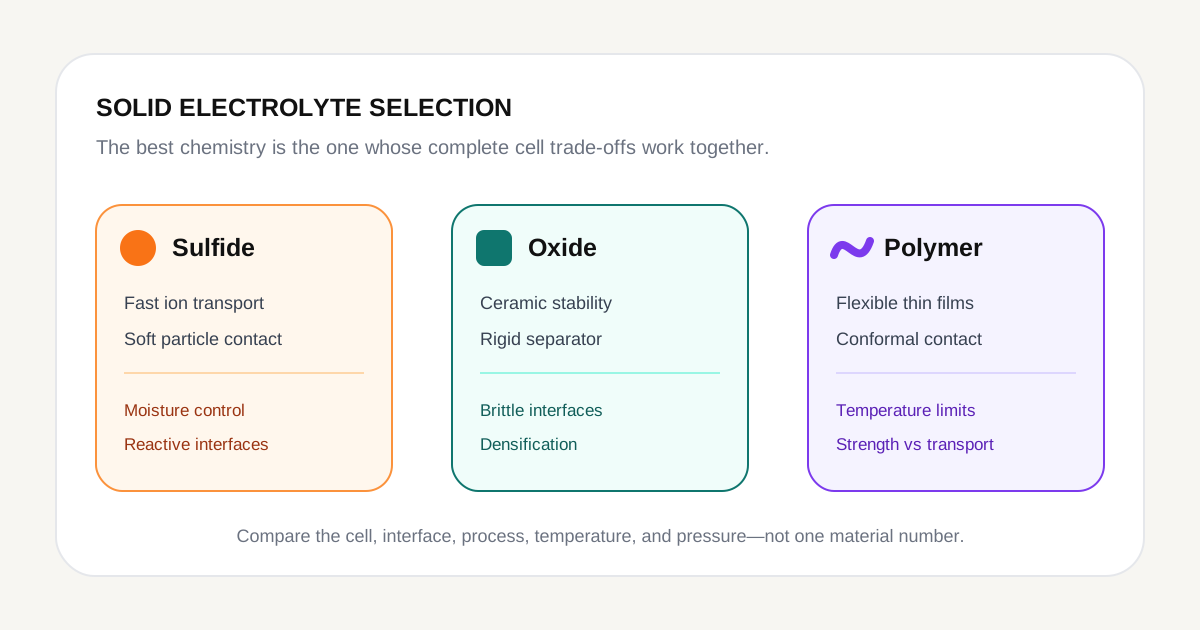
The main solid state battery electrolyte types are sulfides, oxides, and polymers. Each wins on a different part of the engineering problem. Sulfides are relatively soft and can achieve high room-temperature ionic conductivity. Oxides are rigid ceramics with attractive stability in selected chemical windows. Polymers can form thin, flexible films with familiar coating or extrusion methods. None combines ideal conductivity, perfect electrode contact, broad chemical stability, low-cost processing, and effortless scale-up in one material.
That is why choosing an electrolyte from a single conductivity value is unreliable. A practical decision must compare at least five factors: ion transport, interface behavior, operating conditions, environmental controls, and manufacturing route. The electrolyte also has to work with the chosen cathode, anode, current density, layer thickness, pressure, and temperature.
If you first need the cell-level basics, start with our guide to how solid-state batteries work. This article takes the next step: deciding what each electrolyte family makes easier—and what new problem it introduces.
- Choose sulfide research paths when high room-temperature transport and conformal particle contact are priorities—and dry-room or inert-atmosphere controls are realistic.
- Choose oxide research paths when ceramic stability and mechanical rigidity fit the architecture—and the team can solve brittle interfaces and high-temperature processing.
- Choose polymer research paths when flexible thin-film processing is valuable—and the intended temperature and current demand match the polymer conductivity.
- Consider halide or composite paths when one material family cannot meet both cathode stability and separator or anode requirements.
The three main families solve different problems
A solid electrolyte must conduct lithium ions while blocking electrons, separate the electrodes, remain chemically compatible with adjacent materials, and retain contact during cycling. Reviews of solid-state electrolyte materials commonly group candidates into polymers, oxides, sulfides, and—more recently—halides. The three families in this comparison remain the clearest starting point because their mechanical and processing behavior differs so sharply.
The ranges below are directional, not purchasing specifications. Conductivity changes with composition, density, grain boundaries, temperature, measurement method, and sample preparation. A record value from a dense pellet cannot be transferred automatically to a thin separator inside a multilayer cell.
| Decision factor | Sulfide | Oxide | Polymer |
|---|---|---|---|
| Room-temperature ion transport | Often the strongest of the three; leading compositions reach liquid-electrolyte-like ranges | Useful in selected ceramics, but grain boundaries and interfaces can dominate resistance | Often lower in conventional systems; strongly linked to polymer motion and temperature |
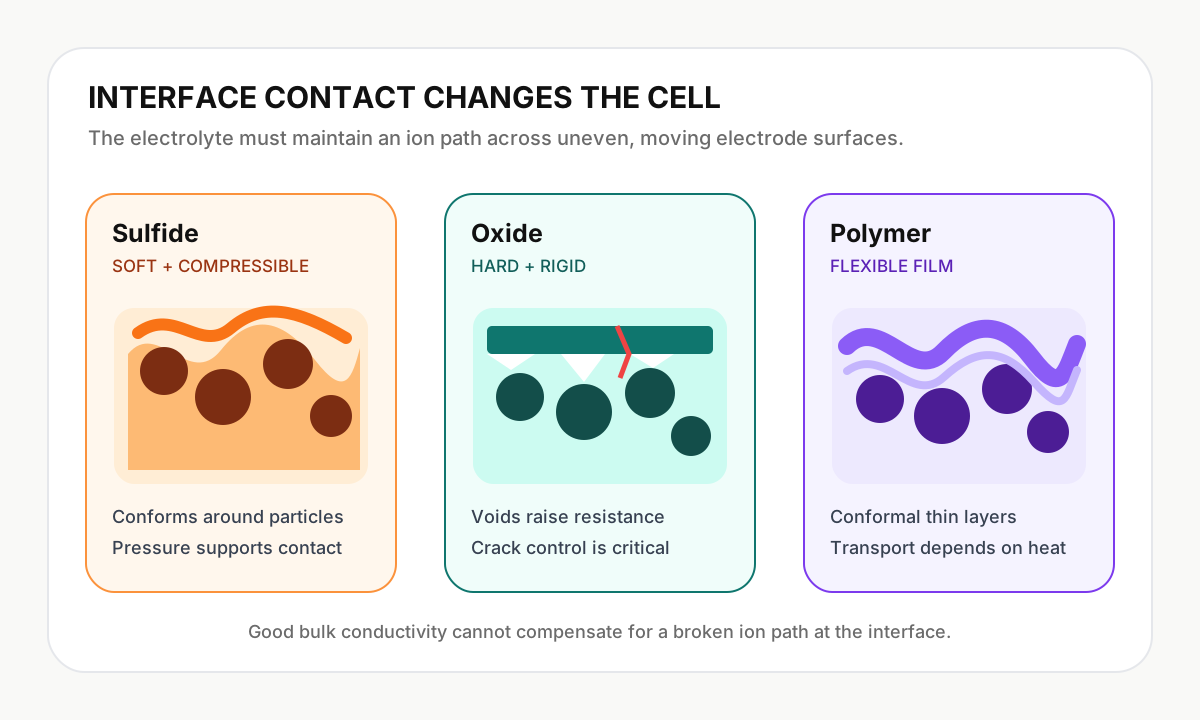
| Mechanical behavior | Relatively soft and compressible | Hard, rigid, and often brittle | Flexible and conformal |
| Electrode contact | Good particle contact under pressure, but reactions may form resistive layers | Difficult solid-solid contact; voids and cracks can raise resistance | Good wetting-like contact, but mechanical strength and stability must be balanced |
| Environmental sensitivity | Frequently moisture sensitive; some chemistries can generate hydrogen sulfide | Generally more tolerant of ambient handling, though surfaces can still react with air | Depends on polymer and salt; moisture and solvent controls still matter |
| Typical processing challenge | Dry processing, solvent compatibility, atmosphere control, pressure management | Densification, sintering temperature, thin-film integrity, interface joining | Thin-film strength, residual solvent, salt distribution, room-temperature conductivity |
| Best-fit reason to investigate | High power potential and scalable composite-electrode contact | Stability-led ceramic architectures and rigid separators | Flexible films and potentially familiar roll-to-roll operations |
These are family-level tendencies. A real comparison must name the exact composition, thickness, electrodes, temperature, pressure, and test method.
Sulfides lead on conductivity and contact, but demand strict atmosphere control
Sulfide solid electrolytes replace oxygen in related frameworks with sulfur. Representative groups include argyrodites such as Li6PS5Cl, LGPS-type conductors, and glass or glass-ceramic thiophosphates. Peer-reviewed reviews report that many sulfide conductors operate in the 10−3 to 10−2 S/cm range at room temperature, although the exact value depends on composition and test method. That combination of fast transport and comparatively soft mechanics makes sulfides attractive for composite cathodes, where particles need continuous ion-conducting contact.
Softness is not the same as simplicity. Many sulfides react with moisture, and some can release toxic hydrogen sulfide. Production therefore needs controlled raw materials, low-humidity or inert handling, compatible binders and solvents, monitored exhaust, and validated moisture limits. The VDMA production guide treats atmosphere control and electrolyte-specific processing as central manufacturing choices, not minor laboratory precautions.
Sulfide interfaces also need deliberate design. Contact with high-voltage oxide cathodes or lithium-metal anodes can create reaction products and resistance. Coatings, buffer layers, composition changes, and pressure can help, but each added measure changes cost, inactive mass, quality control, and scale-up. This link between material sensitivity and factory controls is one reason solid-state batteries remain expensive.
- Ask about moisture: What water-content limit applies to powder, slurry, electrode, and assembled cell?
- Ask about gas safety: How is potential H2S detected, contained, exhausted, and handled during off-normal events?
- Ask about interfaces: Which cathode coating or interlayer is used, and is its mass included in performance figures?
- Ask about pressure: Is pressure applied only during formation or throughout cycling, and is the hardware counted at pack level?
Oxides favor stability, but ceramic interfaces are unforgiving
Oxide electrolytes include garnets such as LLZO, NASICON-type materials such as LATP or LAGP, and perovskite-related conductors. Their strong ceramic frameworks can provide good thermal characteristics and useful electrochemical stability in the right pairing. Recent literature on garnet electrolytes reports room-temperature conductivity around the 10−3 S/cm class for optimized compositions, but a bulk-material number does not capture grain-boundary and electrode-interface losses.
The central oxide problem is mechanical contact. A hard ceramic does not flow around cathode particles the way a liquid—or a softer sulfide—can. Surface contamination, microscopic voids, roughness, cycling strain, and lithium contact can all raise interfacial resistance. Densifying a ceramic layer may require high-temperature treatment, while co-sintering can trigger unwanted reactions between electrolyte and electrode materials.
Oxide routes therefore make the most sense when the complete architecture is designed around ceramic processing. Thin, dense separators; surface preparation; compliant interlayers; low-resistance joining; and crack control matter as much as the nominal electrolyte formula. Claims that a high shear modulus automatically stops lithium penetration should be treated cautiously: defects, grain boundaries, current concentration, and interface conditions can still control failure. Our 10-point battery-claim checklist explains how to separate material evidence from full-cell proof.
Polymers simplify film processing, but temperature can control performance
Solid polymer electrolytes dissolve a lithium salt in an ion-conducting polymer matrix. PEO is the best-known example, but researchers also study polycarbonates, polyesters, nitriles, single-ion conductors, cross-linked networks, and polymer-ceramic composites. Their practical appeal is clear: polymers are flexible, can conform to electrodes, and may fit coating, casting, lamination, or extrusion workflows more naturally than brittle ceramics.
The trade-off is that ion movement in many polymers depends on segmental motion of the chains. Conventional PEO systems crystallize significantly near room temperature, reducing conductivity and making warm operation much easier than cold operation. A Nature Communications perspective on polymer electrolytes emphasizes the continuing gap between attractive laboratory concepts and the combination of conductivity, transference, stability, mechanics, and practical cell conditions required at scale.
Plasticizers, new polymer backbones, cross-linking, ceramic fillers, and composite structures can improve one or more constraints, but terminology then becomes important. A polymer layer containing substantial liquid or gel should not automatically be described as an all-solid-state electrolyte. Temperature must also be disclosed beside any rate or conductivity claim. This matters when interpreting solid-state fast-charging results, because a warm polymer cell and a room-temperature ceramic cell are not equivalent test conditions.
- Temperature: Compare conductivity and cycling at the intended minimum, normal, and maximum operating temperatures.
- Composition: Identify polymer, lithium salt, ceramic filler, plasticizer, and any remaining liquid fraction.
- Mechanics: Measure film thickness, puncture resistance, shrinkage, adhesion, and behavior after repeated cycling.
- Process: Control solvent removal, salt distribution, residual moisture, and thickness uniformity across production width.
Halides and composites are changing the three-way comparison
Sulfide, oxide, and polymer is a useful comparison, but it is not a closed list. Halide electrolytes—especially chlorides—have attracted attention because some compositions combine useful conductivity with improved compatibility at high-voltage cathodes. Their mechanical behavior and lithium-side stability can still require another material or protective layer, so they do not simply replace all three established families.
Composite and multilayer designs are often more realistic than a winner-takes-all choice. A polymer can add flexibility around ceramic particles. A halide can protect a cathode-facing interface while another electrolyte serves near the anode. A thin interlayer can separate two materials that would otherwise react. Research on sulfide-polymer composite films shows why the field increasingly evaluates architectures, not only single powders.
The important boundary is honesty in naming. A hybrid architecture may be the better engineering answer, but its liquid content, layer functions, and test boundary must be disclosed. “Composite,” “quasi-solid,” “semi-solid,” and “all-solid-state” should describe the real ion-conducting structure rather than a marketing tier.
Manufacturing fit can outweigh the best laboratory conductivity
An electrolyte becomes commercially relevant only when it can be made thin, uniform, defect-controlled, fast enough, and repeatedly integrated with electrodes. The same chemistry may look different when the target changes from a dense laboratory pellet to a wide separator film or a high-loading composite cathode.
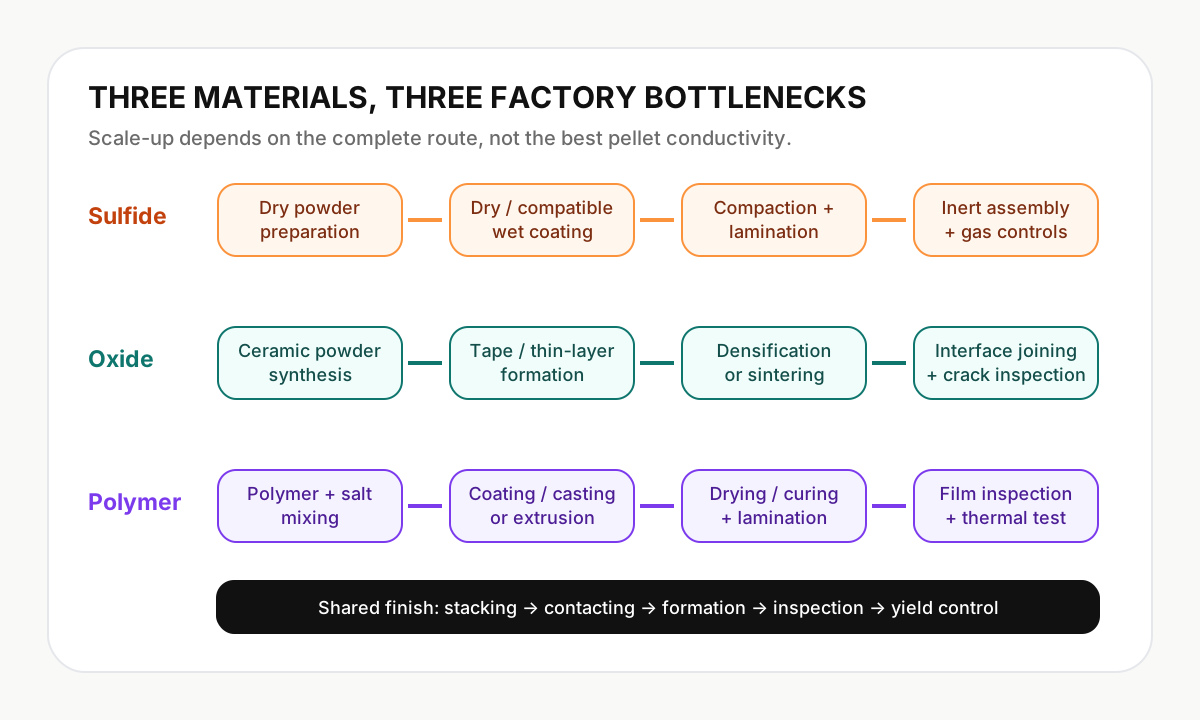
The process comparison below is based on family-level tendencies documented in the VDMA cell-production guide. It is a planning map, not a fixed recipe. Actual lines may use dry coating, wet coating, hot pressing, lamination, deposition, or hybrid sequences depending on the selected material and architecture.
| Process decision | Sulfide route | Oxide route | Polymer route |
|---|---|---|---|
| Material preparation | Controlled grinding/mixing with moisture-sensitive powders | Powder synthesis, particle control, and often high-temperature treatment | Polymer-salt mixing, dissolution or melt processing, and additive control |
| Layer formation | Dry or carefully selected wet process; compaction is important | Ceramic tape, coating, deposition, or supported thin layer followed by densification | Casting, coating, extrusion, cross-linking, or lamination |
| Critical defect | Moisture damage, agglomerates, porosity, interface reaction | Cracks, pinholes, poor density, warped layers, high interface resistance | Thickness variation, residual solvent, weak film, crystallinity, salt segregation |
| Factory burden | Dry/inert atmosphere and gas-risk controls | Thermal budget, precision ceramic handling, joining and inspection | Temperature/solvent control, drying, web handling, and mechanical validation |
| Scale-up question | Can performance survive lower pressure and larger area? | Can a thin ceramic be made and joined without damaging yield? | Can room-temperature performance survive thin, production-speed films? |
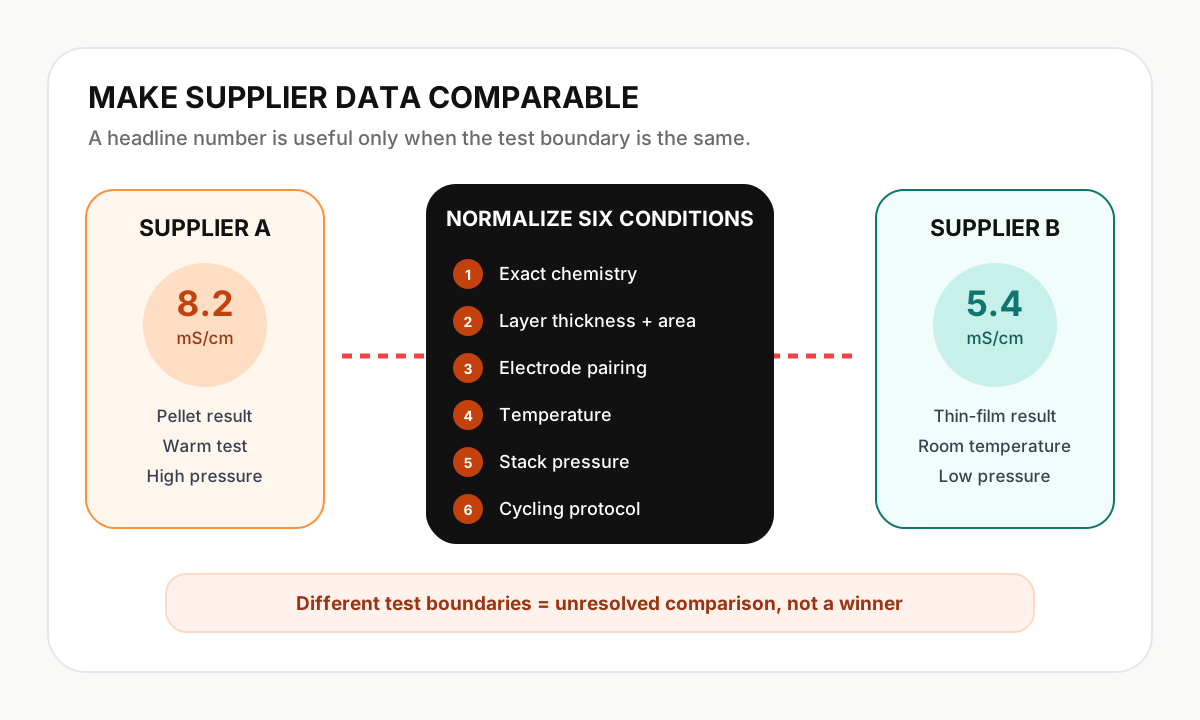
A meaningful supplier comparison uses the same cell format, loading, separator thickness, temperature, pressure, cycle protocol, and reporting boundary.
Compare supplier data under the same test boundary
For buyers and development partners, the best electrolyte is the one that meets the cell requirement with a controllable production process. Request evidence at material, layer, cell, and manufacturing levels. Do not let a strong pellet conductivity value substitute for thin-film yield, full-cell cycling, or safe handling.
A first supplier screen should end with a comparable data package. If two vendors report at different temperatures, pressures, layer thicknesses, or cell formats, normalize the test or treat the comparison as unresolved. The goal is not to eliminate early-stage materials; it is to label what has actually been demonstrated.
- Identity: exact electrolyte family, composition range, additives, and any liquid or gel fraction.
- Transport: ionic and electronic conductivity, temperature range, density, and measurement method.
- Stability: air/moisture exposure protocol, electrochemical compatibility, and relevant gas or thermal tests.
- Interfaces: cathode and anode pairing, coatings, contact method, impedance growth, and required stack pressure.
- Geometry: layer thickness, area, loading, porosity, and complete-cell capacity—not only a pellet or coin-cell result.
- Repetition: sample count, batch count, distribution, failure rate, and full cycling curves.
- Process: line steps, atmosphere, solvents, drying or sintering conditions, in-line controls, and yield evidence.
- Boundary: what mass, volume, pressure hardware, and inactive components are included in every performance number.
FAQs
Which solid electrolyte has the highest ionic conductivity?
Leading sulfide compositions often show the highest room-temperature ionic conductivity among the three main families, with some reaching liquid-electrolyte-like ranges. The result does not make sulfide automatically best because interface reactions, moisture controls, layer thickness, and required pressure also affect the complete cell.
Are oxide solid electrolytes safer than sulfides?
Oxides are generally less moisture-reactive than many sulfides and do not share the same hydrogen-sulfide handling concern. But battery safety depends on the complete cell, including electrodes, interfaces, state of charge, defects, and test conditions; electrolyte family alone is not a full safety verdict.
Why do polymer solid electrolytes often need heat?
Lithium-ion movement in many polymers is coupled to motion of the polymer chains. Conventional PEO becomes more crystalline near room temperature, slowing ion transport; raising temperature increases segmental motion and conductivity. New polymers and composites aim to reduce this limitation.
What is the difference between an oxide and a ceramic electrolyte?
Oxide electrolytes are one major category of ceramic solid electrolyte. Ceramic is the broader materials description and can also include non-oxide inorganic compounds. In battery discussions, garnet, NASICON-type, and perovskite-related oxides are common examples.
Are halide electrolytes better than sulfides?
Halides can offer attractive high-voltage cathode compatibility, while sulfides often provide stronger mechanical conformity and very high conductivity. Many architectures may use them in different layers rather than selecting one universal winner. Lithium-side stability, cost, moisture response, and processing still need case-specific evidence.
How should I compare solid electrolyte suppliers?
Request the exact chemistry and compare conductivity, thickness, density, temperature, pressure, electrode pairing, cell format, loading, sample count, and cycling protocol on the same boundary. Then review moisture controls, gas handling, process steps, yield, and repeatability before comparing headline performance.
Sources and further reading
- PMC: Recent advances and classification of solid-state electrolyte materials
- PMC: Sulfide and oxide inorganic solid electrolytes for all-solid-state lithium batteries
- Nature Communications: A reflection on polymer electrolytes for solid-state lithium batteries
- Communications Materials: Sulfide-based composite solid electrolyte films
- ACS Energy & Fuels: Interfacial stability of garnet solid electrolytes
- ACS Applied Materials & Interfaces: Enhancing moisture stability of sulfide solid-state electrolytes
- VDMA: Production of an All-Solid-State Battery Cell
Related Blogs
Learn More About Battery
Li6PS5Cl Solid Electrolyte: Conductivity, Moisture Risk, Interfaces and Scale-Up
How Much Stack Pressure Does a Solid-State Battery Need? Read the Test Boundary
Semi-Solid-State Batteries: Why They May Reach EVs First
Related Products
Related product
Prismatic Series
AB-100AH Semi Solid Prismatic Cell
- Energy Density
- 285 Wh/kg
- Nominal Voltage
- 3.65 V
Cylindrical Series
AB-21700 Semi Solid Cylindrical Cell
- Energy Density
- 300 Wh/kg
- Nominal Voltage
- 3.7 V
Pouch Cell Series
AB-50AH Semi Solid Pouch Cell
- Energy Density
- 320 Wh/kg
- Nominal Voltage
- 3.7 V