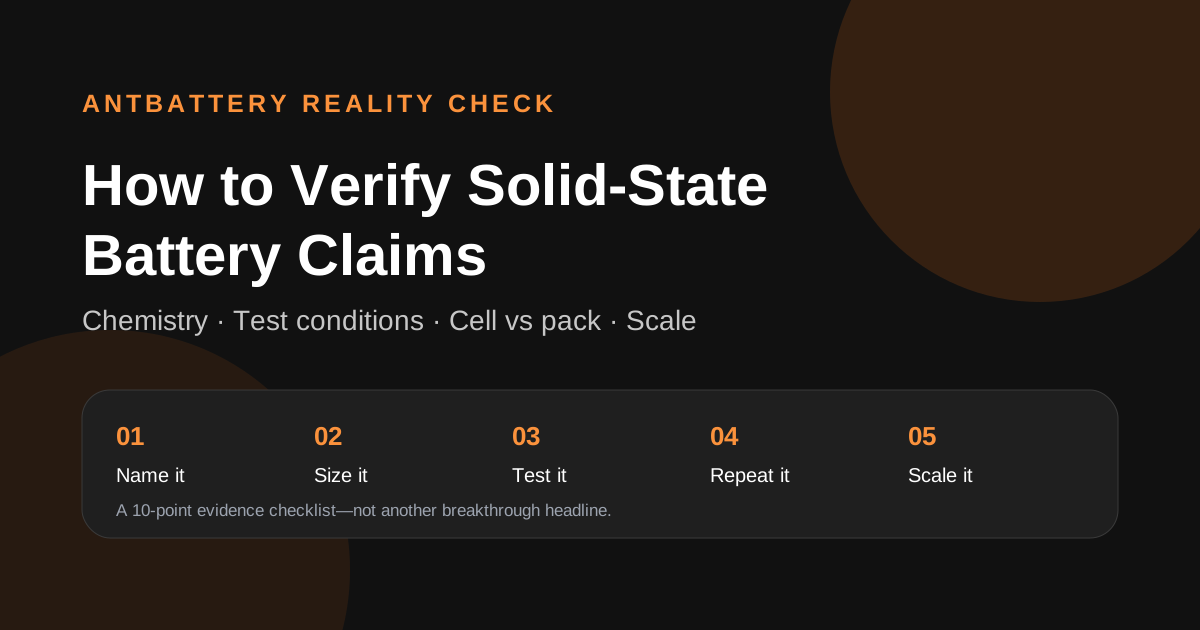
The short answer: verify the claim, not the headline
The fastest way to verify a solid-state battery claim is to ask five questions: What exactly was tested? At what scale? Under which conditions? By whom? And what commercial milestone was actually reached? A credible claim connects all five answers. A weak claim usually gives one impressive number while leaving the test article, boundary, or conditions unclear.
This does not mean every incomplete announcement is false. Early research often cannot disclose every material or customer detail. It means the correct verdict is proportional to the evidence: demonstrated, independently reproduced, qualified, shipped, or still unverified. Missing evidence should lower confidence, not automatically become proof of deception.
The method below complements our article on which solid-state battery companies are actually shipping. That article tracks named programs. This one gives buyers, engineers, investors, and editors a reusable checklist for evaluating any future announcement.
- Level 1 — Stated: a company or laboratory publishes a claim.
- Level 2 — Documented: the claim includes a defined test article, protocol, and raw or detailed data.
- Level 3 — Independently tested: a qualified third party performs a relevant test with a clear scope.
- Level 4 — Reproduced: the result is repeated across samples, batches, or laboratories.
- Level 5 — Commercially validated: the product survives customer qualification, production controls, and repeat delivery.
1. Verify what “solid state” means in this claim
Start with architecture, not branding. Ask whether the ion-conducting path is fully solid, whether a liquid or gel phase remains, and whether the description applies to the complete cell or only one layer. Terms such as solid-state, all-solid-state, semi-solid, quasi-solid, and solid-state architecture are not interchangeable.
A company disclosure is the starting point, but stronger evidence may include electrolyte composition ranges, cell cross-sections, spectroscopy, microscopy, a teardown, or testing by a laboratory capable of identifying the chemistry. Voltage curves and charge-rate results alone rarely prove that an unknown cell is all-solid-state; different lithium-ion architectures can produce overlapping electrical behavior.
Our solid-state battery working-principle guide explains why the electrolyte and interfaces matter. For claim verification, the practical rule is simpler: if the announcement never defines what remains liquid, do not silently upgrade a hybrid design into a full all-solid-state battery.
2. Identify the test article: material, coin cell, pouch cell, module, or pack
Performance becomes harder to achieve as the test article becomes larger and more complete. Ionic conductivity measured in an electrolyte pellet is not cell energy density. A small press cell is not an ampere-hour pouch cell. A pouch cell is not a module, and a module is not a road-qualified battery pack.
Oak Ridge National Laboratory has highlighted the need to test solid electrolytes under conditions closer to practical cells, including realistic cycling capacities and thin lithium anodes. The point is not that small cells are useless. They are essential for discovery. The mistake is using a small-cell result to imply that inactive material, pressure hardware, thermal systems, interconnects, and pack controls have already been solved.
| Test article | Useful evidence | Does not prove by itself |
|---|---|---|
| Material or electrolyte pellet | Conductivity, stability window, mechanical behavior | Practical cell energy density or cycle life |
| Coin or press cell | Electrochemical feasibility and controlled comparisons | Large-format manufacturing or pack performance |
| Single-layer pouch cell | More realistic geometry and packaging | Multilayer yield, module behavior, or vehicle readiness |
| Multilayer Ah-scale cell | Scale-up, loading, interfaces, and repeatability | Automotive pack qualification or production economics |
| Module or pack | System density, controls, thermal and mechanical integration | High-volume manufacturing unless batches and deliveries are shown |
Always request capacity, dimensions, mass, layer count, cell format, and whether the reported result includes fixture or pressure hardware.
3. Read the test conditions before reading the record number
A performance number without conditions is not comparable. At minimum, ask for temperature, applied pressure, charge and discharge rate, voltage window, depth of discharge, cathode loading, electrolyte thickness, lithium excess, rest periods, and the cycle used for the headline result.
This matters unusually strongly in solid-state research. A Nature Energy interlaboratory study involving 21 research groups found substantial performance variability even when groups received the same core materials and electrochemical protocol. Differences in cell assembly, processing pressure, component ratios, loading, and setup affected the results. The authors recommend fuller parameter reporting and data in triplicate.
Room-temperature cycling at low external pressure and practical areal capacity is generally more relevant to a vehicle claim than cycling a tiny cell slowly at elevated temperature and high pressure. Both tests may be scientifically useful, but they answer different questions.
- Was the cell charged at 0.1C, 1C, 5C, or a changing multi-step rate?
- Was “five-minute charging” measured from 10% to 80%, 0% to 80%, or 0% to 100%?
- Was the stated cycle life measured at the same fast-charge rate used in the headline?
- Was the test performed at room temperature, elevated temperature, or after preheating?
- Did the cell require continuous external pressure, and is that pressure hardware counted in system mass?
4. Check whether energy density is material-level, cell-level, or pack-level
Energy density claims need both a numerator and a boundary. Gravimetric energy density is watt-hours divided by mass. Volumetric energy density is watt-hours divided by volume. The result changes depending on whether the calculation includes only active material, a complete cell, a module, or the full pack.
A 500 Wh/kg material or development-cell claim does not mean a 500 Wh/kg vehicle pack. Tabs, casing, electrolyte, excess lithium, compression frames, cooling, busbars, electronics, crash protection, and service structures add mass and volume. Ask for the actual discharged energy, complete test-article mass and dimensions, not only a projected value derived from component capacity.
This is also why our solid-state versus LFP and NMC comparison treats present products separately from future targets. The fair comparison is cell to cell or pack to pack under stated conditions—not a theoretical active material against a commercial pack.
5. Test energy, fast charging, and cycle life together
Battery announcements often select the best number from separate experiments: high energy from one design, fast charging from another, and long life from a gentler protocol. A commercially meaningful claim should show how the same representative design performs across the full set of requirements.
Fast charging is especially easy to overread. A cell may accept a high current for a limited state-of-charge window, but the relevant questions are heat generation, round-trip efficiency, lithium plating, pressure change, and capacity retention after repeated fast-charge cycles. Our article on solid-state battery charging speed explains why C-rate alone is not a complete answer.
The same rule applies to safety. A non-flaming puncture or high-temperature test can be valuable, but it does not automatically prove long cycle life, high density, or a specific electrolyte composition. Each result should support only the claim it actually tested.
6. Look for sample count, repeat tests, and raw curves
One exceptional cell proves possibility, not process capability. Ask how many cells were built, how many passed, whether the headline cell was typical, and whether results came from one batch or multiple production runs. Look for spread, median performance, failure count, and retention curves—not only the best curve.
Reproducibility is a known challenge, not a bureaucratic detail. The same Nature Energy benchmarking work found large interlaboratory scatter and explicitly advocated triplicate reporting. For commercial evaluation, three cells are still only a starting point; customer qualification normally needs larger sample sets and production-lot evidence appropriate to the application.
Raw data should make the basics recoverable: voltage, current, capacity, time, temperature, pressure where relevant, and cycle number. A cropped chart without axes, sample identity, or protocol is promotional evidence, not a reproducible result.
7. Understand what an independent test actually verified
“Independently tested” sounds decisive, but its meaning depends on scope. Who selected and shipped the sample? Did the laboratory identify the chemistry, or only run an electrical protocol? Did it verify mass and dimensions? Was the method designed by the lab, the sponsor, or both? Was the report published in full?
A current example is the debate around third-party tests of highly publicized solid-state cells. IEEE Spectrum reported useful fast-charge test results while also noting that the tests did not demonstrate pack-level performance. That is the right reading discipline: accept what the test establishes without extending it to claims outside its scope.
Independent evidence is strongest when the laboratory is qualified for the method, the sample chain is clear, the protocol matches the claim, the report exposes limitations, and other groups can reproduce the result. Independence reduces one source of bias; it does not repair an irrelevant test design.
8. Separate a prototype milestone from a production milestone
A cell can be real and impressive while still being years from repeat production. Use precise milestone language: material sample, laboratory cell, engineering sample, multilayer prototype, automotive sample, installed test pack, development vehicle, customer qualification, start of production, and repeat customer delivery.
Terms such as A-sample, B-sample, and C-sample can be useful inside automotive development programs, but definitions and exit criteria vary by company. Do not treat the letter alone as a universal certificate. Ask what changed in design maturity, tooling, process control, validation coverage, and customer acceptance.
A prototype vehicle proves integration and test activity. It does not prove retail availability. Likewise, a sample shipment proves that physical cells left the supplier, but not that the customer accepted them or that the process can supply thousands of packs. Our solid-state vehicle reality check applies this distinction to current road programs.
9. Match certificates and safety tests to the claim
Certification evidence is valuable only when you know what it covers. UN Manual of Tests and Criteria subsection 38.3 addresses transport classification for lithium cells and batteries. A UN 38.3 test summary can support transport readiness for a defined model; it does not prove that the electrolyte is fully solid, that a pack will fast-charge in ten minutes, or that the cell meets automotive life targets.
Application testing is a separate layer. ISO 12405-4 specifies performance testing for electric-vehicle battery packs and systems, while UL Solutions lists different cell, module, pack, transport, vibration, and vehicle-safety standards used across markets. Ask for the exact standard, edition, model number, laboratory, report identifier, pass scope, and any excluded configuration.
Also check whether the certificate belongs to the tested product. A report for one cell chemistry, energy rating, protection system, or pack configuration should not be assumed to cover a materially different design.
10. Ask for manufacturing evidence, not only a capacity announcement
A factory nameplate stating gigawatt-hours is not proof of saleable output. Verify installed equipment, qualified process steps, line speed, yield definition, uptime, scrap handling, quality controls, batch traceability, and how much conforming product has actually shipped.
Manufacturing evidence can include repeat lots with statistical process data, customer audits, purchase commitments that become accepted deliveries, quality documentation, and stable specifications across batches. Be careful with the word “shipping”: research samples, paid pilot cells, and serial-production supply are different commercial states.
This is where technical and commercial verification meet. A cell with excellent laboratory performance but low yield may still be valuable research. It is not yet equivalent to a product that an OEM can qualify, warranty, and source repeatedly. The cost consequences of yield and process control are explained in our guide to why solid-state batteries remain expensive.
Use this 10-point solid-state battery claim checklist
Score each item as documented, partial, or undisclosed. The score is not a scientific certification and should not be used to accuse a company of misconduct. It is a disciplined way to decide what the available evidence supports and what still needs verification.
| Check | Evidence to request | Warning sign |
|---|---|---|
| 1. Chemistry | Definition of solid, semi-solid, or all-solid-state architecture | Marketing term without electrolyte disclosure |
| 2. Test article | Format, capacity, dimensions, mass, layer count | Only “cell” or “battery” is stated |
| 3. Conditions | Temperature, pressure, C-rate, voltage window, loading | Record number with no protocol |
| 4. Density boundary | Measured Wh and full cell/pack mass and volume | Material value presented as pack value |
| 5. Combined performance | Density, fast charge, and life on representative design | Best values taken from unrelated tests |
| 6. Repetition | Sample count, batches, failures, median and spread | One best-performing cell |
| 7. Independent scope | Lab, chain of custody, method, full limitations | “Third-party tested” with no scope |
| 8. Development stage | Customer acceptance and milestone exit criteria | Prototype described as retail production |
| 9. Safety/compliance | Exact standard, model, report, configuration | One certificate used to prove every claim |
| 10. Manufacturing | Yield, qualified output, traceability, repeat deliveries | Nameplate capacity presented as shipments |
A strong claim does not need every item to be public, but the conclusion should never outrun the disclosed evidence.
The final verdict should use evidence grades, not hype labels
After applying the checklist, write the conclusion in evidence language. Say “the test demonstrates 5C charging for this cell under the stated protocol,” not “the company solved fast charging.” Say “the chemistry was not independently identified,” not “the battery is fake.” Say “a development vehicle exists,” not “mass production has begun.”
This approach is stricter than repeating a press release and fairer than debunking by instinct. It lets promising work remain promising while protecting buyers and readers from treating a partial result as a complete commercial product.
For sourcing teams, the next step is to turn the checklist into a request for data: define your target cell or pack, application, load profile, temperature range, validation standard, annual volume, and sample stage. Then compare supplier evidence against the same requirement instead of comparing headlines against one another.
FAQs
How can I tell if a solid-state battery claim is real?
Confirm the chemistry definition, test-article size, full protocol, sample count, independent-test scope, development stage, and manufacturing evidence. A claim can be real at laboratory scale without being proven at pack or production scale.
Does independent testing prove every battery claim?
No. It proves only what the laboratory actually tested. A fast-charge test does not automatically verify chemistry, energy density, cycle life, pack performance, safety, or manufacturing scale.
Is a prototype vehicle proof that solid-state batteries are in production?
No. A prototype vehicle demonstrates integration and road testing. Production requires qualified tooling and processes, repeatable output, customer acceptance, and commercial deliveries.
Does UN 38.3 prove a battery is safe and commercially ready?
UN 38.3 supports transport classification for a defined lithium cell or battery model. It does not prove solid-state chemistry, automotive durability, fast charging, cycle life, or compliance with every application-specific safety standard.
Why does cell-level versus pack-level data matter?
A pack includes structure, interconnects, controls, protection, thermal systems, and sometimes pressure hardware. These reduce energy density relative to a cell, so cell-level figures should not be presented as complete vehicle-pack performance.
What is the minimum evidence for a credible breakthrough claim?
At minimum, disclose the test article, capacity, mass or dimensions where relevant, conditions, protocol, sample count, and raw performance curves. Stronger confidence comes from independent reproduction, practical-format cells, customer validation, and repeat manufacturing lots.
Sources and further reading
- Nature Energy: Benchmarking the reproducibility of all-solid-state battery cell performance
- Nature Energy: Benchmarking the performance of all-solid-state lithium batteries
- Oak Ridge National Laboratory: Practical considerations for testing polymer electrolytes
- UNECE: UN Manual of Tests and Criteria Revision 8 and Amendment 1
- ISO 12405-4: EV traction battery pack and system performance testing
- UL Solutions: EV battery regulatory and standards testing overview
- IEEE Spectrum: Review of current third-party solid-state battery testing claims
Related Blogs
Learn More About Battery
Related Products
Related product
Pouch Cell Series
AB-50AH Semi Solid Pouch Cell
- Energy Density
- 320 Wh/kg
- Nominal Voltage
- 3.7 V
Prismatic Series
AB-100AH Semi Solid Prismatic Cell
- Energy Density
- 285 Wh/kg
- Nominal Voltage
- 3.65 V
Cylindrical Series
AB-21700 Semi Solid Cylindrical Cell
- Energy Density
- 300 Wh/kg
- Nominal Voltage
- 3.7 V