
That distinction can change the result even when the capacity value stays the same. The examples below show how the definitions work, then turn them into a report-comparison worksheet. They do not set a retirement threshold or determine whether a battery is safe to use.
Battery State of Health Requires a Defined Metric
A useful SOH report identifies what its percentage measures. The label alone leaves out the quantity being assessed and the scale used to express it. Capacity describes an amount of charge, commonly stated in ampere-hours (Ah); a resistance-based indicator uses a different physical quantity and its own reference values.
The distinction also matters when a health value appears in a battery management system display. A displayed result can come from an estimation model rather than a separate capacity test. The broader battery management system functions include monitoring and protection decisions that a single SOH percentage cannot describe.
The three methods below are documented examples. They establish why the formula belongs beside the number; they are not a claim that every supplier uses one of these definitions.
Capacity-Based SOH Can Use Different Reference Scales
Two capacity-based reports can use different scales. One may report the fraction of a reference capacity that remains. Another may report where the present capacity sits between a new-battery reference and an end-of-life reference. Both use capacity, but their denominators and endpoints differ.
Capacity Retention Uses a Stated Reference Capacity
The MathWorks second-life SOH example defines SOH as the capacity at a given cycle divided by the initial, rated nominal capacity. Expressed as a percentage, its relationship is:
Capacity retention (%) = cycle capacity ÷ initial rated nominal capacity × 100
The reference is part of the definition. A report using a measured initial capacity needs to identify that baseline; a report using rated capacity needs to identify the rating. A comparison should not silently treat those baselines as interchangeable.
MathWorks describes this particular example as energy-focused rather than a measure of power delivery. Its ratio therefore does not establish that a battery retains the same percentage of its original power capability. The source also uses a specific dataset and modeling assumptions, which should remain attached to any interpretation of its results.
An End-of-Life Reference Changes the Capacity Scale
The MathWorks capacity-based SOH estimator uses a different relationship:
Capacity-based SOH (%) = (current capacity − EOL capacity) ÷ (new capacity − EOL capacity) × 100
Here, EOL means the end-of-life reference selected for the model. The index reaches 100% at the new-capacity reference and 0% at the EOL-capacity reference. A zero on this scale does not mean zero physical capacity or an empty battery. It means that the current capacity has reached the stated endpoint.
The endpoint must come from the report's applicable criteria. A software example or default parameter does not establish a retirement rule for another battery or application. When a report says only “capacity-based SOH,” the equation is still needed.
Resistance-Based SOH Uses Its Own Reference Conditions
A resistance-based health indicator needs its own definition and reference data. The MathWorks resistance-based SOH estimator calculates:
Resistance-based SOH (%) = (EOL resistance − current terminal resistance) ÷ (EOL resistance − new terminal resistance) × 100
In this estimator, the new and EOL terminal resistances are lookup tables indexed by state of charge (SOC) and temperature. SOC describes the charge state used for the lookup; temperature is another input. The reference resistance is therefore not simply one unexplained value that can be carried across all conditions.
For a report using this method, record the selected reference values and the SOC and temperature to which they apply. Also identify how the current terminal resistance was obtained. A resistance-based percentage is not automatically a capacity-retention percentage, and this equation does not provide a universal conversion to power capability.
Different SOH Formulas Produce Different Percentages
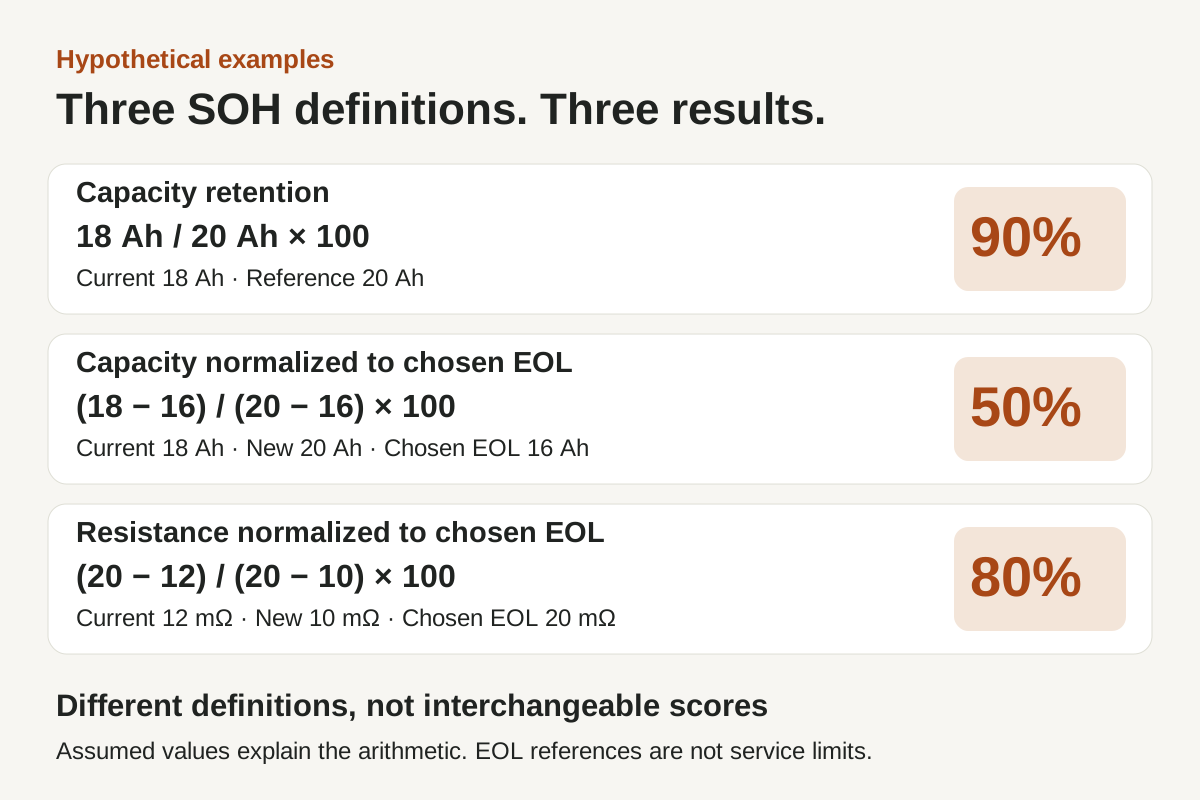
The following calculations are hypothetical. The capacities and resistances are assumed solely to explain the arithmetic. They are not measurements of an AntBattery product, and the EOL references are not recommended service limits.
| Report definition | Hypothetical inputs | Calculation | Result |
|---|---|---|---|
| Capacity retention | Current capacity 18 Ah; reference capacity 20 Ah | 18 ÷ 20 × 100 | 90% |
| Capacity normalized to EOL | Current capacity 18 Ah; new capacity 20 Ah; chosen EOL capacity 16 Ah | (18 − 16) ÷ (20 − 16) × 100 | 50% |
| Resistance normalized to EOL | Current resistance 12 mΩ; new resistance 10 mΩ; chosen EOL resistance 20 mΩ | (20 − 12) ÷ (20 − 10) × 100 | 80% |
The first two rows use the same current capacity and new/reference capacity. The change from 90% to 50% comes entirely from the definition: the second calculation expresses position within a selected capacity interval. It does not show a second loss of capacity.
The resistance row is a separate example. Nothing in these assumptions establishes a relationship between its 80% result and either capacity result. Averaging the three percentages would produce a number without a defined physical meaning.
Scroll the diagram horizontally to read every label.
Comparable Battery Health Reports Need Matching Conditions
Matching the formula is necessary, but the inputs also need a comparable basis. A report should distinguish measurements, model inputs and the resulting estimate. Stanford's battery health monitoring research illustrates that distinction: its observer estimates cell capacity and aging-sensitive parameters rather than reading SOH directly from a sensor. The disclosure describes results for one battery type and plans to calibrate the model for others; it does not validate every BMS estimate.
Conditions deserve the same attention. The MathWorks second-life example assumes constant temperature across cycles and notes that changing temperature affects its selected health indicators. Its resistance-based estimator explicitly uses SOC and temperature in the reference tables. These examples support checking the report's conditions, not applying an invented correction factor to unmatched reports.
Use the following worksheet to identify missing information. It is a document-review aid derived from the cited methods, not a laboratory test standard.
| Comparison field | Information to record from each report | Reason to clarify a mismatch |
|---|---|---|
| Quantity and formula | Capacity ratio, capacity interval, resistance interval or another specified method | The percentages may describe different quantities or scales. |
| Reference values | Rated or measured initial capacity; new and EOL values where used; units | A changed denominator or endpoint changes the result. |
| Battery and reporting scope | Battery identity, configuration, and whether the result describes a cell or a pack | A cell result and a pack result need an explained relationship. |
| Conditions | Temperature, SOC where relevant, and the stated charge/discharge or resistance-test conditions | Inputs may not represent the same operating or test basis. |
| Measurement and estimation | Measured inputs, estimation method, model or software version, and applicable validation | A displayed estimate should not be relabeled as a direct test result. |
| Timing and limitations | Report date, relevant usage history, stated uncertainty and excluded conclusions | A comparison needs context for both the result and its limits. |
Scroll the diagram horizontally to read every label.
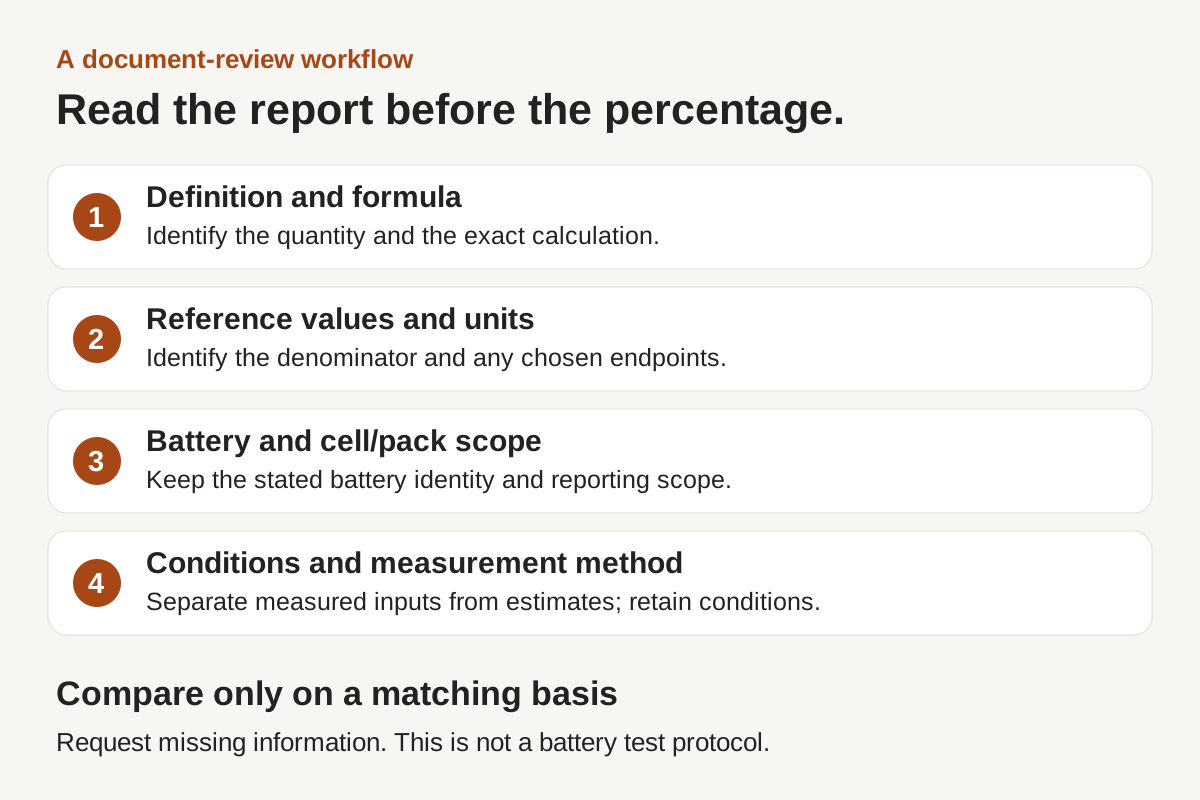
If one of these fields is missing, record the missing field rather than filling it with an assumption. If the methods differ, retain both results under their own definitions. Request a comparison on an agreed basis when the purchase or application decision requires one.
The Report Definition Determines the Next Decision
A higher SOH percentage is useful only when the quantity, scale and relevant conditions support that comparison. The immediate outcome of a report review may therefore be a request for the formula or reference data, rather than an accept-or-reject decision on the battery.
SOH also should not be turned into a remaining-years forecast. Battery life and its operating conditions are a separate question. The defined health metric, the application's capacity and load requirements, and the applicable manufacturer's criteria all need their own evidence; the percentage alone is not a complete safety assessment.
For a new battery sourcing discussion, start with the AntBattery battery product catalog and prepare the application, required capacity and load, and any report's SOH definition and reference conditions. This gives the enquiry a clear technical basis without treating an unexplained health score as a product specification.