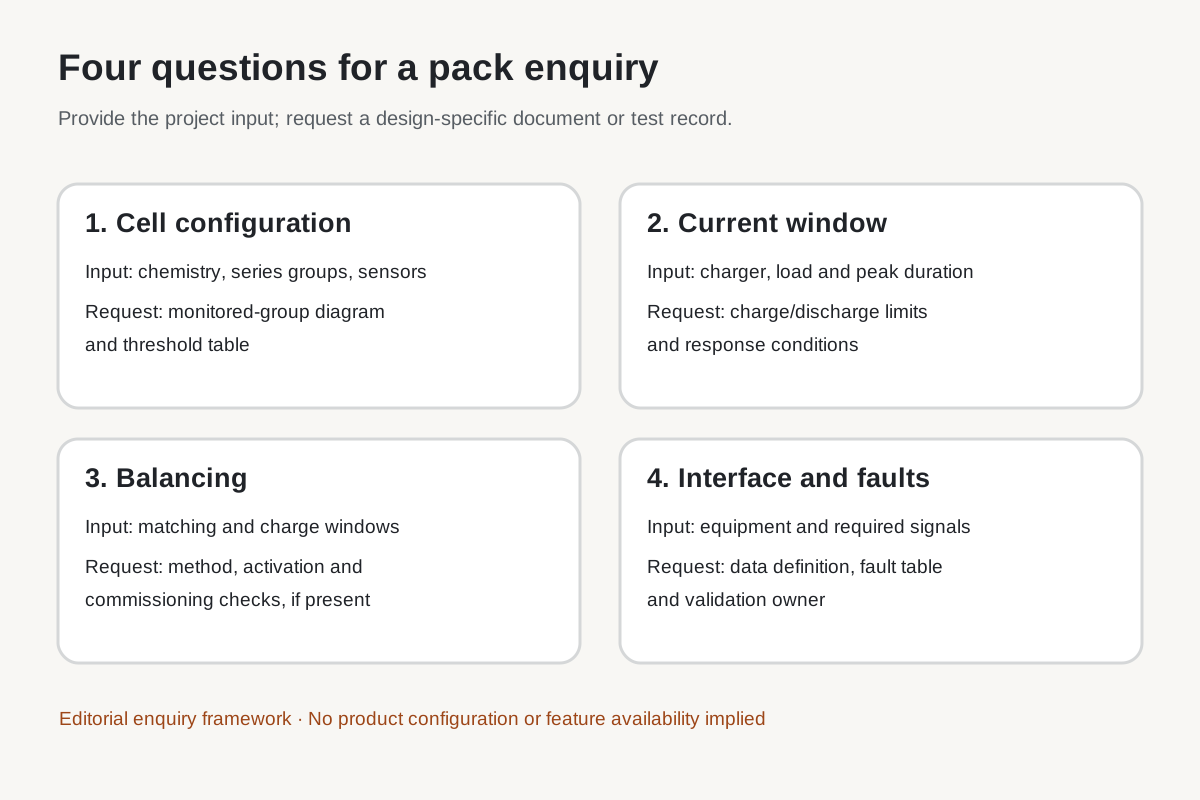
If you are specifying a custom pack, ask four questions before treating a BMS description as a fit: Which cells and chemistry does it monitor? What charge and discharge currents does the complete design permit? How, if at all, does it balance cells? What information and fault behavior must the rest of the equipment support? These are requirement groups, not a universal four-item certification or a promise that AntBattery has a ready-made BMS for your project.
What does a lithium battery BMS actually do?
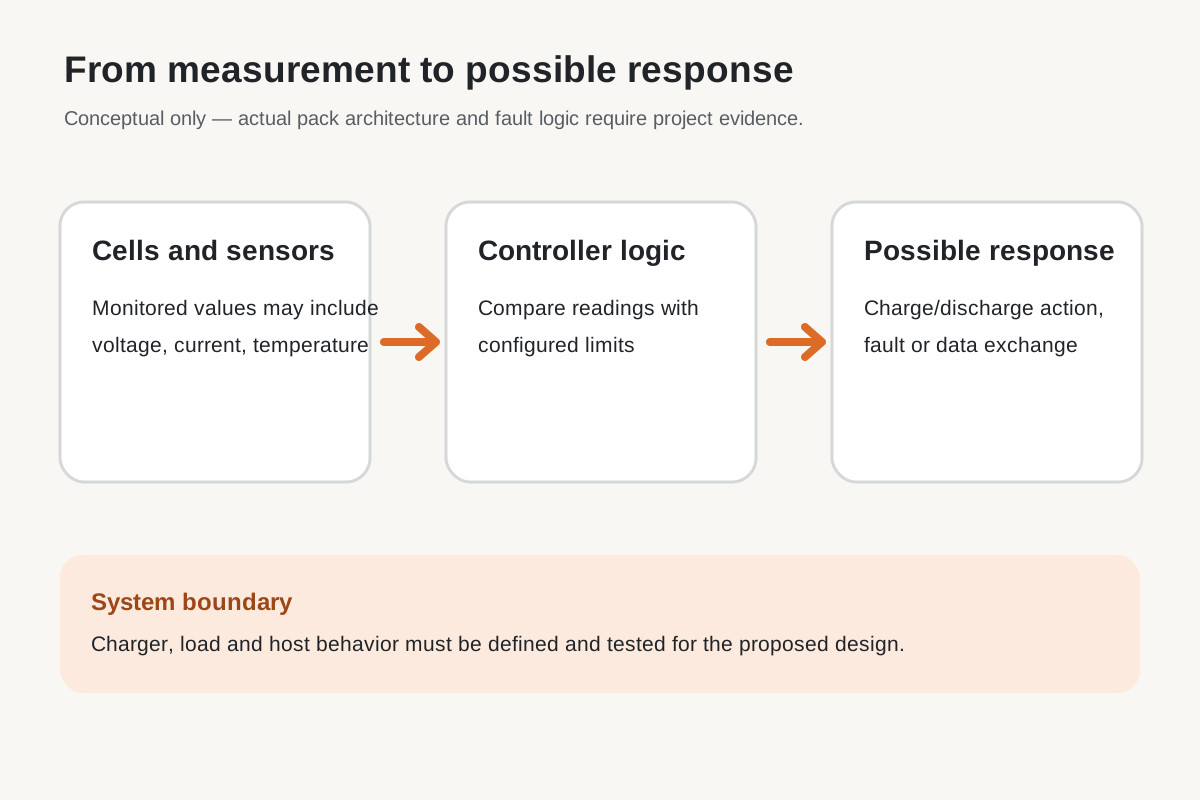
Think of the BMS as a chain of measurement → decision → possible action, not a single magic safety switch. A design may observe cell or group voltages, pack current and temperature. Its controller compares measured values with the selected cell's and application's operating limits. Depending on its architecture, it may then restrict charging or discharging, open a current path, record a fault or communicate a request to another controller. The MPS overview of BMS functions separates monitoring, protection, balancing and reporting; that is a useful vocabulary, but not a checklist of features guaranteed in every product.
Those verbs matter. Monitoring a temperature is not the same as cooling a pack. Detecting overcurrent is not the same as proving the fuse, switch, wiring and load will behave as intended. If the system reports state of charge, ask how that value is determined and checked for this application rather than reading it as a promise of runtime.
Scroll the diagram horizontally to read every label.
A BMS is also not the same thing as a battery cell or a complete pack. Texas Instruments' bq769x0 design note gives a concrete example: that specific monitor/front-end family is not a standalone protector. It needs a host to set thresholds, enable FET outputs and handle fault recovery. TI describes that family for 3–15-cell systems, but neither its cell count nor its architecture is a rule for every BMS. For a buyer, the lesson is to ask who owns the monitor, controller logic, switching, external protection and validation in the actual design.
1. Which chemistry and cell configuration will the BMS monitor?
Start with the proposed cell chemistry, series count and the way cells are grouped for measurement. A pack's nominal voltage alone does not identify its chemistry, the number of series groups or the cell-level limits. Ask for a block diagram showing the monitored groups, temperature-sensor locations and the selected cells' approved operating window. Then ask who sets and verifies the charge, discharge and temperature thresholds for that design.
This check is about the integrated pack, not permission to wire finished batteries together. Connecting separate batteries in series or parallel is a different, model-specific decision. The question here is narrower: does the proposed BMS architecture actually observe the cells and conditions it is supposed to control?
A useful supplier answer names the cell type, monitored series groups, sensor placement and the document that defines thresholds. “48 V BMS” on its own is not enough. For a 48 V-specific project, the 48 V product collection is commercial context, not confirmation that a particular BMS or pack configuration is available.
2. What are the charge, discharge, continuous and peak current limits?
Ask for separate charging and discharging limits, and for continuous and time-limited peak ratings where peaks matter. A motor or inverter can have a short surge that differs from its sustained load. Conversely, a charger can stress a pack under a different current and temperature profile from the equipment that discharges it. The Ansys discussion of current protection distinguishes charge from discharge and continuous from peak limits; it does not supply an amperage or pulse duration for your pack.
Give the supplier a load profile: sustained current or power, expected starting or transient peak, its duration, repetition and ambient conditions. Request the proposed pack's current-versus-time and temperature limits, plus the response when a limit is crossed. “Peak current: 100 A,” without duration and conditions, is not a complete acceptance criterion. Nor does a BMS rating alone establish the rating of the cells, interconnects, connector, fuse or charger.
Low-temperature charging deserves an explicit question. Ask what temperature is sensed, where the sensor sits, which charging limit applies and whether the system inhibits or adjusts charging under the specified conditions. The answer should come from the selected chemistry and pack design rather than a generic BMS label.
3. Is cell balancing present, and how does it work?
Cells in a series pack do not remain perfectly identical over time. A balancing design aims to manage differences among monitored groups, but “balancing included” still leaves practical questions. Ask whether the design uses passive dissipation, active charge transfer or another method; when balancing is enabled; what group-level measurements it uses; and what balance current or time window the maker documents. MPS explains the passive-versus-active distinction. It does not establish that either method is present in the pack being quoted.
For a duty cycle with short charging windows, the timing of balancing may affect how useful the feature is. That is a project question, not grounds to borrow another manufacturer's balancing time or performance figure. Request the selected BMS/pack specification and the test or commissioning record that shows how imbalance and balance status are detected. If no balancing is implemented, ask how the designer manages cell matching and the resulting operating limits.
4. What does the BMS tell the rest of the system—and what happens on a fault?
First define the equipment that must interact with the battery: charger, motor controller, inverter, supervisory controller or display. Then distinguish required data from nice-to-have telemetry. Does the equipment need a simple enable/disable signal, fault output, state-of-charge estimate, current limit request or a specified digital data set? If a digital interface is required, ask for its protocol, connector/pinout, message or register definition, update behavior and integration responsibility. Do not assume that a BMS supports SMBus, I²C, UART, CAN or any other interface merely because such interfaces exist in the market.
A fault table is at least as important as a data sheet. Ask what condition triggers each action, whether charge, discharge or both are interrupted, what the external equipment sees, and what conditions allow recovery. TI's bq769x0 example shows why controller ownership matters: in that architecture, host logic handles threshold setup and fault clearing. Another architecture may differ. The charger, controller and pack supplier should agree who tests the complete response; the BMS data sheet alone cannot prove that the whole machine is safe or compatible.
Turn functions into evidence requests
A strong BMS specification is a short set of project inputs and documents to return. The matrix below is an editorial enquiry aid, not an industry standard or an AntBattery product specification.
| Function or decision | Project input to provide | Evidence to request |
|---|---|---|
| Cell monitoring and limits | Chemistry, series-group count, voltage range, sensor locations and operating temperatures | Cell/pack limits, monitored-group diagram, threshold table and measurement points |
| Charge and discharge control | Charger profile, sustained load, peak current, pulse duration and repetition | Charge/discharge current-versus-time limits, temperature derating and protection response |
| Balancing | Cell matching plan and available charge/idle windows | Whether balancing exists, method, activation conditions, documented balance capability and commissioning checks |
| System interface and faults | Charger/controller models, signals or data required, stop/restart expectations | Interface/data definition, connector mapping, fault table, recovery sequence and named validation owner |
The table deliberately asks for evidence rather than offering universal settings. An answer can say a feature is not included; that can still be usable if the system designer understands the consequence and documents another control. What should not pass review is an undefined feature implied by the word “smart.”
Scroll the diagram horizontally to read every label.
Two boundaries keep this article distinct from neighboring work. The existing series/parallel article decides whether and how finished batteries may be interconnected. The planned 48 V pack-specification article will own 48 V chemistry, usable energy, application sizing and a full system RFQ. Here, the focus stays on BMS functions, design ownership and proof of the proposed behavior.
What to send with a custom-pack enquiry
Send the application and charger/controller models, cell chemistry or target if known, required voltage window, load profile, peak duration, temperature range and interface requirements. State what you need the supplier to document: monitored groups, protection thresholds, balancing method if used, communications, fault recovery and system-level test responsibility. If you do not know one of these items, say so; that is a design question to resolve, not a reason to invent a value.
You can review the AntBattery product range and then use the existing quote form to discuss a custom lithium-pack project. The site's voltage pages describe possible OEM pack/BMS integration, but this article does not confirm that a named BMS, protocol, current rating or finished pack is available for your application. Request a project-specific proposal and supporting documents before treating any configuration as approved.