The short answer: buy a defined test article, not a label
If you are deciding where to buy a solid-state battery, begin with suppliers that can describe exactly what they will ship, how the sample was selected, and under which conditions its data was produced. The phrase “solid-state battery” can refer to an all-solid-state cell, a semi-solid or hybrid cell, an electrolyte material, a laboratory coupon, a prototype cell, or a pack assembled around another company's cells. Those are not interchangeable purchases.
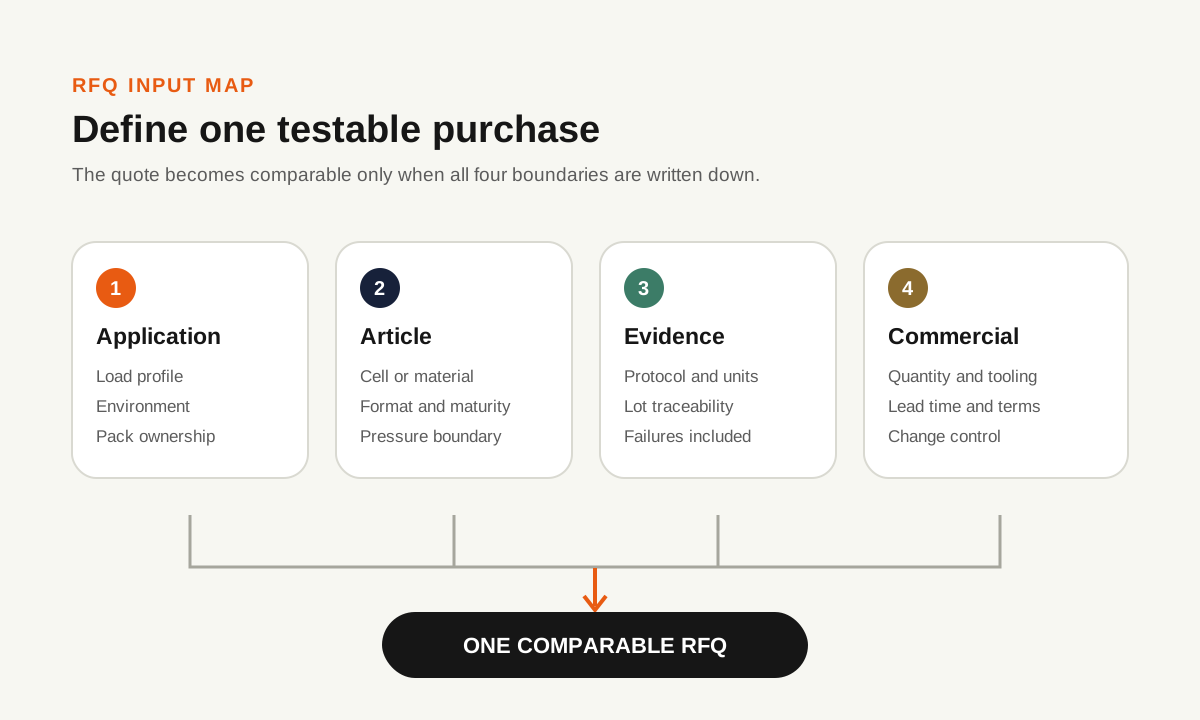
Send the same requirements and evidence table to every candidate. Ask for the cell or pack boundary, format and dimensions, usable electrical window, temperature and pressure conditions, sample-lot traceability, complete test protocol, transport documentation, and commercial change-control terms. Normalize the replies before comparing price. A supplier that identifies limitations and sends comparable records is more useful than one that responds only with a high energy-density figure.
AntBattery's current public catalogue focuses on semi-solid pouch, prismatic, and cylindrical cells. It should not be read as proof that every all-solid-state format or specification is available. Use the checklist below to prepare a requirements-based inquiry, and ask the supplier to confirm the exact technology and test article in writing.
- Define the technology and physical article before discussing performance.
- Require the same test boundary and requested documents from each supplier.
- Separate document review, sample testing, and pilot approval into three gates.
- Treat unavailable or non-comparable data as a gap—not as a passing result.
Before the RFQ: define what you are actually buying
Write one sentence that identifies the intended application, nominal pack voltage, continuous and peak power, expected environment, mechanical envelope, target quantity, and current project stage. That sentence prevents a supplier from optimizing a quote around a different use case. A cell that works in a pressure-controlled laboratory fixture may not be ready for a mobile pack; a demonstration pouch may not have the terminals, enclosure, or production controls needed for a pilot build.
Then classify the requested article. For this procurement comparison, all-solid-state means the electrochemical cell uses a solid electrolyte without a performance-enabling liquid phase inside the claimed boundary. Semi-solid or hybrid cells may use a reduced-liquid, gel, composite, or mixed architecture. Materials and electrolyte powders are inputs, not functioning cells. Prototype packs add BMS, enclosure, thermal, interconnect, and protection decisions that must be specified separately. If chemistry selection is still open, compare the practical differences among sulfide, oxide, and polymer electrolyte routes before freezing the RFQ.
Do not force a supplier into a label if its design does not fit neatly into one category. Ask for the electrolyte family, cell architecture, any liquid or gel component, pressure requirement, and the boundary covered by each performance claim. The goal is a testable description, not a marketing argument.
| Offered item | What the quote must identify | Main comparison risk |
|---|---|---|
| All-solid-state cell | Electrolyte family, anode/cathode system, cell format, required pressure | Lab fixture or small coupon presented as application-ready |
| Semi-solid or hybrid cell | Liquid/gel role, production format, operating window, safety and life data | Compared with all-solid-state claims without disclosing the architecture |
| Material or electrolyte sample | Composition, grade, lot, handling, storage, intended process | Material properties mistaken for full-cell performance |
| Prototype module or pack | Cell source, series/parallel layout, BMS, enclosure, thermal and protection boundary | Pack-level claim cannot be traced to cell and control conditions |
Ask each supplier to place its offer in one row and explain any hybrid boundary before you compare it with another offer.
1. Confirm the technology and the exact test article
Request a one-page identity sheet for the quoted item. It should state cell versus material versus module, chemistry and electrolyte family at a useful level, form factor, sample maturity, manufacturing route, and whether the delivered item is the same configuration used in the supporting test report. If disclosure is limited by confidentiality, the supplier can still define the functional boundary and state what is not disclosed.
Record whether the data comes from a coin cell, small pouch, automotive-format cell, engineering sample, pilot lot, or production line. Area, loading, capacity, enclosure, and current density can materially change results. A best-performing laboratory device does not establish that a larger delivered sample will behave the same way.
2. State the application and pack boundary
Give the supplier the load profile, not just energy in kilowatt-hours. Include continuous and peak current, pulse length, recharge window, duty cycle, ambient and cell-temperature limits, altitude or pressure environment if relevant, vibration or shock exposure, service-life target, and allowed pack mass and volume. Identify whether your team or the supplier owns the BMS, thermal system, fusing, contactors, communications, enclosure, and validation plan.
Ask the supplier to mark which requirements are confirmed by existing evidence, which need engineering review, and which are outside the offered product boundary. This creates a useful decision record and prevents a cell-level data sheet from being treated as a complete pack promise.
3. Lock the format, dimensions, mass, and interfaces
Specify the allowed cell or module dimensions, orientation, terminal geometry, tab material, connector, mass, mounting method, swelling allowance, compression surface, and service clearances. For a pouch or pressure-dependent cell, ask whether thickness is measured at a defined state of charge, temperature, and fixture pressure. For cylindrical and prismatic formats, request drawings with tolerances rather than nominal dimensions alone.
If the first sample uses a temporary enclosure or terminal, require a written path to the pilot configuration. A mechanically incompatible sample can consume weeks of fixture work while proving little about the intended design.
4. Define the electrical window and BMS assumptions
Ask for nominal capacity and energy together with minimum and maximum voltage, recommended charge method, continuous and pulse-current limits, pulse duration, cutoff logic, rest periods, self-discharge basis, and the temperatures at which those values apply. Request resistance or power data at specified state-of-charge and temperature points rather than one unspecified value.
Clarify whether stated energy is nominal, measured discharge energy, or calculated from nominal voltage and capacity. Also ask whether the figure applies to the bare cell, a fixture, a module, or a pack. BMS limits, balancing, sensing, and protection logic must be compatible with the actual cell window; they cannot be inferred safely from a broad chemistry name.
5. Record temperature, pressure, and test conditions
A solid-state result is not portable unless its test conditions travel with it. Request temperature, applied pressure, fixture area and construction, cell orientation, charge/discharge rates, cutoff criteria, rest time, measurement method, and whether the cell received any special conditioning. If external pressure is required, ask whether that pressure must remain during storage, charge, discharge, and life testing—and what hardware supplies it in the intended product.
The United States Department of Energy's Federal Consortium for Advanced Batteries emphasizes common pre-application testing and validation capabilities in its national blueprint. For a buyer, the practical lesson is simple: comparable protocols matter. Do not compare one supplier's warm, lightly loaded, clamped test with another supplier's room-temperature, application-rate test as if the headline results shared one boundary.
6. Ask how samples were selected and traced
Request manufacturing date, plant or line, lot identifier, quantity made, sample-selection method, grading rules, and whether failed or excluded units were recorded. Ask whether the units offered to you come from the tested lot or from a later build, and require notice of any material, process, dimension, firmware, or supplier change between them.
There is no universal sample count that proves readiness. Set the quantity from the decision you need to make: incoming inspection, fixture development, initial electrical screening, environmental or abuse tests, life testing, teardown, and retained witnesses consume different units. The first order should be large enough to reveal variation relevant to the next gate, but not treated as production qualification.
7. Request comparable protocols, raw records, and failures
A graph without protocol and units is not qualification evidence. Ask for specimen identity, equipment, calibration basis, test sequence, temperature, pressure, current or power, voltage limits, rest conditions, sampling interval, calculation method, and individual results. Request distributions or unit-level records where possible instead of only an average or a selected best curve.
Include failures, interruptions, exclusions, and retests. A supplier that documents a limitation may be easier to qualify than one that presents only successful examples. Independent laboratory work can add confidence, but you still need to know who selected the sample, what the laboratory verified, and whether the report covers the same configuration you will receive. Use the site's 10-point solid-state claim checklist when a performance statement needs a deeper evidence review.
8. Match transport and safety documents to the shipped configuration
Ask which transport classification applies to the exact cells, batteries, state of charge, packaging, and shipping route. When UN 38.3 test-summary requirements apply, the United Nations Manual of Tests and Criteria identifies information such as manufacturer and laboratory contact details, a unique report identifier, description of the cell or battery, test list and results, references to the tested edition and amendments, and a signatory. Confirm that identifiers and configuration match the goods being shipped.
Safety and certification scope also depends on the product boundary and intended application. UL describes battery testing across cells, modules, packs, and use-specific standards; one report or mark should not be assumed to cover every assembled system. Ask the relevant laboratory, carrier, authority, or qualified compliance professional to confirm the requirements for your product and destination. This checklist is a sourcing aid, not certification or dangerous-goods advice.
9. Put quantity, tooling, schedule, and change control in writing
Separate sample price, non-recurring engineering, fixtures, tooling, qualification lots, pilot quantity, and production pricing. Ask for minimum order quantities at each stage, lead-time assumptions, payment milestones, shelf-life and storage conditions, warranty boundary, acceptance criteria, and the process for nonconforming units. A low sample price can hide tooling or redesign costs that appear only after evaluation begins.
Require written notification and approval rules for changes to materials, electrolyte source, separator or coating, cell dimensions, terminals, enclosure, process location, firmware, test method, or key sub-suppliers. State which records must accompany every lot. Change control is what makes a successful sample relevant to a later pilot purchase; the same evidence should connect to the supplier's manufacturing and scale-up controls.
Normalize supplier quotes before comparing price
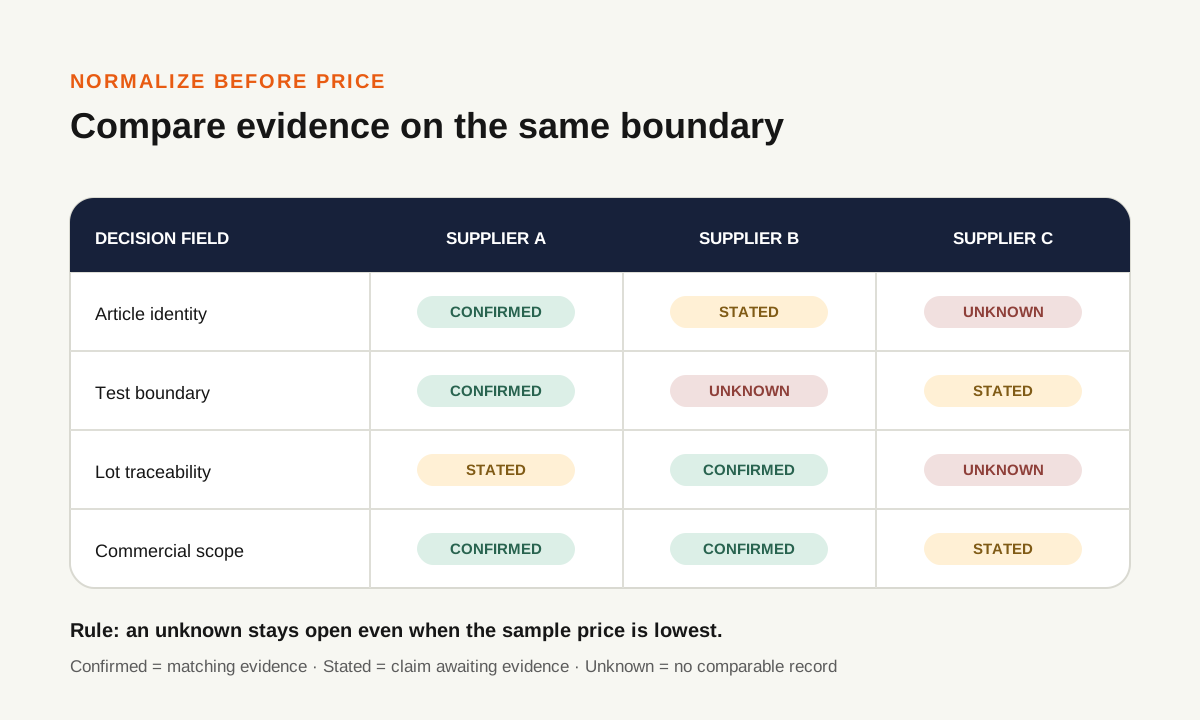
Create one row per supplier and do not score the row until the same fields are populated. Use three statuses: confirmed with matching evidence, stated but not yet evidenced, and unknown or not applicable. Keep engineering fit, evidence quality, sample readiness, logistics, and commercial terms separate; a weighted total can otherwise hide a critical unknown.
Compare price only after normalizing included hardware, tested capacity, usable energy boundary, sample quantity, fixtures, shipping terms, taxes, tooling, and support. If two offers use different cell maturity or test conditions, label them non-comparable and request clarification instead of forcing a ranking.
| Decision field | Evidence to record | Do not accept as equivalent |
|---|---|---|
| Article identity | Architecture, format, maturity, configuration ID | A broad “solid-state” label |
| Electrical fit | Window, rate, temperature, pressure and unit-level data | One best-case capacity or energy-density number |
| Traceability | Lot, line/date, sample-selection and change history | Unidentified showcase samples |
| Documents | Protocol, test summary, safety data and shipping configuration | Logo, badge or report title without scope |
| Commercial scope | Quantity, fixtures, tooling, Incoterms, lead time and support | Unit price with exclusions unstated |
Critical unknowns remain open issues even when a supplier has the lowest normalized price.
Use three gates: documents, samples, then pilot
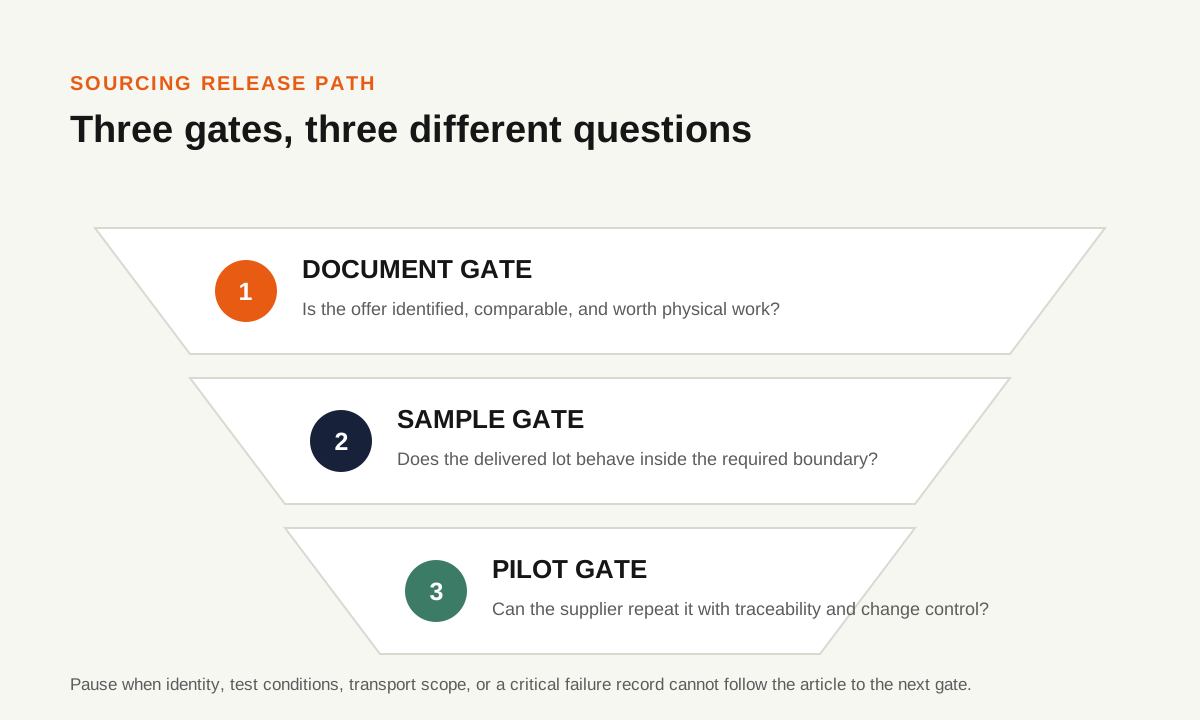
At the document gate, confirm that the offered article and evidence boundary match your application well enough to justify physical work. At the sample gate, inspect identity and dimensions, run a defined screening protocol, compare unit variation, record failures, and decide whether the design is worth a pilot. At the pilot gate, require representative process conditions, traceability, change control, incoming criteria, and a plan for application-level validation.
Stop or pause when the supplier cannot identify the shipped configuration, refuses to state test conditions, substitutes a different sample without disclosure, or treats a future roadmap as current availability. Escalate gaps that affect safety, transport, pack design, or irreversible tooling before issuing a purchase order.
Red flags that should pause a sample order
Pause when the product name changes between the quotation, data sheet, report, and shipping record; when energy density lacks a mass or volume boundary; when cycle life omits rate, temperature, pressure, cutoff, or retention criterion; or when a third-party report cannot be tied to the delivered configuration. The same applies when a sales claim describes all-solid-state technology but the technical team will not define the liquid, gel, or fixture boundary.
Commercial red flags include a production-scale promise supported only by hand-built samples, a short quote validity paired with no engineering-change terms, tooling charges before the mechanical interface is frozen, and a request to ship before transport documents are matched. None proves misconduct, but each creates an unresolved decision risk that belongs in the issue log.
Send one comparable inquiry
Your first message can be concise: identify the application and stage; state whether you need cells, a module, or material; attach the same requirements table used for every candidate; list the nine evidence requests; and ask the supplier to mark confirmed, requires review, or unavailable. Include the decision date and the next gate, not an artificial demand for immediate production pricing.
If your project may fit a semi-solid cell, review AntBattery's current product formats and submit a requirements-based request through the quote form. Provide voltage, capacity or energy, continuous and peak load, dimensions, temperature range, quantity, application, and any documentation needs. The engineering response should confirm the offered boundary before you treat it as a match.
FAQs
Can I buy an all-solid-state battery today?
Research cells, materials, development samples, and limited pilot articles may be available from some organizations, while application-ready commercial availability varies by format and requirement. Ask the supplier to identify the exact architecture, maturity, quantity, and evidence for the article it can ship now.
What is the difference between solid-state and semi-solid batteries when sourcing?
An all-solid-state claim and a semi-solid or hybrid architecture use different electrolyte and interface boundaries. Request the role of any liquid, gel, or composite phase, the cell construction, required pressure, and the configuration covered by the data before comparing them.
What documents should I request with battery samples?
Request a configuration identity sheet, drawings, electrical and environmental limits, test protocols and unit-level results, lot traceability, safety information, applicable transport test summary, packaging details, and written change-control terms. The exact compliance documents depend on the cell, battery, application, route, and destination.
How many battery samples should I order for evaluation?
There is no universal quantity. Build the count from incoming inspection, fixture development, screening, life or environmental tests, destructive work, failures, and retained witnesses. The sample plan should support the next decision without being mistaken for production qualification.
How do I compare two solid-state battery supplier quotes?
Normalize article identity, dimensions, electrical window, temperature and pressure, protocol, lot traceability, included hardware, sample quantity, tooling, shipping terms, lead time, and support. Mark missing evidence as unknown and avoid ranking non-comparable offers by unit price alone.
Sources and further reading
Related Blogs
Learn More About Battery
How to Verify Solid-State Battery Claims: A 10-Point Reality Check
Solid-State Battery Sample Shipping Checklist: Documents, Packaging and Handoff Evidence
Solid-State Battery for Drones: 3 Cell Tiers, 350–500 Wh/kg, and 7 Supplier Checks
Related Products
Related product
Prismatic Series
AB-100AH Semi Solid Prismatic Cell
- Energy Density
- 285 Wh/kg
- Nominal Voltage
- 3.65 V
Pouch Cell Series
AB-50AH Semi Solid Pouch Cell
- Energy Density
- 320 Wh/kg
- Nominal Voltage
- 3.7 V
Cylindrical Series
AB-21700 Semi Solid Cylindrical Cell
- Energy Density
- 300 Wh/kg
- Nominal Voltage
- 3.7 V