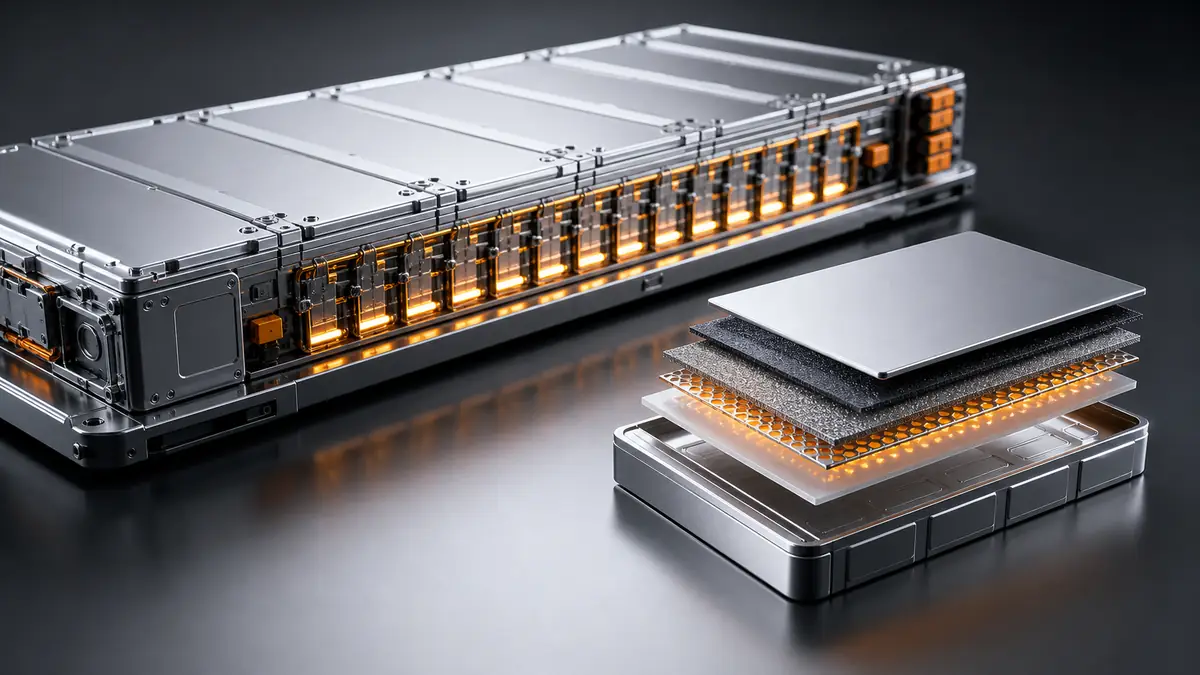
Short answer: theoretically yes — under specific conditions
Solid state batteries can charge faster than conventional lithium-ion cells in principle, and in lab demonstrations they often do. The reason is structural: liquid electrolytes degrade when forced to carry very high current densities, generating heat and irreversible reaction products that limit how fast a cell can safely accept charge. Solid electrolytes do not have this decomposition mechanism.
In practice, the speed advantage is not automatic. A different constraint — interface resistance — limits how fast lithium ions can move from the electrolyte into the electrode at solid-solid boundaries. Managing this interface is the central engineering challenge in solid state fast charging.
The most useful benchmark available today is semi-solid batteries, which use a partial solid electrolyte. These are in commercial production and have demonstrated 4C to 6C charging in real vehicles. Full solid state cells in the lab have shown comparable or better rates, but production-verified data at automotive cell sizes is still accumulating.
Why solid electrolytes enable faster charging in theory
In a conventional lithium-ion cell charged at high speed (high C-rate), several degradation mechanisms accelerate. The liquid electrolyte generates heat and byproducts from oxidation and reduction reactions at the electrodes. Lithium ions can plate metalically on the graphite anode surface if they arrive faster than they can intercalate — a process called lithium plating that causes irreversible capacity loss and, in extreme cases, short circuits.
Solid electrolytes are not subject to these liquid-phase degradation pathways. A ceramic electrolyte does not decompose under high current. It cannot catch fire or generate volatile byproducts. This removes what is effectively a thermal speed governor on charging rate.
The lithium metal anode used in many solid state designs also contributes. Lithium metal does not require intercalation into graphite layers — lithium ions arriving at the anode surface deposit directly as metal. Theoretically, this should allow faster charge acceptance than graphite, which has kinetic limits related to ion insertion and diffusion through the graphite lattice.
- No liquid electrolyte decomposition at high C-rates: removes the primary thermal limit on charging speed.
- No lithium plating on graphite: lithium metal anodes accept lithium deposition by design, eliminating a graphite-specific failure mode.
- Higher thermal stability: solid electrolytes can sustain higher temperatures without decomposing, giving thermal management more headroom.
- No electrolyte flammability: removes the safety threshold that limits liquid electrolyte charging speed.
The real bottleneck: interface resistance at high charge rates
The most important constraint on solid state fast charging is not the electrolyte itself — it is the interface between the solid electrolyte and the electrode. In a liquid electrolyte cell, the liquid conforms to the electrode surface, maintaining intimate contact as the electrode expands and contracts during cycling. In a solid state cell, two rigid materials must stay in contact under mechanical stress.
When a cell charges at high speed, lithium ions arrive at the electrolyte-anode interface faster than they can be uniformly distributed. If the interface contact is imperfect — even at a microscopic level — lithium can accumulate unevenly, creating local stress that causes delamination or, in the worst case, dendrite formation through micro-cracks in the electrolyte.
This interface resistance is temperature-dependent and gets worse at low temperatures. Most solid electrolytes have lower ionic conductivity at cold temperatures than warm liquid electrolytes, which compounds the interface challenge when charging in cold weather.
The engineering response has been to develop interface coating layers, use elevated stack pressure to maintain physical contact, and design intermediate semi-solid buffer layers between the electrode and the hard ceramic electrolyte. These approaches are working — but they add cost and manufacturing complexity.
Lab data: what C-rates have been demonstrated
C-rate describes how quickly a battery charges or discharges relative to its capacity. A 1C rate charges a battery in one hour. A 4C rate charges it in 15 minutes.
QuantumScape published results in 2021 and 2022 showing their lithium-metal anode / oxide electrolyte cells charging at 4C (15 minutes to 80%) with over 400 cycles retained. In 2023 follow-up data, they demonstrated continued improvement toward 1,000 cycles at 4C rates in automotive-format cells.
Samsung SDI has cited 9-minute charging targets for its 2027 solid state cells — approximately 6C to 7C — in technical presentations. Toyota has been less specific about fast-charging rate targets in public materials, emphasising energy density and safety over raw charge speed.
For context: most current production lithium-ion EV batteries are designed for 1C to 2.5C regular charging and thermally limited fast charging at the DC fast charger. Tesla's 4680 cell supports approximately 2.5C to 3C in Supercharger conditions. CATL's semi-solid Qilin battery supports 4C to 5C in the NIO ET9.
| Battery type | Max C-rate (fast charge) | Approx. 10–80% time | Status |
|---|---|---|---|
| Standard NMC lithium-ion | 1.5C–2.5C | 30–45 min | Commercial production |
| Tesla 4680 (NMC) | ~3C | ~20 min | Commercial production |
| CATL semi-solid Qilin (NIO ET9) | 4C–5C | 12–15 min | Commercial, limited volume |
| QuantumScape (oxide, lab) | 4C | ~15 min | Pre-production validation |
| Samsung SDI solid state (target) | 6C–7C | ~9–10 min | Target, 2027 production |
Lab and target figures are at cell level under controlled conditions. Pack-level performance is typically lower due to thermal management constraints.
Semi-solid batteries: what is already on the road
Semi-solid batteries occupy a practical middle ground. They use a gel-like or partially solid electrolyte that preserves some of the solid electrolyte's advantages — particularly reduced flammability and improved high-temperature stability — while maintaining better interface contact than a fully ceramic electrolyte.
CATL's semi-solid Qilin battery and its successor Shenxing Plus (2024) use this approach and have demonstrated 4C to 5C charging in production. The NIO ET9, delivered in China from early 2025, uses a CATL semi-solid pack that charges from near-empty to 80% in approximately 12 to 15 minutes at a compatible high-power charger.
CATL's 2024 Naxtra battery, which uses a sodium-ion/semi-solid architecture, achieved 4C charging in mass production. These are not full solid state, but they are the most direct real-world evidence of what solid electrolyte technology can deliver in charging speed when production-hardened.
Full solid state cells are expected to match or exceed these figures once interface engineering matures and manufacturing processes are validated at scale, targeting the late 2020s.
What to realistically expect in EVs by 2027–2030
The most credible near-term scenario is that solid state batteries in EVs will initially prioritise energy density and cycle life over maximum charging speed. The first commercial solid state EVs — from Toyota or Samsung SDI, targeting 2027–2028 — will likely ship with charging speeds comparable to the best current semi-solid batteries (4C to 5C) rather than the 6C to 7C targets that require the most advanced interface engineering.
The fast-charging headline will matter more as a differentiator once multiple solid state EVs are on the market. Early-production batteries that achieve 4C to 5C are already substantially faster than today's mass-market NMC cells, which is a meaningful consumer benefit even if the theoretical ceiling has not yet been reached.
Cold-weather fast charging will take longer to improve. The ionic conductivity challenge at low temperatures means early solid state EVs in cold climates may charge more slowly than the headline 4C rate without thermal preconditioning. Expect manufacturers to ship battery pre-heating software as a standard feature to address this, similar to how liquid electrolyte EVs manage cold-weather charging today.
The 9-minute charging target cited by Samsung SDI and others represents a future state that requires both production-quality cells and compatible high-power charging infrastructure above 500 kW. The charging network, not just the battery, is part of the full fast-charging equation.
FAQs
How fast can solid state batteries charge?
In lab conditions, solid state cells have demonstrated 4C charging (approximately 15 minutes to 80%) with sustained cycle performance. Samsung SDI targets 6C to 7C (approximately 9 minutes) for its planned 2027 production cells. Semi-solid batteries already in commercial vehicles (CATL Qilin, NIO ET9) are achieving 4C to 5C in real-world conditions.
Do solid state batteries charge faster than lithium-ion?
Compared to conventional NMC lithium-ion batteries (which typically support 1.5C to 2.5C in regular fast charging), solid state and semi-solid batteries demonstrate meaningfully faster rates in both lab and production settings. Compared to the fastest current production cells (Tesla 4680 at ~3C, CATL Kirin at 4–5C), the gap is smaller and depends on the specific solid state design.
What is C-rate and how does it relate to charging time?
C-rate is a measure of how quickly a battery is charged or discharged relative to its capacity. 1C means the battery is fully charged in one hour. 2C means 30 minutes. 4C means 15 minutes. 6C means 10 minutes. The practical charging time from 10% to 80% is typically faster than the headline C-rate implies because most fast chargers taper down from peak rate as the battery approaches 80% state of charge.
Are semi-solid batteries faster to charge than regular lithium-ion?
Yes. CATL's semi-solid Qilin battery in the NIO ET9 charges from near-depleted to 80% in approximately 12 to 15 minutes at a compatible high-power charger, versus 25 to 35 minutes for most mainstream NMC lithium-ion EVs. This is one of the most tangible real-world benefits of semi-solid electrolyte design already demonstrated in production.
Does cold weather slow solid state battery charging?
Yes, more than it affects liquid electrolyte cells in current designs. Solid electrolytes have higher ionic resistance at low temperatures, which reduces the maximum safe charging rate when the battery is cold. Manufacturers plan to address this with battery pre-heating systems that warm the pack to optimal temperature before fast charging begins. The same general approach used in liquid electrolyte EVs today will apply, though the temperature management requirements may be stricter.
Sources and further reading
- QuantumScape 2022 data: 4C fast charging with >80% retention over 400 cycles in automotive-format cell
- Nature Energy 2022: Interface resistance in solid state batteries — mechanisms and engineering approaches
- CATL Qilin battery fast-charge technical specifications — 4C, 12-minute charging
- Samsung SDI solid state battery roadmap: 9-minute charging target for 2027 production
- Journal of The Electrochemical Society 2023: Ionic conductivity of solid electrolytes at sub-zero temperatures
Related Blogs
Learn More About Battery
Related Products
Related product
Pouch Cell Series
AB-50AH Semi Solid Pouch Cell
- Energy Density
- 320 Wh/kg
- Nominal Voltage
- 3.7 V
Prismatic Series
AB-100AH Semi Solid Prismatic Cell
- Energy Density
- 285 Wh/kg
- Nominal Voltage
- 3.65 V
Cylindrical Series
AB-21700 Semi Solid Cylindrical Cell
- Energy Density
- 300 Wh/kg
- Nominal Voltage
- 3.7 V