The short answer: semi-solid is a manufacturing bridge
A semi solid state battery uses more immobilized or solid electrolyte than a conventional liquid-electrolyte cell but still retains a liquid, gel, or wetting phase. That phase can help ions move across electrode interfaces and can reduce the solid-solid contact problem that complicates all-solid-state cells. The label alone does not define one chemistry, one liquid percentage, or one safety level.
This matters for EV timing because manufacturers may be able to keep parts of existing electrode coating, filling, formation, and pack integration while changing the electrolyte and separator system step by step. All-solid-state designs often demand new powder handling, thin solid-electrolyte layers, interface coatings, densification, and pressure control at once.
The practical conclusion is not that semi-solid is “better.” It is that a staged process change can be easier to industrialize than a complete architecture change. The buyer still needs comparable cell and pack evidence.
- Classify the cell: request electrolyte composition, liquid or gel fraction, separator structure, and anode/cathode design.
- Define the boundary: keep semi-solid, quasi-solid, gel, hybrid, and all-solid terms tied to the actual ion-conducting phases.
- Compare evidence: use the same cell format, temperature, rate, pressure, cycle window, and reporting boundary.
Semi-solid and all-solid-state cells solve the interface differently
Lithium ions must cross several interfaces during every charge and discharge. A liquid can wet rough, porous electrodes and maintain contact as materials expand and contract. A rigid solid electrolyte cannot flow into a newly formed gap. Softer sulfides and polymers improve contact, but chemistry, pressure, and mechanical change still affect resistance.
Semi-solid designs use a limited mobile or gelled phase to preserve some wetting. All-solid-state designs instead rely on engineered solid contact, coatings, compliant layers, pressure, or composite electrolytes. The electrolyte-family comparison explains why sulfide, oxide, and polymer routes create different constraints.
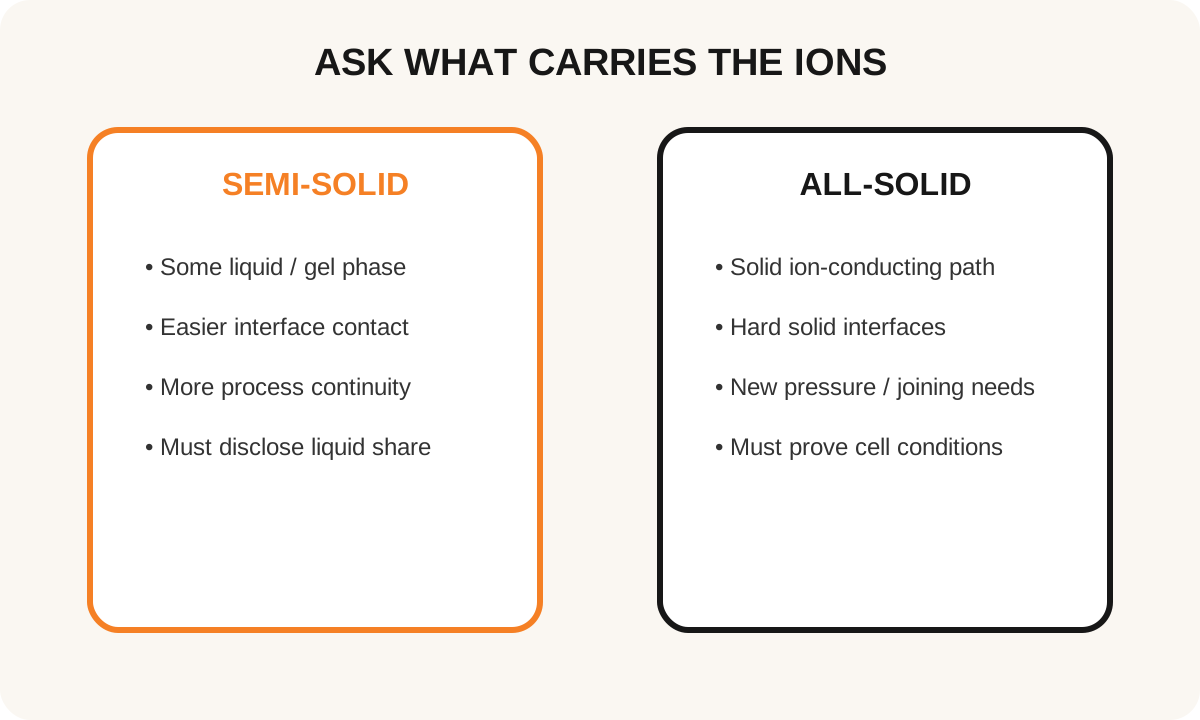
| Decision factor | Semi-solid / quasi-solid route | All-solid-state route |
|---|---|---|
| Ion-conducting phase | Solid or immobilized phase plus disclosed liquid/gel contribution | Solid electrolyte provides the intended continuous path |
| Interface contact | Residual wetting can reduce initial contact resistance | Contact must be engineered through layers, surfaces, pressure, or compliance |
| Process continuity | May reuse more liquid-cell equipment and controls | Often needs new handling, densification, joining, and inspection |
| Claim risk | Liquid fraction and naming may be unclear | Laboratory pressure, thickness, and scale may be hidden |
| Buyer evidence | Composition, liquid fraction, leakage/abuse tests, cell and pack data | Electrolyte family, pressure, layer thickness, cell format, yield and pack data |
These are architecture tendencies, not universal performance results. Exact designs can overlap.
Why the route may reach EV production earlier
A factory improves a process by controlling transfers between steps. Semi-solid approaches can sometimes preserve established current collectors, electrode coating, calendering, winding or stacking, formation, diagnostics, and pack electronics. Reusing qualified equipment and control plans can reduce the number of simultaneous unknowns.
The remaining electrolyte can also make large-area contact less sensitive to microscopic roughness. That does not remove new work: the factory must control liquid distribution, immobilization, leakage, gas generation, ageing, moisture, filling or in-situ curing, and consistency across a production-width electrode.
Commercial readiness should therefore be described by demonstrated line scale, repeatability, yield, traceability, and pack qualification—not by a prototype vehicle announcement. Use our 10-point claim-verification guide to separate a material result from production evidence.
Safety and energy claims need a declared test boundary
Reducing free liquid may reduce leakage or flammable-solvent exposure in some designs. But battery safety also depends on cathode oxygen release, lithium plating, internal shorts, separators, current interruption, thermal propagation barriers, cooling, controls, manufacturing defects, and pack design. A safer electrolyte does not automatically make a safe vehicle pack.
Energy-density claims can also move when the boundary changes. A thin laboratory separator and excess lithium may look strong at material or coin-cell level. The useful figure for an EV buyer must count current collectors, tabs, enclosure, pressure hardware, cooling, electronics, and the usable state-of-charge window. Ask whether a number is material, electrode, cell, module, or pack level.
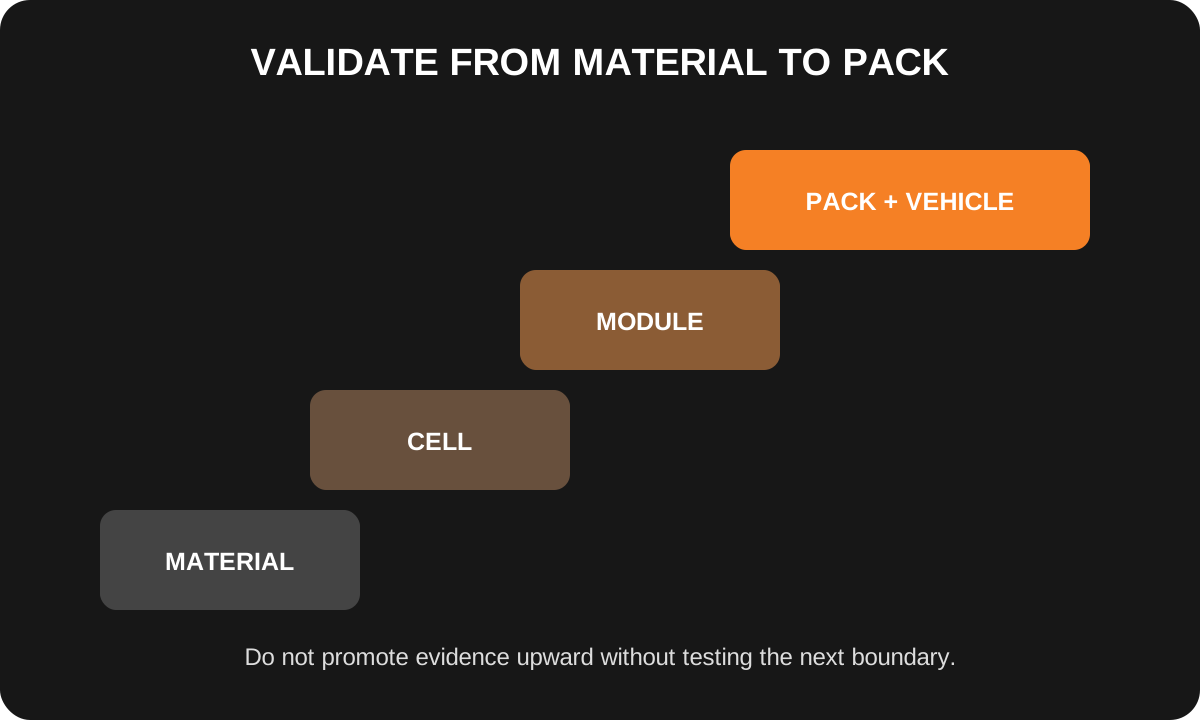
A five-step supplier validation path
Start with architecture disclosure, then move through comparable samples, controlled cell testing, module integration, and pack or vehicle validation. Each stage should have written entry criteria, test conditions, acceptance limits, exception handling, and retained raw data.
For samples, record cell format, capacity, electrode loading, electrolyte quantity, temperature, pressure, charge/discharge rate, voltage window, rest periods, cycle definition, repetitions, and failures. For modules and packs, add thermal gradients, mechanical support, sensing, fault response, propagation tests, service strategy, and warranty assumptions.
- Architecture: identify every electrolyte phase and its function.
- Cell: compare matched formats under the intended operating window.
- Manufacturing: review atmosphere, coating/filling/curing, traceability, yield, and rework.
- Module: test electrical, mechanical, and thermal interactions.
- Pack/vehicle: verify abuse response, controls, durability, charging, service, and regulatory evidence.
What the label can and cannot tell a buyer
“Semi-solid-state” can signal a useful development direction, but it cannot tell you the liquid content, chemistry, safety result, energy density, cycle life, fast-charge capability, production yield, or delivery date. Those need separate evidence. The Chemical Reviews survey of semi-solid and solid electrolytes shows how widely materials and device types vary.
For a sourcing or development decision, turn every headline into a testable field. Ask what changed from the previous liquid cell, what equipment was retained, which failure modes were added, what has been tested independently, and what remains at prototype scale. That produces a roadmap instead of a label debate.
FAQs
What is a semi solid state battery?
It is a battery that combines a solid or immobilized electrolyte structure with a remaining liquid, gel, or mobile ion-conducting phase. The exact architecture and liquid fraction must be disclosed.
Is a semi-solid battery the same as an all-solid-state battery?
No. An all-solid-state design intends the ion-conducting path to be solid, while a semi-solid design retains a non-fully-solid contribution.
Are semi-solid-state batteries safer?
Some designs may reduce leakage or flammable-liquid exposure, but safety must be demonstrated at cell and pack level under declared abuse tests.
Why might semi-solid batteries enter EVs sooner?
They may preserve more familiar production steps and improve interface wetting, reducing the number of simultaneous scale-up changes. Readiness still depends on yield and pack validation.
What should a buyer request?
Request architecture, liquid fraction, cell conditions, safety and cycle reports, production controls, yield boundary, pack validation, warranty, and unit traceability.
Sources and further reading
Related Blogs
Learn More About Battery
Related Products
Related product
Pouch Cell Series
AB-72AH Long-Range Pouch Cell
- Energy Density
- 335 Wh/kg
- Nominal Voltage
- 3.72 V
Prismatic Series
AB-100AH Semi Solid Prismatic Cell
- Energy Density
- 285 Wh/kg
- Nominal Voltage
- 3.65 V
Cylindrical Series
AB-21700 Semi Solid Cylindrical Cell
- Energy Density
- 300 Wh/kg
- Nominal Voltage
- 3.7 V