Define the decision and the quantity being measured
State whether the test screens abnormal cells, compares candidate materials, estimates short-term retention, investigates an internal leakage mechanism or supplies input to a storage model. These decisions do not share one universal duration or pass limit.
A 2026 Nature Energy analytical model of solid-state battery self-discharge (Alt and Janek) describes reversible internal self-discharge as arising from residual electronic conductivity and a chemical-potential gradient across the solid separator, distinct from irreversible degradation; a companion 2026 Nature Energy study attributes this physical self-discharge to the electronic conductivity of the solid electrolyte and reports that it is largely recovered on recharge, unlike chemical self-discharge that consumes lithium inventory irreversibly. These are analytical and abstract-level findings, not a product test. A retention result alone should not be labelled calendar life, shelf life or permanent capacity loss without the measurements needed for that conclusion.
Choose the reported quantity before testing: recovered capacity or energy, open-circuit voltage behavior, internal current inferred by an approved method, coulombic balance, or another defined metric. Record formula, units, reference capacity and uncertainty.
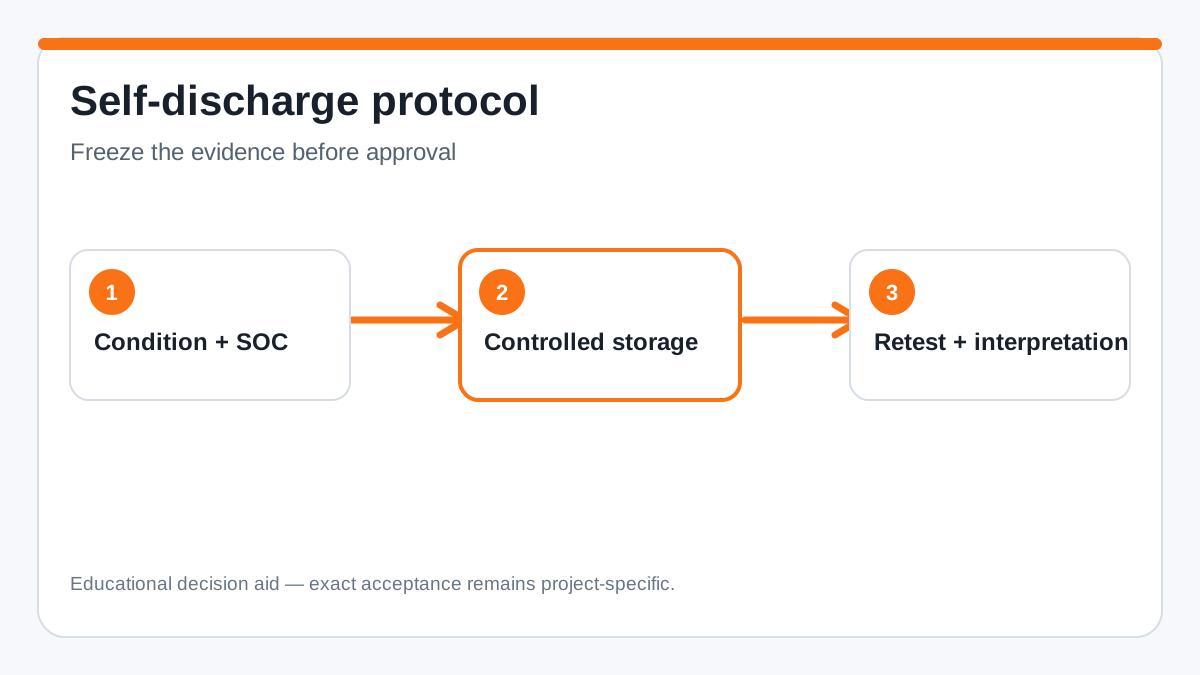
Freeze sample identity, fixture and initial condition
Assign every specimen a unique ID linked to material lot, electrode and separator description at the approved disclosure level, format, dimensions, nominal capacity, fabrication and formation history, storage history and visible condition. Quarantine compromised or untraceable samples.
For pressure-sensitive solid-state formats, record fixture geometry, loading history, contact area, applied force or pressure, control mode and whether the fixture remains engaged during storage. Do not transfer one pressure condition across architectures.
Define the initial SOC using a controlled charge or discharge sequence, voltage and current limits, temperature, taper or cutoff logic and rest. A nominal SOC label without its conditioning route is not enough for comparison.
Control storage temperature, time and monitoring load
Temperature can change electronic leakage and parasitic reactions. Calibrated self-discharge measurements on lithium-ion cells show an Arrhenius temperature dependence, and P2D storage-degradation modelling of lithium iron phosphate cells reports that elevated temperature and high state of charge together accelerate parasitic interface reactions and capacity loss. Those studies use liquid-electrolyte cells and one is a simulation, so they support controlling and recording temperature and state of charge; they do not create one universal storage temperature for solid-state cells.
Record chamber setpoint and measured range, sensor location, stabilization time, storage duration, atmosphere when relevant, fixture state and sample orientation. Store comparator groups together or use an approved method that accounts for chamber differences.
Any logger, voltage monitor or safety circuit can draw current. Record the instrument, input impedance, sampling interval, lead configuration, calibration and whether measurements are continuous or periodic. Run an equipment or fixture control when leakage through the measurement chain could affect the result.
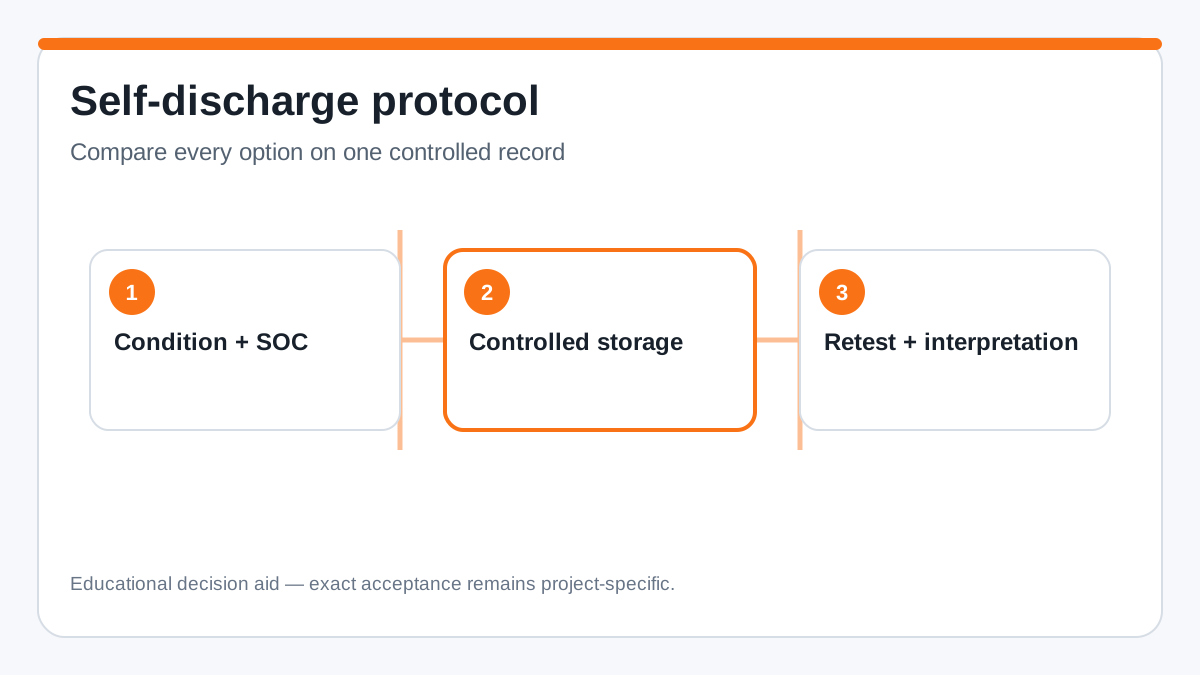
Use a retest sequence that can recover the retained charge
At the end of storage, define equilibration, inspection, fixture check, voltage measurement and the exact discharge or charge-discharge sequence used to quantify retained capacity or energy. Use the same temperature, limits, rest and normalization basis as the approved protocol.
Open-circuit voltage alone may be an insensitive state-of-charge indicator for some chemistries and ranges, and calibrated direct-current self-discharge methods were developed in part because a voltage-drop reading resolves small internal currents poorly. If OCV is monitored, state what it can and cannot prove and pair it with the selected capacity, energy or current evidence.
Preserve raw time series and individual specimens. Report interruptions, chamber excursions, contact changes, swelling, short-circuit indications and safety stops. Do not replace a failed or interrupted specimen silently.
Separate self-discharge from irreversible loss
A lower recovered capacity after storage can include reversible charge redistribution, internal electronic leakage, parasitic reactions, lithium inventory loss, contact change, fixture drift or test-system error. Build diagnostic branches instead of forcing one cause from the headline number.
When the decision matters, compare immediate recovered capacity with subsequent controlled cycles, impedance or other approved diagnostics. Define which evidence supports reversible loss, irreversible fade, abnormal leakage or not-comparable status. Mechanistic claims require method-specific evidence.
Do not describe a short storage experiment as a life guarantee. Sample count, variability, temperature range and duration limit the inference.
Write accept, retest, reject and not-comparable rules
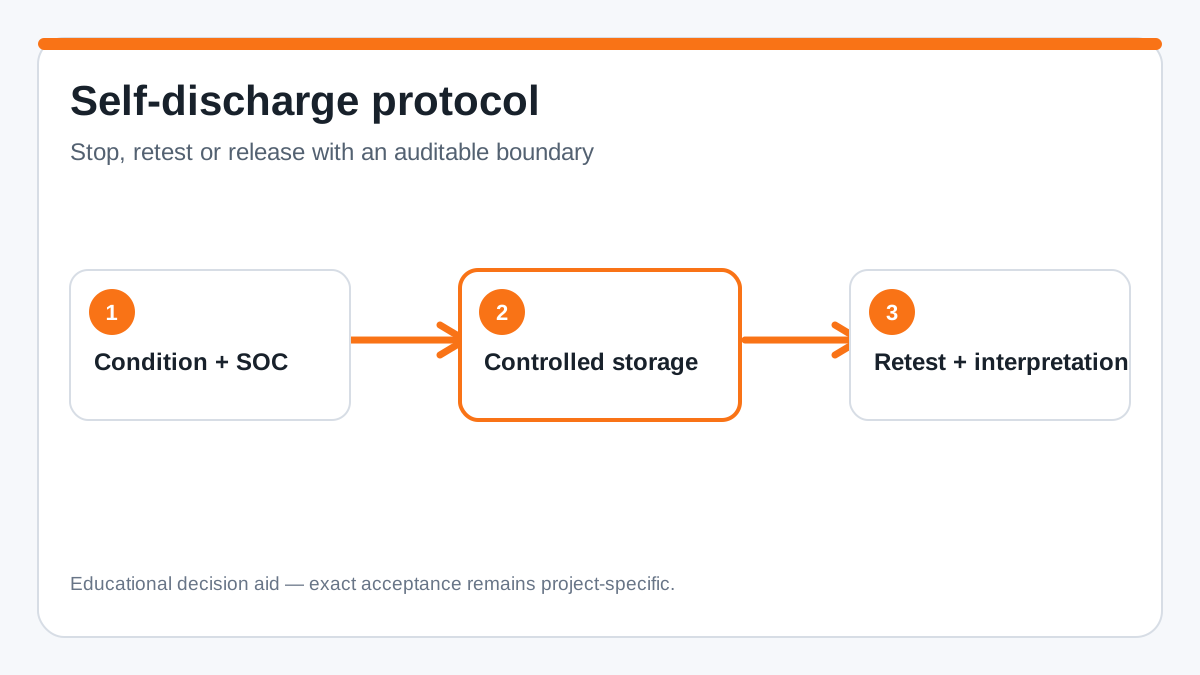
Accept only when identity, conditioning, storage, monitoring and retest all meet the protocol and the selected metric satisfies the project criterion. Retest only for a predeclared recoverable event, such as a documented equipment interruption or insufficient valid specimens; keep the original result.
Reject a valid result that fails the agreed criterion or a sample that violates an identity or safety requirement. Use not comparable when changed SOC, temperature, duration, fixture, instrument load or retest conditions prevent the intended comparison.
Prepare the technical inquiry
Provide the cell architecture, test decision, sample IDs and count, initial conditioning, SOC definition, fixture or pressure method, temperature and duration, monitoring circuit, retest sequence, calculation, controls, raw-data format and decision rules.
Review the battery product families, then use the technical contact path to align sample format and evidence. AntBattery can discuss a project-specific protocol, but no cross-chemistry self-discharge limit is implied.
FAQs
What is self-discharge in a solid-state battery?
It is loss of stored charge while the cell is not supplying an external load. The mechanism and reversibility depend on the cell, separator, interfaces and conditions, so the test must distinguish it from degradation and equipment leakage.
Can open-circuit voltage measure self-discharge by itself?
Not reliably for every chemistry and SOC range. Define the OCV interpretation and use the approved retained-capacity, energy or current method when the decision requires it.
Which storage temperature should be used?
Use temperatures justified by the application and test objective. Control and record them precisely; do not copy one value or acceleration factor across cell designs.
Should stack pressure stay applied during storage?
That depends on the cell architecture and decision. Freeze the fixture, pressure basis, control mode and storage state, because changing them can change contact and the measured result.
How long should a self-discharge test run?
There is no universal duration. Choose a period that resolves the expected signal with acceptable uncertainty and supports the intended decision, while recording what longer-term behavior remains untested.
When is a result not comparable?
Use not comparable when sample identity, SOC, temperature, duration, fixture, monitoring load, retest sequence or calculation differs enough that the intended comparison is no longer valid.
Sources and further reading
- Alt & Janek, Nature Energy 11, 780–785 (2026) — Quantifying the self-discharge rate of solid-state batteries (abstract consulted; full text paywalled)
- Nature Energy (2026) — Electronic conductivity of solid electrolytes causes physical self-discharge in all-solid-state batteries (abstract and summary consulted; full text paywalled)
- Al-Zubaidi R-Smith et al., Energy Reports 9, 3394–3401 (2023) — Fast method for calibrated self-discharge measurement of lithium-ion batteries including temperature effects (liquid-electrolyte cells)
- RSC Advances 15 (2025) — Impact of temperature and state-of-charge on long-term storage degradation in lithium-ion batteries (open access; LFP/graphite P2D simulation)
Related Blogs
Learn More About Battery
How to Evaluate Solid-State Battery Samples: Test Scope, Controls and Comparable Evidence
Where to Buy Solid-State Batteries: 9 RFQ Checks Before You Request Samples
How to Verify Solid-State Battery Claims: A 10-Point Reality Check
Related Products
Related product
Prismatic Series
AB-100AH Semi Solid Prismatic Cell
- Energy Density
- 285 Wh/kg
- Nominal Voltage
- 3.65 V
Cylindrical Series
AB-21700 Semi Solid Cylindrical Cell
- Energy Density
- 300 Wh/kg
- Nominal Voltage
- 3.7 V
Pouch Cell Series
AB-50AH Semi Solid Pouch Cell
- Energy Density
- 320 Wh/kg
- Nominal Voltage
- 3.7 V