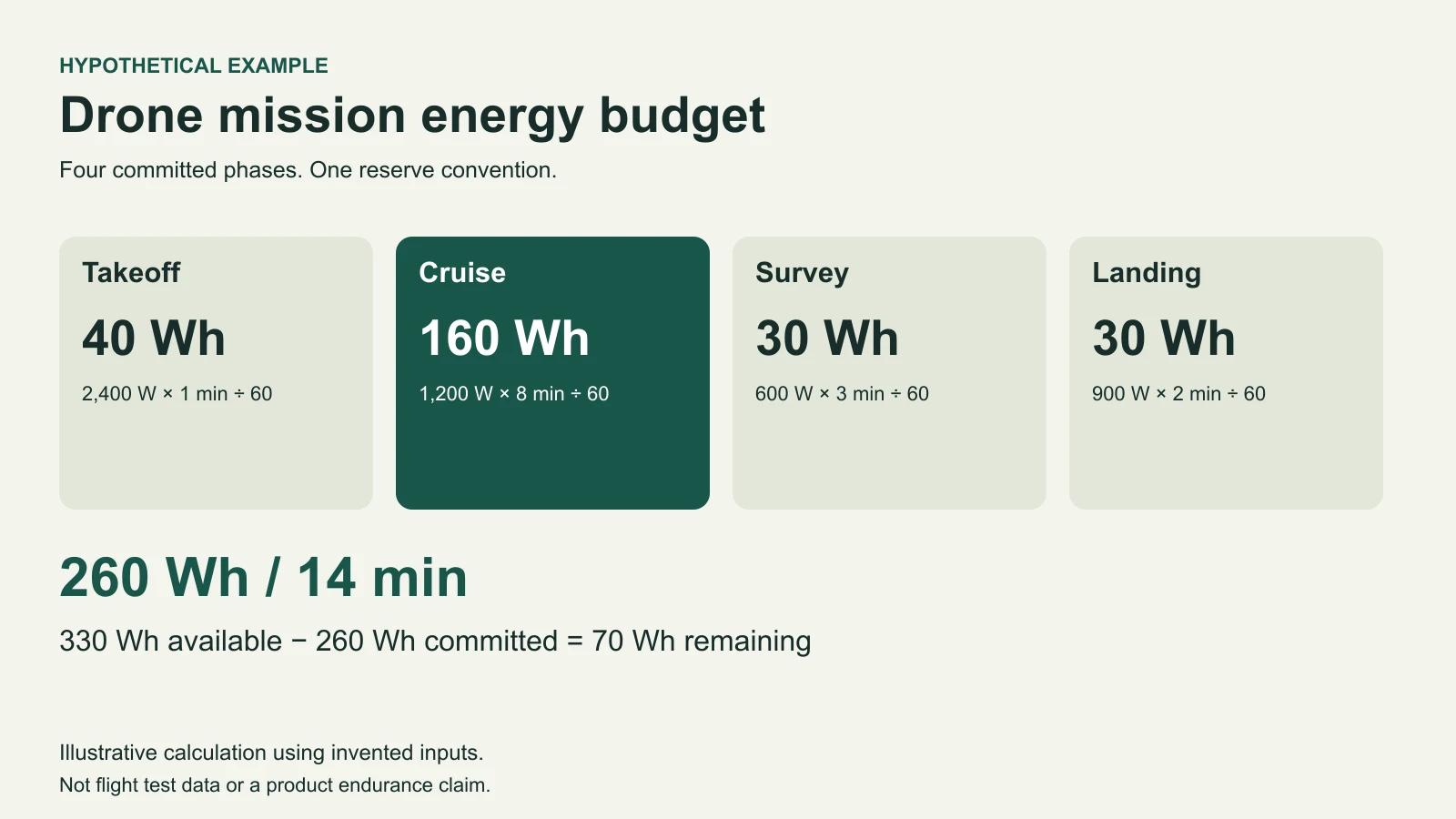
Choose the power and energy inputs
Start with an energy allowance in watt-hours (Wh), plus a power and time record for each phase. A watt-hour measures energy. A watt (W) measures how quickly that energy is being used. Use an allowance established for the relevant battery, aircraft, load and conditions. This article takes that allowance as an input; it does not establish it from a pack label.
Write down whether the allowance already excludes reserve. Here, the mission-available allowance is 330 Wh, with reserve already excluded. This is an invented input for the example, not a recommended limit or a battery specification.
Use the same measurement boundary throughout. Battery-side power means electrical power leaving the battery toward the aircraft. It differs from motor shaft power or useful lift power. Check whether the record includes the payload and other relevant onboard loads. Mixing battery-side and motor-side numbers will not produce a consistent ledger.
When voltage and current vary, calculate power from samples recorded at the same time and account for their durations. Separate averages can give a different answer. Two invented equal-duration samples of 40 V at 10 A and 30 V at 20 A give 400 W and 600 W, averaging 500 W. Multiplying their separate averages, 35 V and 15 A, gives 525 W instead.
For a phase summary, use power averaged over that phase's time. If your log already reports phase energy at the correct boundary, keep its method and units. When the underlying battery evidence remains unclear, compare the evidence behind a UAV battery quotation before treating the energy allowance as settled.
A four-phase mission energy example
Phase energy (Wh) = average phase power (W) × phase time (minutes) ÷ 60.
This invented mission has four accounting blocks: takeoff, cruise, survey and landing. These labels do not prescribe a flight sequence. Each power value is the assumed time average for that block.
| Phase | Average battery-side power | Duration | Calculation | Energy |
|---|---|---|---|---|
| Takeoff | 2,400 W | 1 min | 2,400 × 1 ÷ 60 | 40 Wh |
| Cruise | 1,200 W | 8 min | 1,200 × 8 ÷ 60 | 160 Wh |
| Survey | 600 W | 3 min | 600 × 3 ÷ 60 | 30 Wh |
| Landing | 900 W | 2 min | 900 × 2 ÷ 60 | 30 Wh |
| Total | — | 14 min | 40 + 160 + 30 + 30 | 260 Wh |
Illustrative assumptions only. These are not recorded flight data, typical power requirements, or product test results.
Scroll the diagram horizontally to read every label.
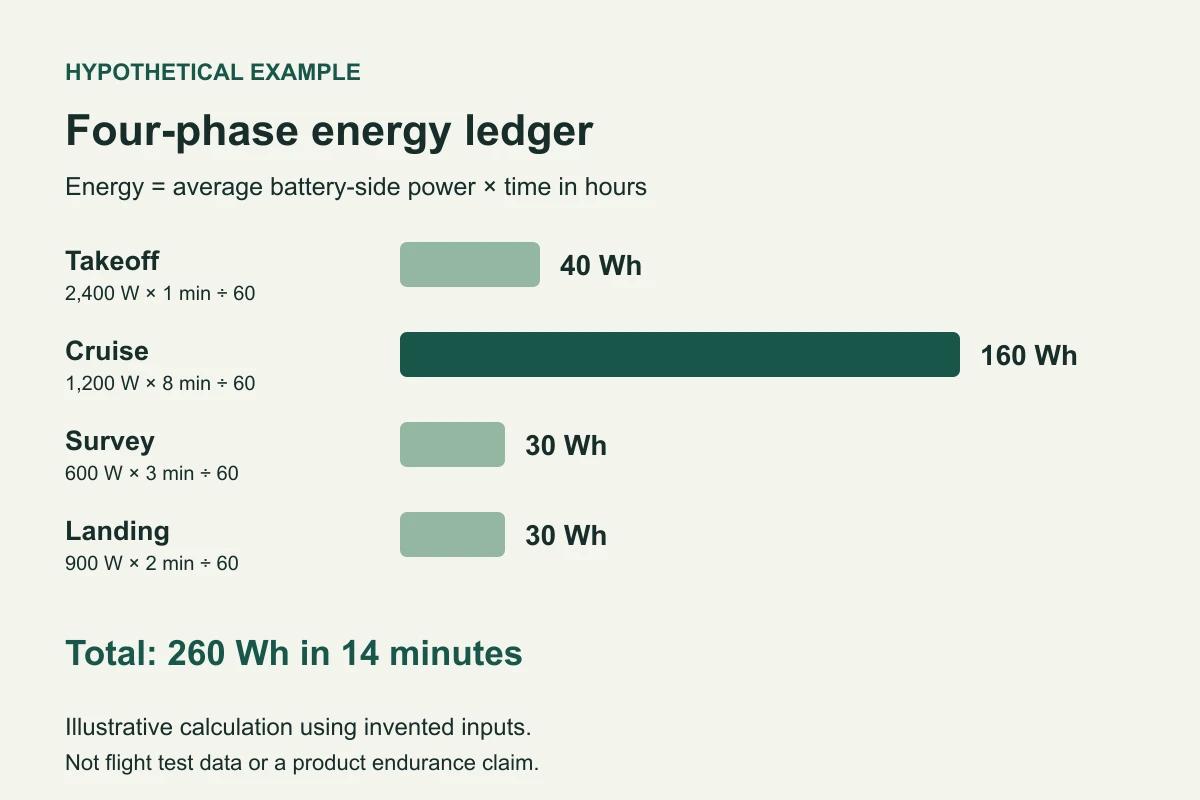
Cruise uses the most energy here because it lasts eight minutes. Takeoff uses twice the cruise power, but only for one minute. Power values alone would miss that difference.
The mission's mean power must account for time:
Mission mean power = 260 Wh ÷ (14 ÷ 60 hours) = about 1,114.3 W.
A simple average of the four power values is 1,275 W. That would be correct if all four phases had equal durations. They do not. The time-weighted result gives a cross-check: about 1,114.3 W multiplied by 14/60 hours returns about 260 Wh, allowing for rounding.
Count reserve once
Keep reserve handling beside the energy input. These two descriptions can represent the same hypothetical allowance:
| How the energy input is described | Reserve treatment | Mission-available energy |
|---|---|---|
| 360 Wh before a separately chosen 30 Wh reserve | Subtract 30 Wh once | 330 Wh |
| 330 Wh after that reserve has already been excluded | Do not subtract it again | 330 Wh |
The 360 Wh and 30 Wh values illustrate bookkeeping only. No reserve value or universal percentage is recommended here. Appropriate reserve and operating limits require the aircraft operator's applicable process and evidence.
Scroll the diagram horizontally to read every label.
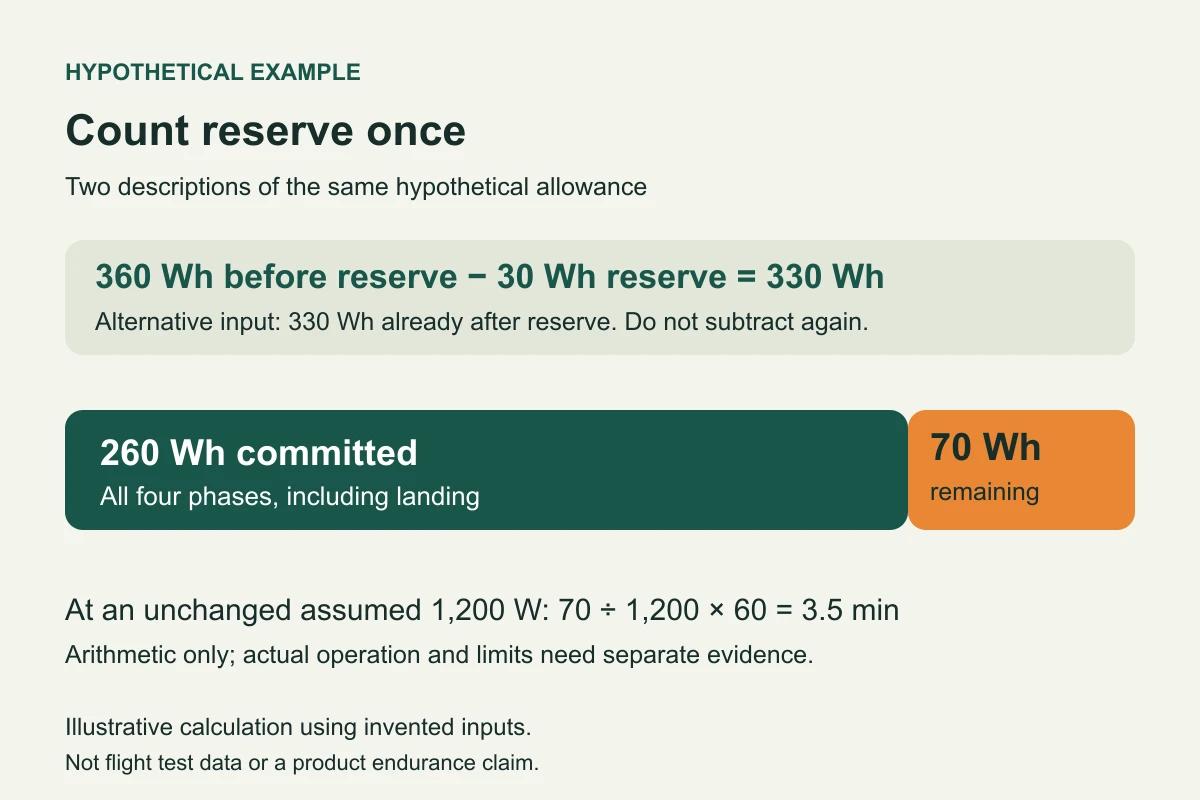
This example uses the second input description. Subtracting another 30 Wh from its 330 Wh would count the same reserve twice. Starting with an allowance that still includes reserve and treating it all as mission energy would leave reserve out of the ledger.
Calculate the energy left for one phase
The four planned phases require 260 Wh. Against the stated 330 Wh mission allowance:
Remaining energy = 330 Wh − 260 Wh = 70 Wh.
Landing is already included in the 260 Wh. Keep all committed phases in the ledger before asking how much energy remains for an extra task. Omitting a later phase would make the remaining amount look larger than the example supports.
Suppose the only change is additional cruise at the same assumed 1,200 W:
Extra cruise time = 70 Wh ÷ 1,200 W × 60 = 3.5 minutes.
This result depends on the stated assumptions. It does not show that the aircraft can safely add 3.5 minutes or return from a particular location. If extra cruise changes the route, landing needs, payload operation or power demand, update those commitments and recalculate the whole budget.
A negative balance means the stated allowance does not cover the stated phases. Record the shortfall. Do not drop landing or change reserve silently to make it fit. Revise an input only when there is a documented reason.
What this budget cannot establish
An energy ledger does not establish peak or continuous current capability, voltage or temperature limits, mechanical fit, aircraft compatibility or operational approval. A battery can have enough stated Wh for the arithmetic while another requirement remains unresolved. The battery current and C-rate limits need a separate check.
A research overview of UAV energy-consumption models discusses different models and their assumptions. It supports treating estimates as condition dependent. It does not validate this example's invented power values or any AntBattery pack's endurance.
Keep the aircraft and configuration, payload, relevant conditions, power source, measurement boundary, phase times, energy allowance and reserve convention with the worksheet. Distinguish measured inputs from planned assumptions. When an input changes, update the affected phases before comparing budgets.
Carry the worksheet into a configuration enquiry
Use the completed ledger to explain the mission's energy requirement. Keep phase power, duration and reserve handling with the aircraft's voltage, current, space, mass and interface constraints. This makes the basis of the request easier to review than a flight-time target alone.
For an AntBattery configuration enquiry, start with UAV battery-pack configurations and request evidence for the exact pack under discussion. The worksheet is supporting information. Compatibility, availability and performance still need confirmation for that configuration.
FAQs
Can I average the four phase power numbers?
Use a time-weighted mean when phase durations differ. Divide this example's total 260 Wh by 14/60 hours to get about 1,114.3 W. The simple average of 1,275 W does not describe the mission because the phases have different durations.
Do I subtract reserve again from 330 Wh?
No. The example defines 330 Wh as the mission allowance after reserve has already been excluded. If your own supplied value still includes reserve, state and subtract the chosen allowance once before using it as the mission budget.
Can I multiply average voltage by average current?
That can differ from average electrical power when voltage and current vary together. Use synchronized voltage/current samples with their time intervals, or a suitable battery-side power or energy record. Keep the measurement method with the worksheet.
Does the extra 3.5 minutes prove the aircraft can fly longer?
No. It divides a hypothetical 70 Wh balance by an assumed constant 1,200 W. The original four phases remain committed, but the calculation does not validate the energy input, actual power demand, route, battery limits or aircraft operation.
Sources and research limits
- Original four-phase arithmetic and synchronized-sample counterexample: the calculation worksheet shown above. All example inputs are hypothetical; no flight tests or company experience are claimed.
- Research overview: https://arxiv.org/html/2206.10775v2, retrieved 2026-10-24. Used only for condition-dependent model context.
- No product price, performance uplift, universal reserve or guaranteed duration is asserted by the example.