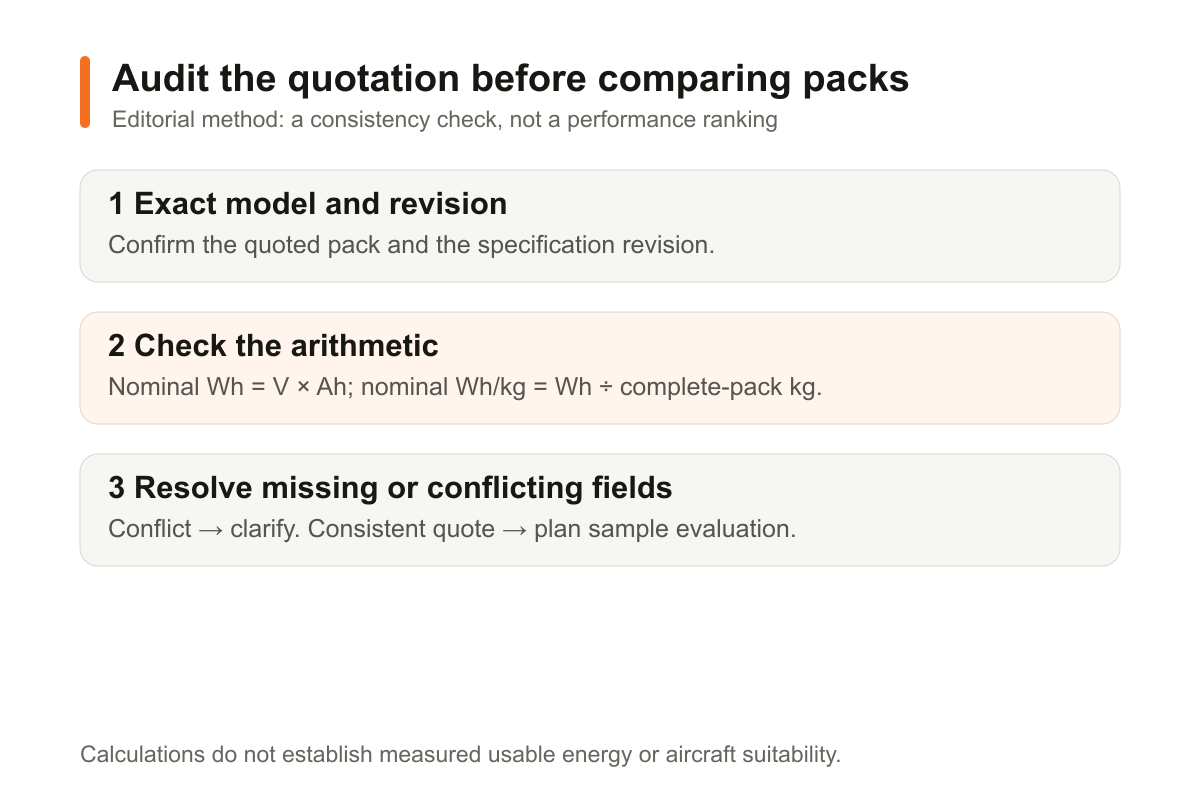
This guide uses published supplier specifications and transparent calculations to show that process. The examples are quote checks, not flight tests or evidence that one battery technology will outperform another on your UAV.
Define the Two Packs You Are Comparing
Start with a model number and datasheet revision for each candidate. “Conventional LiPo” and “semi-solid” are useful buying labels, but they do not define two fully separate categories. Tattu, for example, uses both “semi-solid” and “LiPo” in the name of one pack. Do not read “semi-solid” as “all-solid-state,” or assume that two packs with the same series count share charging limits.
Keep the chemistry background brief when comparing quotes. The solid-state and semi-solid UAV battery background covers technology maturity and broader supplier checks. Here, the question is narrower: does each quoted pack have enough documented information to enter your project's sample evaluation?
Write one common comparison brief before opening the supplier tables:
- The aircraft's allowed battery voltage window, including the lowest acceptable loaded voltage.
- The required mission, payload and current profile.
- The available battery space and maximum installed battery mass.
- The charger, connector, wiring, BMS and communication requirements.
- The reserve policy and the conditions a sample must meet.
Use the same mass boundary for both candidates. If one quote excludes leads, mounting hardware or required electronics, ask for the installed total before comparing its Wh/kg with a complete pack.
Audit Each Quote Before Calculating a Winner
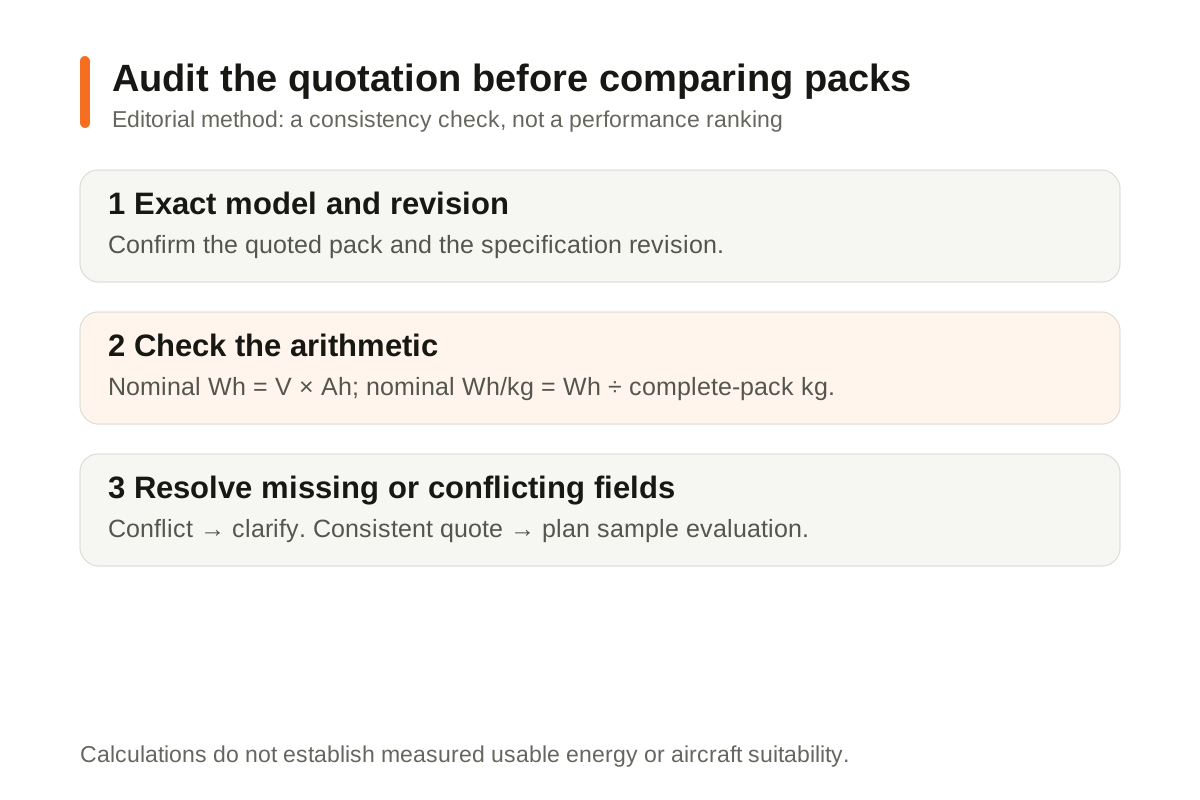
Two simple calculations catch inconsistent inputs:
Nominal energy (Wh) = nominal voltage (V) × capacity (Ah)
Nominal specific energy (Wh/kg) = nominal energy (Wh) ÷ complete-pack mass (kg)
These formulas check the quoted numbers. They do not tell you how much energy remains usable at your mission load, temperature and cutoff.
The supplier pages below were checked on October 18, 2026. Confirm the current model revision before using their numbers in an order.
| Quote-check input | Tattu conventional LiPo example | Tattu semi-solid example |
|---|---|---|
| Exact model | TAA220006S30X | TAA280006S5X9S |
| Published capacity | 22 Ah | 28 Ah |
| Published nominal voltage | 22.2 V | 22.2 V in title/table; 22.8 V in prose |
| Published net mass | 2.460 kg | 2.500 kg |
| Published C-rating | 30C | 5C |
| Energy calculation | 22 × 22.2 = 488.4 Wh | 621.6 Wh if 22.2 V; 638.4 Wh if 22.8 V |
| Procurement action | Confirm the quoted revision and test conditions | Request a corrected, revision-specific datasheet |
The Tattu 22 Ah 6S 30C specification gives the first pack's inputs. Dividing 488.4 Wh by 2.460 kg gives about 198.54 Wh/kg, calculated from the manufacturer's nominal figures. This is not an independently measured result.
The Tattu 28 Ah 6S 5C specification contains the voltage conflict shown in the table. The two energy calculations are conditional alternatives. They are not a measured energy range, and neither should become the confirmed energy of that SKU until the supplier resolves the voltage.
Check series tables the same way. The Grepow 350 Wh/kg pack table lists TARBG3533K06S10X as 33 Ah, 22.2 V and 273.6 Wh. Multiplication gives 732.6 Wh. Using the listed 2.216 kg mass, that calculation gives about 330.60 Wh/kg, which matches the density column. Flag the conflicting Wh entry and ask which fields apply to the quoted revision. Do not silently replace 273.6 Wh with your calculation and label it supplier-confirmed.
Scroll the diagram horizontally to read every label.
Check Current at Takeoff, Cruise, and Landing
Energy is only one part of the sample decision. Give each supplier the current profile your project requires, including the duration of peaks and the required loaded voltage. Request the conditions behind any continuous and peak ratings: temperature, starting state of charge, voltage sag and the point at which the test stops.
C-rate converts to a label-current figure when multiplied by capacity in Ah. For the examples above, 22 Ah × 30C is 660 A, while 28 Ah × 5C is 140 A. These are label conversions, not permission to draw those currents through the connector or aircraft. They do not establish validated continuous output under your conditions. The battery C-rate and current calculation guide explains the units and the limits of that shortcut.
Use a current-review sheet with separate rows for takeoff, cruise and landing. Enter the required current and duration, the minimum loaded voltage, the supplier evidence and any unresolved condition. A large nominal-energy figure should not erase a missing peak-duration or voltage-sag answer.
Compare Usable Energy Under the Same Conditions
Once the quote is consistent, turn the missing evidence into an agreed sample acceptance plan. The engineering team and supplier should confirm an appropriate test procedure within the limits of the pack, equipment and aircraft. This worksheet is a planning aid, not a set of operating limits.
| Acceptance record | Fix before testing | Record for each sample |
|---|---|---|
| Sample identity | Model, revision and sample ID | Actual identifiers and documents |
| Comparison duty | Agreed load or mission profile | Actual current/load trace |
| Starting conditions | Charge procedure and temperature | Actual starting conditions |
| Endpoint | Approved cutoff and reserve policy | Loaded voltage and stopping reason |
| Useful output | Definition of usable Wh | Measured usable Wh under those conditions |
| Installed boundary | Included leads, electronics and hardware | Complete mass and dimensions |
| Acceptance | Project-specific energy, voltage and temperature limits | Pass, fail or unresolved, with evidence |
Leave measured-result fields blank until testing supplies them. If the packs need different approved operating limits, show those limits explicitly and explain how the project will compare them. Do not force identical settings that conflict with either manufacturer's instructions.
A nominal Wh difference is not the same as a flight-time difference. The acceptance record must connect the usable output to the actual aircraft duty and installed mass. Without that connection, the defensible result is a sample candidate or an unresolved question, rather than a promised endurance gain.
Price the Integration Changes
Ask for a quotation that separates the battery price from the changes needed to use it. That makes a lower pack price easier to assess and prevents an incomplete quote from appearing cheaper simply because it omits work.
| Cost or interface | Quote A | Quote B | Evidence to request |
|---|---|---|---|
| Pack and included hardware | To fill | To fill | Exact quoted scope and revision |
| Connector and harness | To fill | To fill | Wiring, current limits and required changes |
| Mounting and battery space | To fill | To fill | Drawing and installed envelope |
| Charger and balance connection | To fill | To fill | Pack limits and compatible charger details |
| BMS or communication | To fill | To fill | Required interface and protocol |
| Sample qualification | To fill | To fill | Agreed work, responsibility and acceptance record |
Mark each interface “unchanged,” “change required” or “unresolved.” Do not call a candidate a direct replacement while a required interface remains unresolved. Keep currency, quote date, quantity and included services beside the costs so the totals describe the same purchasing scope.
Model Cost per Accepted Mission
Use a scenario rather than a chemistry-based savings claim:
Cost per accepted mission = attributable pack, integration, qualification and replacement costs ÷ accepted mission count
Choose a consistent project period and cost boundary for both candidates. Define an accepted mission before filling in the denominator—for example, a mission meeting your agreed duty and reserve criteria. Keep the definition the same in both scenarios.
The difficult input is often the accepted mission count. If matched duty-cycle evidence is unavailable, leave it as an assumption and show how the decision changes when it changes. Do not substitute a marketing cycle-life number for missions your aircraft has actually completed under the required conditions.
Keep a short assumption log: quoted costs and currency; integration and qualification costs; expected use; replacement criteria; and the evidence behind mission count. Where warranty coverage or downtime affects the decision, state the assumption and its source. Without comparable prices and life evidence, the model cannot support a fixed savings percentage or payback date.
Decide: Keep LiPo, Test Semi-Solid, or Request Clarification
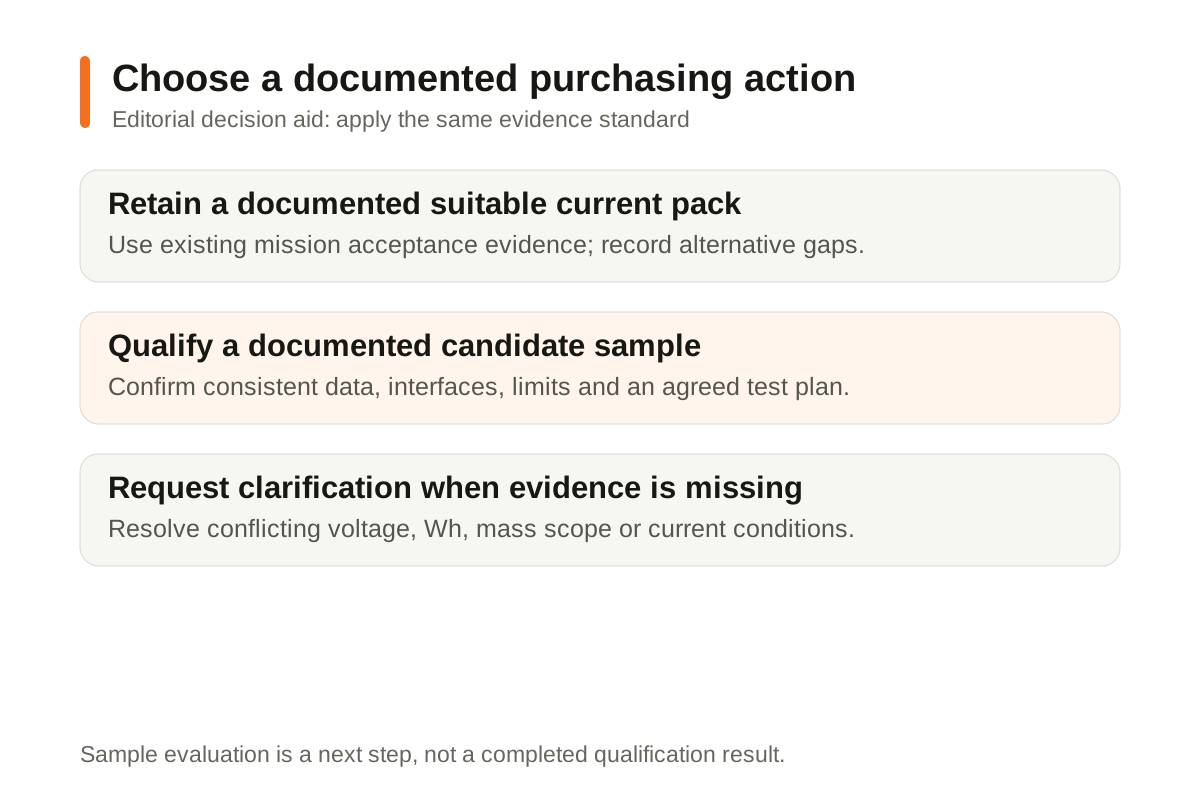
The useful output is a procurement action with a reason. It does not have to be a chemistry winner.
| Action | When it fits | What to document |
|---|---|---|
| Keep the current LiPo pack | It has documented suitability for the required mission, and the alternative lacks a demonstrated project benefit | Existing acceptance evidence and the unresolved alternative requirements |
| Qualify a semi-solid sample | The quote is internally consistent, required interfaces and limits are documented, and a relevant sample evaluation is justified | Sample identity, agreed test plan, costs and acceptance criteria |
| Request clarification | Voltage, Wh, mass scope, current conditions or another required field is missing or contradictory | Exact conflicting fields, requested document revision and supplier response |
Apply the same evidence standard to both candidates. A familiar pack still needs documented suitability for the intended duty. A new candidate still needs more than a high density label to earn an order.
Scroll the diagram horizontally to read every label.
Send a Pack-Specific Evaluation Request
AntBattery's published reference information needs the same scrutiny. The 350 Wh/kg series shows an 8S reference with 29.6 V, 40 Ah and 1,184 Wh. A verified complete-pack mass is still needed before calculating that pack's specific energy. The 400 Wh/kg series shows a 6S reference with 2 kg mass and 70 × 75 × 190 mm dimensions; its 800 Wh figure is conditional on 400 Wh/kg × 2 kg. Confirm nominal voltage, Ah and whether the density rating refers to cells or the complete pack.
These references do not establish a tested advantage over the Tattu examples. They help identify the questions a configuration-specific request must resolve. The reference pack's dimensions, mass or capacity should not be copied across other series configurations.
Use the UAV battery pack configuration options to identify the relevant series and prepare an evaluation request. Include the aircraft and mission, voltage window, required usable energy, current profile, battery space and mass limit, charger and interfaces, quantity and destination. Attach the two-column quote sheet, highlight contradictions and request the relevant configuration-specific datasheet, drawing and available test or transport documents.
Ask for three clear outputs: a revision-specific quotation, written answers to the unresolved fields, and the proposed conditions for sample evaluation. Those documents make the next purchasing decision reviewable without turning a label or a calculation into a performance promise.