The useful distinction is between a number you can calculate and a capability the manufacturer has documented. A large C label answers neither question on its own.
Convert C to amps using the stated capacity
Use the capacity basis associated with the discharge rating. If it is written in milliamp-hours, divide by 1,000 first: 2,000 mAh is 2 Ah, not 2,000 Ah. For a hypothetical battery with a documented 5C discharge rating and a 2 Ah capacity basis, the corresponding current is 5 × 2 = 10 A.
Power-Sonic’s C-rating explanation gives both directions of the relationship:
- Current in amps = numerical C-rate × capacity in Ah.
- Numerical C-rate = current in amps ÷ capacity in Ah.
Here, Ah means capacity, not energy in watt-hours. Keep that unit distinction even when a source uses “energy” loosely. The C-to-A equation also does not predict an exact runtime: this article uses it to normalize current, not to promise how long a battery will run.
Before multiplying, identify what the number describes. A rate used to measure capacity is not automatically the maximum allowable discharge rate. A charging rating is not the discharge rating you are looking for either. If the document does not make the basis clear, the missing definition is a question for the manufacturer—not a reason to select the largest number on the label.
Compare batteries in amps, not just C
Consider two hypothetical batteries. Their stated capacities and discharge ratings are inputs for arithmetic, not specifications of AntBattery products.
| Hypothetical battery | Capacity basis | Assumed documented discharge rate | Corresponding current |
|---|---|---|---|
| A | 2 Ah | 5C | 10 A |
| B | 5 Ah | 3C | 15 A |
Battery A has the higher C number, yet Battery B’s stated rate corresponds to more amps. That is why comparing 5C against 3C without their capacities can reverse the conclusion you draw.
Scroll the diagram horizontally to read every label.
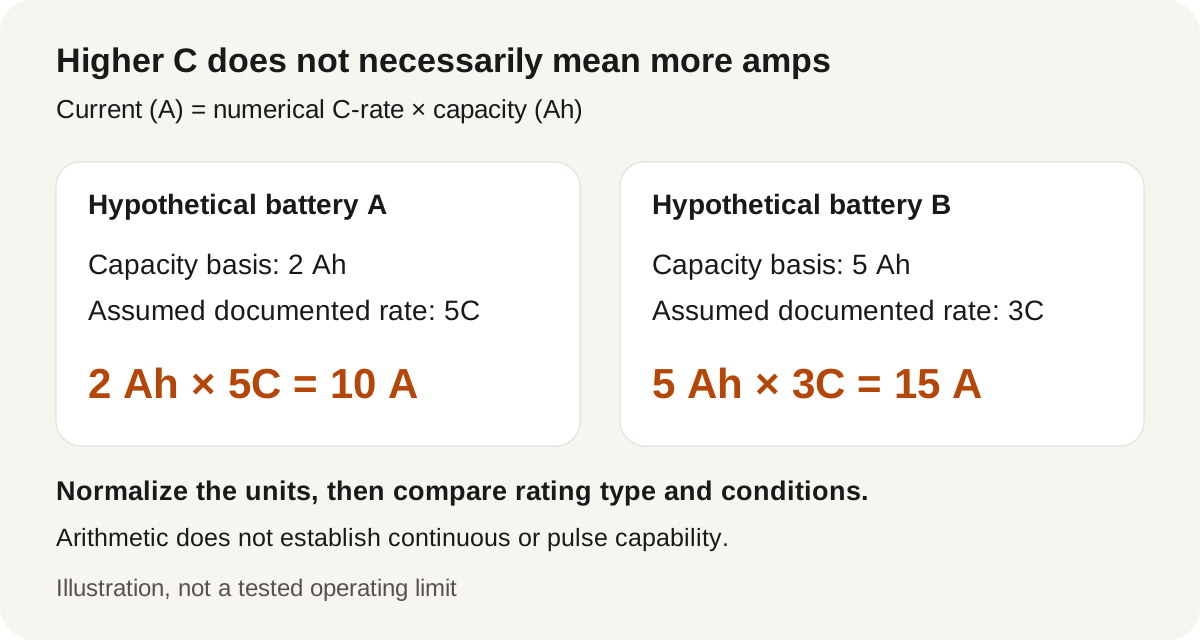
Even this table is not enough to choose Battery B. The inputs must represent comparable rating types and conditions. If A’s number is continuous and B’s is a short pulse, the larger amp figure is not a continuous-current comparison. First normalize the units; then decide whether the underlying specifications are comparable.
Keep continuous, pulse and MAX labels separate
A useful comparison preserves the manufacturer’s wording. Do not rename “MAX” as “continuous,” or treat an unspecified burst number as permission to sustain that load. Power-Sonic explicitly notes that some high-C claims are based on maximum pulse discharges; that makes the type of rating part of the answer, not a footnote.
Read the field in three parts: what is rated, under which conditions, and for how long. For a continuous-current statement, look for the manufacturer’s applicable conditions. For a pulse statement, look for duration and the allowed repetition or recovery conditions. If these are absent, record them as unknown.
There is no universal peak-to-continuous multiplier or pulse duration established by the sources used here. Applying a blanket “twice continuous” or “a few seconds” rule would supply evidence the document does not contain.
Read a manufacturer page without filling in the blanks
The Molicel P45B product page, retrieved on October 4, 2026, is a concrete example of why individual fields need separate interpretation. Its specification summary lists typical capacity as 4.5 Ah and discharge current as “MAX” 45 A. It also lists power outputs of 184 W at 10 seconds and 90% state of charge, and 168 W at 10 seconds and 50% state of charge.
| Retrieved webpage field | What is explicitly stated | What this field does not establish |
|---|---|---|
| Typical capacity | 4.5 Ah | The appropriate capacity basis for every possible test or application |
| Discharge current | MAX 45 A | A continuous-current limit under your conditions |
| Power output | 184 W, 10 s, SOC 90% | A continuous rating or a pulse-current value inferred from power alone |
| Power output | 168 W, 10 s, SOC 50% | Permission to repeat that pulse with any chosen duty cycle |
The important result is not a new rating calculated from those numbers. It is an evidence boundary. The power fields explicitly carry duration and state-of-charge conditions; the current field retains its MAX label. The retrieved summary does not establish the temperature, cutoff or repetition conditions for using these figures in a particular application.
The full P45B datasheet was not retrieved for this article. The page itself says its information is for reference only, is not a performance guarantee or product warranty, and directs application-specific enquiries to the manufacturer. This is a webpage field-reading example, not a complete datasheet assessment, operating recommendation, or comparison with an AntBattery cell.
When reading another model, apply the same discipline: quote the stated field, preserve its qualifiers, and leave missing information missing.
Work backward from load current to a C-rate requirement
If the current requirement is already known, the inverse calculation expresses it on a capacity basis. For a hypothetical 20 A load and 5 Ah basis:
20 A ÷ 5 Ah = 4C.
That means the load corresponds to 4C on that basis. It does not mean a battery marked 4C has been approved for the application. You still need the correct rating type and evidence for the actual conditions.
Keep sustained current and peak current separate in the request. A sustained 20 A requirement and a brief 20 A event are different questions for the manufacturer, even though dividing either number by the same Ah produces the same numerical C-rate. The conversion describes the current-to-capacity relationship; it cannot supply the missing time conditions.
For a finished pack, this arithmetic is also not system acceptance. It does not assess the configuration, protection or other constraints of the finished assembly. Keep this article’s calculation at its stated capacity basis rather than turning a single-cell figure into an unverified pack claim.
Treat missing conditions as missing evidence
When a label gives C but no supporting discharge documentation, the defensible next step is to request that documentation. Power-Sonic likewise advises contacting the manufacturer when the rating cannot be found. Do not infer it from capacity, cell shape, chemistry marketing or another model.
Use this compact check when deciding whether there is enough information to compare:
- Identity: Is the document for the exact cell or battery model being considered?
- Basis: Which Ah value and measurement conditions accompany the rate?
- Type: Is the field continuous, pulse, MAX, or a capacity-test rate?
- Time: For a pulse, are duration, repetition and recovery conditions stated?
- Conditions: Are relevant temperature, state of charge and cutoff conditions documented?
- Scope: Does the evidence answer your actual duty cycle, or does it leave that question open?
Scroll the diagram horizontally to read every label.
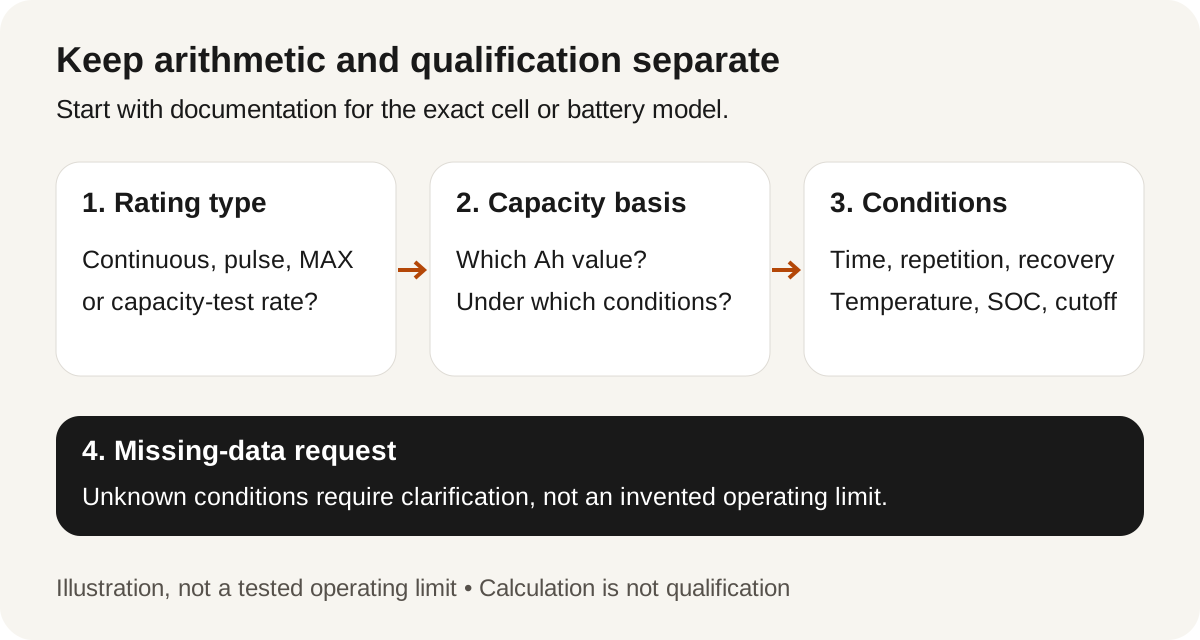
For example, a label showing capacity and a high C number but no rating type lets you perform a conditional calculation. It does not let you decide how long the resulting current may be drawn. Record the arithmetic as conditional and mark capability as unresolved. An honest incomplete comparison is more useful than a precise-looking amp figure that silently assumes continuous operation.
Request discharge data for the exact model
If you are considering a listed AntBattery cell, first browse AntBattery’s cylindrical cell catalogue to identify the model. The catalogue provides a model-enquiry path; its presence is not evidence of a discharge rating, stock or suitability for your load.
Then send a model-specific discharge-data enquiry through the existing requirements form. Include the model, capacity basis, sustained current in amps, peak current with duration and repetition, duty cycle, temperature, cutoff and application. Ask whether corresponding discharge documentation is available and which conditions its ratings cover.
This next step is a request for evidence, not a promise that a particular model meets the requirement or that a specific report is available. Keep the decision open until the applicable model information answers it.
Sources and research limits
- Power-Sonic, “What is a Battery C Rating?” — equation, missing-rating guidance and pulse-claim context; retrieved October 4, 2026.
- Molicel, “INR-21700-P45B” product webpage — attributed specification fields and reference-only disclaimer; retrieved October 4, 2026. Full datasheet not retrieved.
- AntBattery catalogue and requirements-form observations — model-document enquiry path only; no form submission or backend-delivery test.
All worked battery comparisons and load calculations above are hypothetical arithmetic, not measured product results or operating instructions.