The short answer: compare watt-hours, not amp-hours
Amp-hours (Ah) measure charge. Watt-hours (Wh) measure energy. The practical difference is that a watt-hour figure already contains the voltage and an amp-hour figure does not, so two batteries can only be compared on amp-hours when their voltages are the same. The moment the voltages differ — a different chemistry, a different series count, a 12 V pack against a 48 V pack — the amp-hour numbers stop being comparable, and a larger amp-hour figure can mean less stored energy.
The rest of this article is about what comes after that rule, because a watt-hour figure is only as trustworthy as the conditions behind it, and those conditions are not always published — including in our own table further down.
Summary. Compare batteries in watt-hours, not amp-hours, because watt-hours include the voltage. Convert with watt-hours = volts × amp-hours, and divide milliamp-hours by 1,000 first. Then check what the capacity rating was measured at before you treat either number as comparable.
Converting Ah, mAh and Wh in both directions
There is one formula and it runs both ways.
- Amp-hours to watt-hours: Wh = V × Ah
- Watt-hours to amp-hours: Ah = Wh ÷ V
- Milliamp-hours to amp-hours: Ah = mAh ÷ 1,000
- Watt-hours to kilowatt-hours: kWh = Wh ÷ 1,000
The voltage you use matters. For a single cell or a finished pack, use the nominal voltage the manufacturer publishes, not the fully charged voltage; the fully charged figure is higher, so it inflates the result before you have even started comparing.
The US Federal Aviation Administration publishes the same method for the public, with a worked example: a 12-volt battery rated at 8 Ah is rated at 96 Wh, because 12 × 8 = 96. For milliamp-hours, the FAA instructs you to divide by 1,000 to reach amp-hours and then multiply by the voltage.
| You have | You want | Do this | Example |
|---|---|---|---|
| 100 Ah at 12 V | Wh | multiply | 12 × 100 = 1,200 Wh |
| 8 Ah at 12 V | Wh | multiply | 12 × 8 = 96 Wh |
| 10,000 mAh at 3.7 V | Wh | divide by 1,000, then multiply | 10 Ah × 3.7 = 37 Wh |
| 370 Wh at 3.7 V | Ah | divide | 370 ÷ 3.7 = 100 Ah |
| 5,000 Wh | kWh | divide by 1,000 | 5 kWh |
Use the published nominal voltage, not the fully charged voltage.
The third row answers a common question: no, 10,000 mAh is not 100 Wh. At a typical 3.7 V cell nominal it is about 37 Wh. A milliamp-hour figure without a voltage is not an energy figure at all.
Same amp-hours, different energy: where the ranking reverses
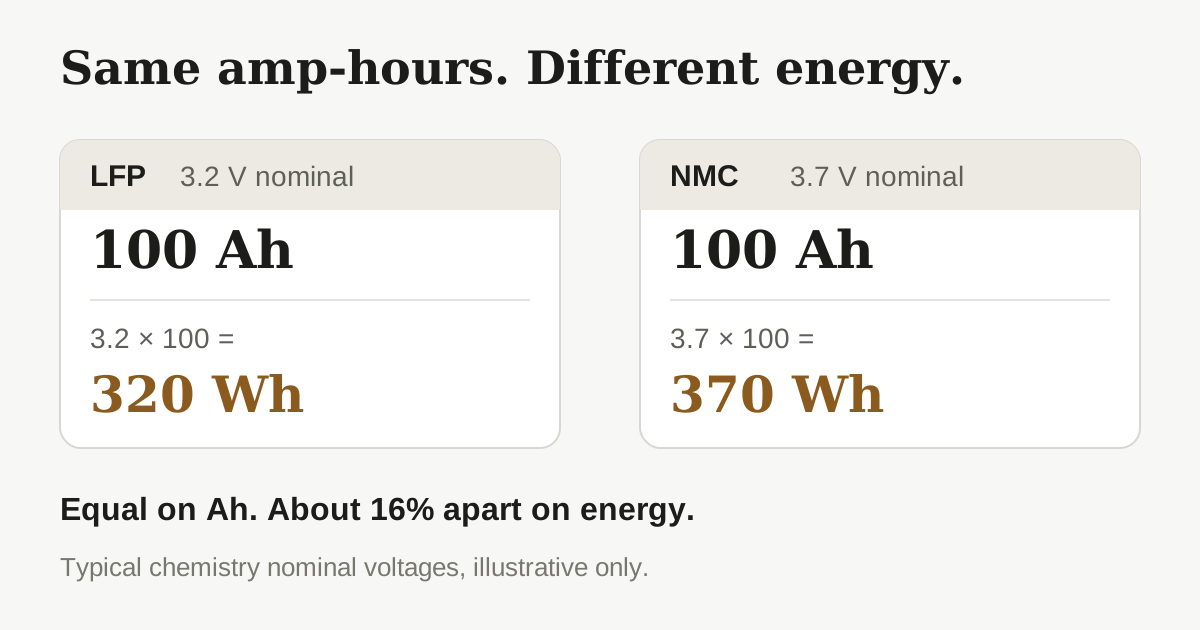
Take the two most common lithium chemistries at their typical nominal cell voltages — lithium iron phosphate (LFP) at about 3.2 V, and nickel-manganese-cobalt (NMC) at about 3.7 V:
- 100 Ah at 3.2 V nominal = 320 Wh
- 100 Ah at 3.7 V nominal = 370 Wh
Identical amp-hour figures, about 16% different energy. Now make the amp-hour figure disagree with the energy on purpose:
- 110 Ah at 3.2 V nominal = 3.2 × 110 = 352 Wh
- 100 Ah at 3.7 V nominal = 3.7 × 100 = 370 Wh
Scroll the diagram horizontally to read every label.

The first battery has 10% more amp-hours and about 5% less energy. If your comparison sheet has an Ah column and no Wh column, you will rank these two backwards, and nothing about either product’s specification is wrong or misleading.
So an amp-hour figure is only a comparison within one voltage. Across chemistries or across pack voltages, convert first.
The 3.2 V and 3.7 V figures above are the typical nominal voltages associated with those chemistry families, used to show the arithmetic. They are not a specification of any particular product, and real cells vary.
An amp-hour rating is a measurement, not a property
A rated capacity is not a fixed property of a battery. It is the result of a test, and the same cell will return a different amp-hour figure depending on three things:
- The discharge current it was measured at. Draw harder and you get fewer amp-hours out of the same cell.
- The cutoff voltage the test discharged down to. A lower cutoff yields a higher number.
- The ambient temperature the test ran at. A rating taken at room temperature does not describe a cold morning.
Scroll the diagram horizontally to read every label.
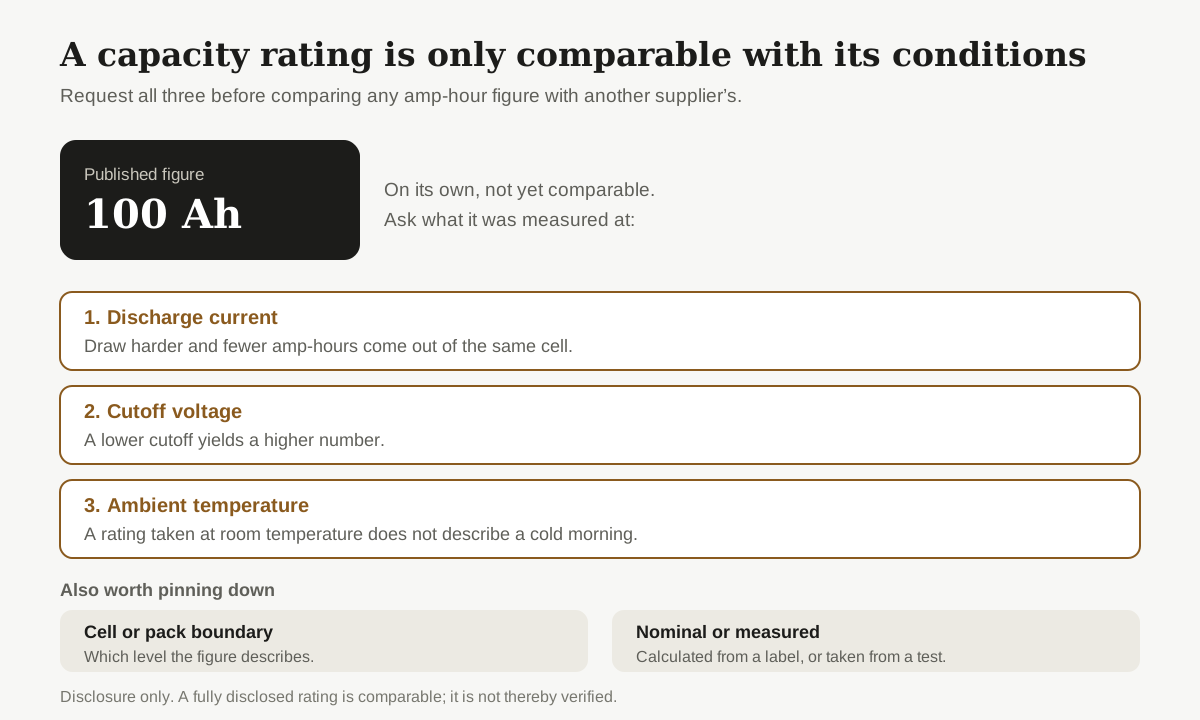
Two suppliers can both publish “100 Ah”, both be entirely honest, and hand you cells that behave differently in your application — because they tested at different currents, to different cutoffs, at different temperatures. Until you know those three conditions, you do not have two comparable numbers.
Our own published cell specifications list energy density, nominal voltage, capacity, cycle life, operating temperature range and format:
| Cell | Nominal voltage | Capacity | Nominal energy |
|---|---|---|---|
| AB-50AH Semi Solid Pouch Cell | 3.7 V | 50 Ah | 3.7 × 50 = 185 Wh nominal |
| AB-72AH Long-Range Pouch Cell | 3.72 V | 72 Ah | 3.72 × 72 = 267.8 Wh nominal |
| AB-100AH Semi Solid Prismatic Cell | 3.65 V | 100 Ah | 3.65 × 100 = 365 Wh nominal |
| AB-21700 Semi Solid Cylindrical Cell | 3.7 V | 5.5 Ah | 3.7 × 5.5 = 20.4 Wh nominal |
Watt-hour figures are nominal arithmetic from the published specifications, not measured delivered energy.
That table does not state the discharge current, cutoff voltage or ambient temperature at which those capacities were rated. Until a supplier gives you those three conditions, treat any amp-hour figure — ours included — as not yet comparable, and request them with your enquiry. The watt-hour column is nominal arithmetic from the published figures, for the reason in the next section.
For the wider version of this check — how to audit an energy-density or cycle-life claim rather than a capacity rating — see the claims-verification checklist.
What a nominal watt-hour figure does and does not tell you
Multiplying nominal voltage by rated amp-hours gives a nominal watt-hour figure. Treat it as a planning-level estimate that will usually overstate what you draw in service, for two reasons.
First, the cell’s voltage falls as it discharges. The nominal figure is a label for the middle of that curve, so under a heavier load the average sits below it and the energy you withdraw can fall below nominal volts times rated amp-hours. Second, your system stops at its own cutoff voltage, and if that cutoff is higher than the one the capacity test discharged to, discharge ends before the rated capacity has been withdrawn.
Neither effect can be calculated from published nominal data. A delivered-energy figure comes from a measurement under your own discharge current, cutoff voltage and ambient temperature, not from arithmetic on a datasheet. How hard you draw is part of this, and that is the C-rate question. This article gives you no percentage to shave off, because that number depends on a measurement under your own conditions.
Where the conversion is binding: US passenger-flight limits
In US passenger-aircraft rules, watt-hours are the unit the limits are written in, not amp-hours. The FAA states that lithium-ion batteries of 0–100 Wh are allowed on passenger aircraft (spare batteries in carry-on baggage only), that 101–160 Wh requires approval from the air carrier and is limited to two spare batteries per person, and that batteries exceeding 160 Wh are forbidden. It then tells the public how to obtain the figure: multiply volts by amp-hours, the same conversion and the same worked example given earlier in this article.
Those are US passenger-aircraft limits, published by the FAA under 49 CFR 175.10 on the PackSafe lithium batteries page (last updated 11 August 2026) and the airline passengers and batteries page (last updated 10 August 2026), both retrieved on 28 September 2026; individual airlines may be more restrictive. Cargo and commercial shipment falls under a different regime these pages do not cover, so if you are moving product rather than luggage, get the per-cell and per-package watt-hour figures from your supplier and check the rules with your freight forwarder.
Compare quotes on dollars per kWh
The same unit problem shows up in pricing. A price per amp-hour is only comparable between products at the same voltage, and across voltage classes it will rank cost backwards for exactly the reason the capacity figures did.
Normalise on energy instead:
- Nominal watt-hours = nominal voltage × rated amp-hours
- kWh = Wh ÷ 1,000
- Price per kWh = quoted price ÷ kWh
Because the first step uses nominal energy, the result is a basis for comparing quotes against each other, not a cost per delivered kilowatt-hour. It also ignores freight, duties, tooling, minimum order quantity and lifetime cost, any of which can outweigh the cell price in a real sourcing decision.
What to send a supplier
Ask for the capacity rating plus the three conditions behind it:
- Discharge current the rated capacity was measured at
- Cutoff voltage the rating discharged to
- Ambient temperature of the rating
Two more fields are worth pinning down in the same message: whether the figure describes a cell or a finished pack, and whether it is a nominal figure calculated from a label or one taken from a test.
And state what you need on your side, so the answer is useful the first time:
- Required energy in Wh or kWh — not amp-hours, unless you have already fixed the voltage
- Your system nominal voltage, and series count if you know it
- Your discharge current or power profile
- The cutoff voltage your system will enforce
- Your operating temperature range
- Whether you need the figure at cell level or pack level
A supplier who answers those three conditions gives you a number you can begin to compare, provided the conditions match the ones your application will impose. Without them, you cannot line the figure up against anyone else’s. When you are ready to run that comparison against real cells, the cell catalogue lists nominal voltage and capacity for each format, and a specification enquiry is the way to ask for the rest.
FAQs
How many Wh is in a 100 Ah battery?
It depends entirely on the voltage, which is why the question cannot be answered from the amp-hour figure alone. At 12 V it is 1,200 Wh; at a 3.2 V LFP cell nominal it is 320 Wh; at a 3.7 V NMC cell nominal it is 370 Wh. Multiply the nominal voltage by 100, and treat the result as a nominal figure rather than the energy you will draw.
How many Wh in 1 Ah?
One amp-hour is worth the voltage in watt-hours, so 3.7 Wh at 3.7 V, 12 Wh at 12 V and 48 Wh at 48 V. An amp-hour on its own is a quantity of charge and cannot be converted to energy without a voltage.
Is 100 Wh the same as 10,000 mAh?
No. 10,000 mAh is 10 Ah, and 10 Ah at a typical 3.7 V cell nominal is about 37 Wh. To reach 100 Wh at 10 Ah you would need about 10 V. At 3.7 V each 1,000 mAh is 3.7 Wh, so convert before comparing anything labelled in mAh with anything labelled in Wh.
What is a good Wh for a battery?
There is no good number in the abstract, because it depends on the energy your application needs. For scale, the four cells listed in this article run from 20.4 Wh to 365 Wh nominal. The useful version of the question is how many watt-hours you need at your voltage, discharge current, cutoff voltage and ambient temperature, and whether the supplier will state the conditions behind the figure they quote.
Should I compare batteries in Ah or Wh?
Watt-hours, whenever the voltages differ, which in practice is most of the time. Amp-hours are a valid comparison only between products at the same nominal voltage. Even then, the amp-hour figures are only comparable if both were rated at the same discharge current, cutoff voltage and ambient temperature.
Sources and further reading
Ask for the conditions, not just the capacity
Send the required energy in Wh or kWh, your system nominal voltage, discharge current or power profile, enforced cutoff voltage and operating temperature range, and state whether you need the figure at cell or pack level. Ask for the discharge current, cutoff voltage and ambient temperature behind any capacity we quote.
Request a quote