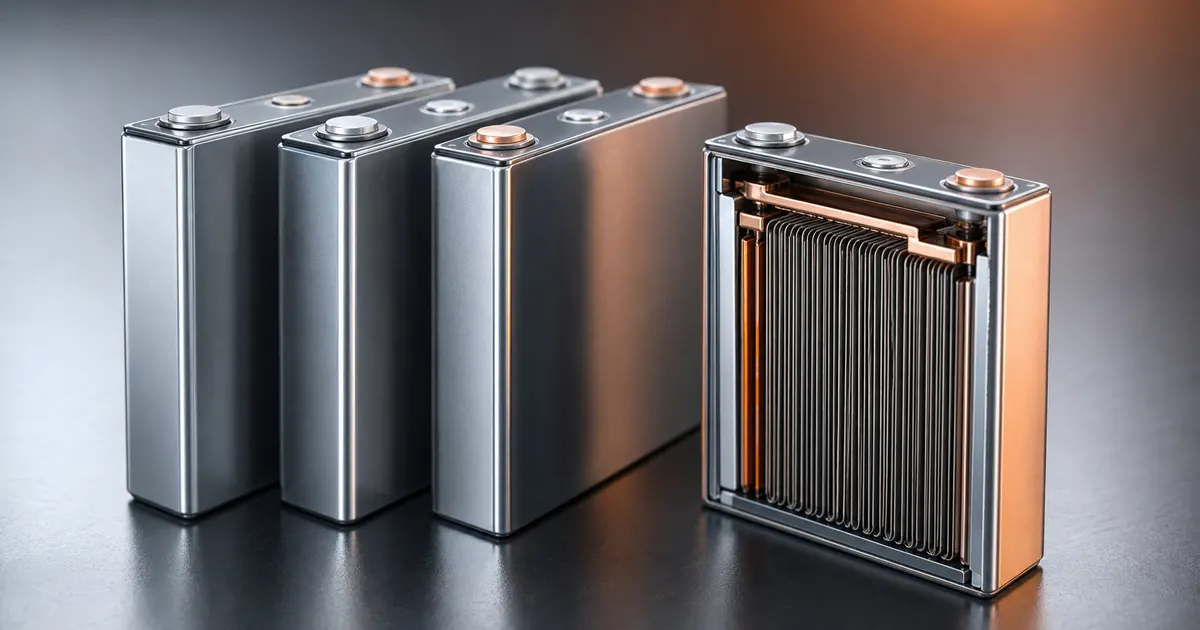
What are prismatic battery cells?
A prismatic battery cell is a rechargeable cell packaged inside a rigid rectangular housing instead of a cylindrical metal can or flexible pouch. The US Department of Energy battery explainer describes the common internal building blocks of modern batteries, including anode, cathode, electrolyte, and separator. In a prismatic cell, the format difference shows up in the outer enclosure, tab layout, stack or wound structure, and how the cell is arranged into modules or packs.
That makes prismatic a cell-format decision first. It affects packing density, module count, cooling layout, weight distribution, and structural support. It does not automatically tell you the chemistry, because prismatic cells can be built with LFP, NCM, LTO, and other chemistry paths depending on the application.
How prismatic battery cells differ from cylindrical and pouch cells
The US Environmental Protection Agency uses the same three familiar format buckets in its battery guidance: cylindrical, prismatic, and pouch. Cylindrical cells use round metal cans, pouch cells use laminated flexible packaging, and prismatic cells use a rigid rectangular case.
For buyers, prismatic cells usually sit in the middle between the other two. They can deliver better use of pack space than cylindrical cells, while offering more mechanical stability than pouch cells. The tradeoff is that large-format prismatic cells can be heavier and need careful thermal design because each cell carries more energy. If you want to compare the flexible side of the market too, our pouch cell battery guide covers that format in the same structure.
- Prismatic: rigid rectangular housing with strong module-friendly geometry
- Cylindrical: highly standardized round can with strong mechanical robustness
- Pouch: light laminated enclosure with higher packaging flexibility but less self-support
Main types of prismatic battery by chemistry
There is no single chemistry called a prismatic battery. Prismatic is the outer format. Inside that enclosure, manufacturers can use different chemistry families depending on energy density, cost, cycle life, power, and safety targets. Official sources from CATL's 2024 annual report and BYD's Blade Battery page show how prismatic formats span both nickel-based and LFP-based programs.
The table below gives a buyer-focused map of the main prismatic battery directions. It is meant for format and sourcing comparison, not as a claim that every supplier offers every type at the same maturity, certification level, or pack architecture.
| Chemistry or type | Typical use | Key strengths | Key tradeoffs | Common prismatic applications |
|---|---|---|---|---|
| NMC or NCM prismatic | Range-focused mobility systems | Strong energy density with established EV supply history | Higher cost and stricter thermal control than LFP | Passenger EV modules, premium industrial mobility |
| LFP prismatic | Cost-sensitive and long-life platforms | Safety reputation, cost control, and long cycle life | Lower energy density than high-nickel chemistries | Commercial EVs, ESS, forklifts, industrial systems |
| Blade-style long prismatic LFP | Space-efficient structural vehicle packs | High packaging efficiency and strong safety messaging | Vehicle-pack integration is more architecture-specific | BYD-style EV battery packs and structural pack designs |
| LTO prismatic | High-power and fast-charge duty | Excellent cycle life, power delivery, and low-temperature behavior | Lower energy density and larger pack size | Heavy-duty equipment, backup systems, specialty transport |
| Large-format module-ready prismatic | High-capacity automotive or ESS pack building | Lower part count and efficient rectangular packing | Thermal propagation control and service strategy matter more | EV modules, battery containers, large industrial packs |
Chemistry, enclosure shape, and module architecture should be screened separately. Some rows above describe chemistry, while others describe prismatic construction style.
Other prismatic battery types by construction and application
After chemistry, buyers usually split prismatic batteries by construction style and end use. Some are conventional flat rectangular cells for standard EV modules. Others are long, narrow blade-style cells designed to raise structural and packaging efficiency. Official BYD material says the Blade Battery uses LFP chemistry with an optimized structural layout, while CATL states in its annual report that it mass-produced the world's first large prismatic NCM battery cell in 2014.
This is also where buyer confusion usually starts. A blade battery is still part of the prismatic family, but it is not the same thing as every rectangular metal-cased cell. Likewise, a prismatic EV cell, a prismatic ESS cell, and a prismatic semi-solid development cell can share outer geometry while behaving very differently in chemistry, cooling needs, and qualification path. If your project may also compare future chemistry claims, our solid state battery meaning guide separates packaging language from electrolyte architecture.
- Standard flat prismatic cells for EV and industrial modules
- Blade-style long prismatic cells for structural pack efficiency
- Large-format prismatic cells for module-count reduction
- High-power prismatic cells for industrial and heavy-duty equipment
Advantages and disadvantages of prismatic battery cells
Prismatic cells are popular because they use rectangular space efficiently and reduce the number of cells needed in many pack designs. That can simplify module layouts, busbar design, and service packaging compared with dense arrays of smaller cylindrical cells.
The tradeoff is that each prismatic cell is usually larger and more energy-dense at the unit level, so thermal management, swelling control, and propagation barriers become more important. In other words, prismatic cells can help pack efficiency, but they move more design responsibility into cooling, structural compression, and safety engineering.
- Advantages: efficient rectangular packing and lower cell-count strategies
- Advantages: rigid housing and simpler mechanical handling than pouch cells
- Disadvantages: larger cells can increase thermal management and propagation demands
- Disadvantages: pack architecture becomes more sensitive to swelling, cooling, and service access
Where prismatic battery cells are used today
Prismatic cells are widely used in EVs, buses, trucks, stationary storage, forklifts, and other industrial systems where rectangular module geometry makes system integration easier. BMW notes that the BMW iX and BMW i4 battery modules were produced from supplied prismatic battery cells, while newer BMW communications use that prismatic baseline as the comparison point for its later cylindrical strategy.
On this site, the most relevant application paths are electric vehicle battery programs, higher-capacity cells and system options on our product page, and the packaging logic behind advanced battery platforms in our technology section. Those internal pages matter because the right prismatic cell is rarely selected by format name alone. It is selected by voltage window, thermal envelope, available installation volume, and certification needs.
How to choose the right prismatic battery for your project
Start with the job the battery has to do. Is the project trying to maximize energy in a fixed enclosure, reduce module count, simplify pack assembly, improve cycle life, or hit a cost target? Once that is clear, you can narrow the shortlist by chemistry and then by prismatic subtype, cell dimensions, terminal position, and module integration method.
For buyer-side RFQs, the useful input is not just “we need a prismatic battery.” It is a defined system brief: nominal voltage, required capacity, current profile, allowable dimensions, cooling limits, operating temperature, and transport or compliance requirements. If you are ready to compare real options, start with our semi solid battery lineup, review the system-level logic in our technology overview, and then move into sample and specification review with an application-specific pack target.
FAQs
What are prismatic battery cells in simple terms?
Prismatic battery cells are rechargeable cells packaged in a rigid rectangular case rather than a round can or flexible pouch. The outer format helps pack batteries efficiently into flat, module-friendly spaces.
Are prismatic battery cells the same as blade batteries?
Not exactly. Blade batteries are a subtype within the broader prismatic family. They use a long, narrow prismatic construction rather than representing every prismatic cell on the market.
Are prismatic cells better than cylindrical cells?
Neither format is automatically better. Prismatic cells usually offer more rectangular packing efficiency and lower cell counts, while cylindrical cells often offer stronger standardization and easier thermal segmentation.
What are the main types of prismatic battery?
The main prismatic battery types are usually grouped first by chemistry, such as NCM, LFP, or LTO, and then by construction style, such as standard flat prismatic cells, large-format prismatic cells, or blade-style long prismatic cells.
Why do EV makers use prismatic battery cells?
EV makers use prismatic cells when they want efficient use of rectangular pack space, lower module part count, and a rigid cell housing. The tradeoff is that bigger cells demand careful cooling, swelling control, and safety design.
Can prismatic cells be used in semi-solid battery projects?
Yes. Prismatic describes the external package shape, so it can be paired with different chemistry and electrolyte pathways, including semi-solid development programs. The key is to separate form factor from internal battery architecture.
Sources and further reading
- US Department of Energy: DOE Explains... Batteries
- US Environmental Protection Agency: Used Lithium-Ion Batteries
- BYD Media Hub: Blade Battery technology page
- CATL 2024 annual report PDF
- BMW Group: prismatic cells used in BMW iX and BMW i4 battery modules
- BMW Group: Gen6 cylindrical cells compared with Gen5 prismatic cells
Related Blogs
Learn More About Battery
Related Products
Related product
Prismatic Series
AB-100AH Semi Solid Prismatic Cell
- Energy Density
- 285 Wh/kg
- Nominal Voltage
- 3.65 V
Cylindrical Series
AB-21700 Semi Solid Cylindrical Cell
- Energy Density
- 300 Wh/kg
- Nominal Voltage
- 3.7 V
Pouch Cell Series
AB-50AH Semi Solid Pouch Cell
- Energy Density
- 320 Wh/kg
- Nominal Voltage
- 3.7 V