What is pouch cell battery?
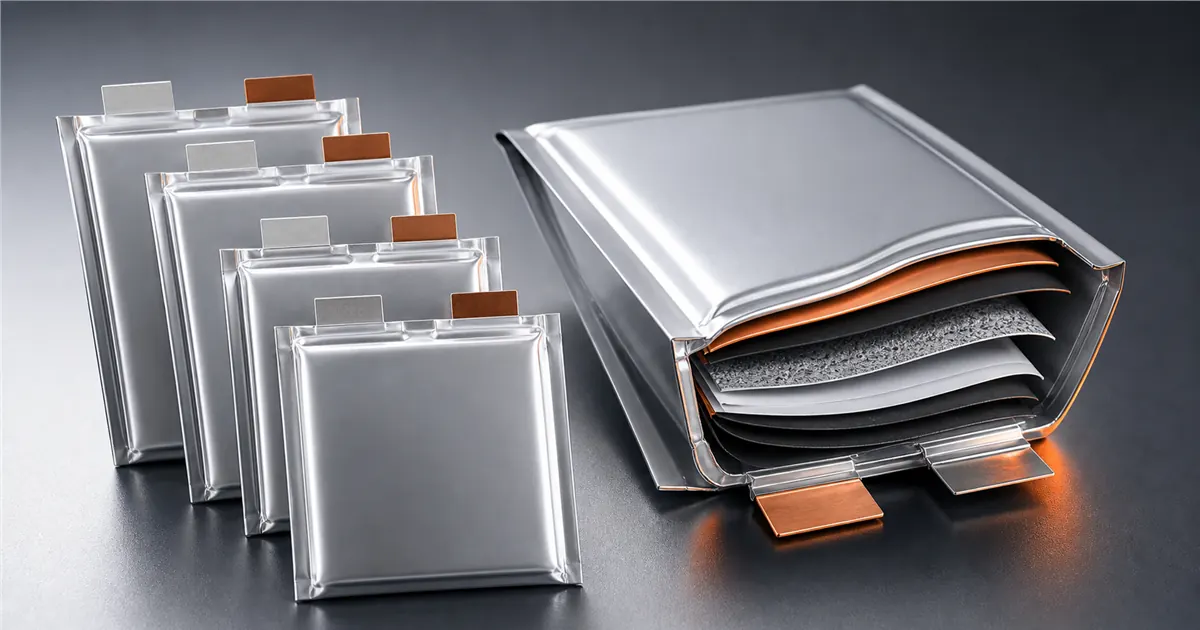
A pouch cell battery is a rechargeable cell sealed inside a laminated aluminum-plastic film pouch instead of a rigid cylindrical can or prismatic metal housing. The US Department of Energy battery explainer describes the same core lithium-ion building blocks across modern cells: an anode, a cathode, a separator, and an electrolyte. In a pouch cell, the main difference is the external package and the way the cell is supported inside the module or pack.
That packaging choice matters because it changes space efficiency, weight, thermal design, swelling management, and how easily the cell can be customized for a specific product. If your team is comparing form factor choices before chemistry choices, pouch is a format decision first, not automatically a statement about solid-state, semi-solid, or any single cathode recipe.
How pouch cell batteries differ from cylindrical and prismatic cells
The US Environmental Protection Agency uses the same three familiar format labels in its battery guidance: cylindrical, prismatic, and pouch. Cylindrical cells use a rigid metal can, prismatic cells use a box-like rigid case, and pouch cells use a flexible laminated enclosure.
For buyers, the practical difference is easy to summarize. Pouch cells usually offer strong packaging efficiency and lower inactive material weight, but they need better mechanical support because the outer pack is not self-supporting. Cylindrical cells are robust and easy to standardize, while prismatic cells sit between the two with a rigid shell and flatter geometry. If your project is vehicle-related, our electric vehicle industry page shows where cell format tradeoffs start to affect module and pack selection.
- Pouch: lighter outer package, flat geometry, higher packaging flexibility
- Cylindrical: strong metal can, easy handling, standardized formats
- Prismatic: rigid case, dense module layout, simpler mechanical support than pouch
Main types of pouch cell battery by chemistry
There is no single chemistry called a pouch cell battery. Pouch is the package format. Inside that package, manufacturers can build different chemistry families depending on the application target. Official battery maker announcements from LG Energy Solution's high-nickel NCMA supply program and its pouch-type LFP battery program are a good reminder that chemistry and form factor are separate decisions.
The table below gives a buyer-focused map of the most common pouch-cell chemistry directions. It is not a claim that every supplier offers every type in the same maturity, size range, or qualification status. It is a practical comparison framework for early sourcing discussions.
| Chemistry or type | Typical use | Key strengths | Key tradeoffs | Common pouch-cell applications |
|---|---|---|---|---|
| NMC or NCM pouch | High-energy mobile systems | Good energy density and mature automotive supply base | Higher cost and stricter thermal management than LFP | Passenger EVs, drones, premium portable power |
| NCMA or high-nickel pouch | Range-focused EV programs | Higher energy focus for long-range designs | Validation, cost, and thermal control demands stay high | Premium EV modules and advanced mobility packs |
| LFP pouch | Cost-sensitive and safety-focused systems | Cycle life, safety reputation, and lower material cost | Lower energy density than high-nickel chemistries | Commercial EV packs, energy storage, portable systems |
| LTO pouch | Fast-charge and long-cycle applications | Strong cycle life, high power, low-temperature performance | Lower energy density and larger pack size for the same runtime | Industrial backup, specialty vehicles, harsh-duty equipment |
| Lithium-polymer or thin laminated pouch | Thin or custom-shape electronics | Very thin profile and flexible shape options | Lower capacity scale and more mechanical handling sensitivity | Wearables, sensors, medical, smart devices |
Format and chemistry should be screened separately. A pouch cell can use different cathode and electrolyte pathways, including future semi-solid programs.
Other pouch cell battery types by construction and application
After chemistry, buyers usually sort pouch cells by construction and use case. Some programs prioritize flat high-energy cells for EV modules, others prioritize high-rate discharge cells for drones or robotics, and others need very thin laminated cells for sensors, wearables, or medical devices. Murata's laminated rechargeable battery lineup and Panasonic's flexible laminated battery work show how far pouch construction can be adapted beyond automotive scale cells.
This is also where buyers often mix up cell format and chemistry branding. A thin lithium-polymer pouch cell, a high-energy EV pouch cell, and a future semi-solid pouch cell may all share the same external format family while behaving very differently inside. If your team is also screening next-generation chemistry claims, our solid state battery meaning guide separates electrolyte architecture from packaging language.
- High-energy flat pouch cells for EV and long-runtime products
- Power-oriented pouch cells for drones, robotics, and peak-discharge loads
- Ultra-thin laminated pouch cells for compact electronics and wearables
- Custom-tab or custom-dimension pouch cells for integration-driven projects
Advantages and disadvantages of pouch cell batteries
Pouch cells are popular because they let engineers use internal pack volume efficiently and reduce dead weight from heavy metal housings. That can make them attractive for EV modules, UAV batteries, and premium portable devices where every millimeter and gram matters.
The tradeoff is that pouch cells need better external support. They can swell during cycling, need consistent compression design, and are more sensitive to handling damage than cells with a rigid outer can. In other words, pouch cells can perform very well, but they usually place more responsibility on module and pack engineering.
- Advantages: lower package weight, good shape flexibility, efficient use of space
- Advantages: easy to adapt dimensions for application-specific packaging
- Disadvantages: needs compression or frame support, more sensitive to swelling and puncture
- Disadvantages: pack engineering quality matters more than with a rigid can alone
Where pouch cell batteries are used today
Pouch cells are already widely used in products where flat geometry and energy density matter. That includes passenger EV packs, drones and UAV batteries, portable power products, medical electronics, and many compact industrial devices. Their fit is strongest when the product team wants to optimize space and mass at the system level rather than simply standardize around a commodity can size.
On this site, the most relevant application paths are electric vehicle battery projects, custom-format cells shown on our product page, and the semi-solid packaging decisions outlined in our battery technology section. Those internal pages matter because the right pouch cell is rarely chosen by chemistry headline alone. It is chosen by dimensions, discharge profile, thermal window, and certification pathway.
How to choose the right pouch cell battery for your project
Start by defining the job the cell must do. Is the priority high energy density, high discharge, low temperature performance, long cycle life, thin packaging, or lower cost? Once that is clear, you can narrow the shortlist by chemistry and then by physical format, tab position, thickness, and module integration requirements.
For buyer-side projects, the most useful request-for-quote data is not a broad message saying you need a pouch cell. It is a clear pack or device target: nominal voltage, required capacity, peak current, operating temperature, available installation space, and any transport or certification constraints. If you are ready to screen real options, start with our semi solid battery lineup, compare the format logic in our technology overview, and then move into sample and specification review with a defined application brief.
FAQs
What is pouch cell battery in simple terms?
A pouch cell battery is a rechargeable battery cell packaged in a laminated foil pouch instead of a rigid metal can. The electrochemical materials can vary, but the format stays flat, light, and packaging-efficient.
Is a pouch cell battery the same as a lithium polymer battery?
Not always. Many lithium-polymer cells use a pouch format, but pouch is the package shape and lithium polymer is a chemistry or electrolyte label. Some pouch cells use NMC, NCMA, LFP, or other chemistry paths.
Are pouch cells better than cylindrical cells?
Neither format is automatically better. Pouch cells usually win on packaging flexibility and lower casing weight, while cylindrical cells often win on mechanical robustness and handling simplicity.
What are the main pouch cell battery types?
The main pouch cell battery types are usually grouped first by chemistry, such as NMC, NCMA, LFP, LTO, or lithium-polymer, and then by construction and application, such as high-energy EV cells, high-power drone cells, or ultra-thin laminated electronics cells.
Why do EV makers use pouch cells?
EV makers use pouch cells when they want a flat geometry, efficient use of pack space, and lower package weight. The tradeoff is that pouch cells demand stronger module compression, protection, and thermal design.
Can pouch cells be used in semi-solid battery projects?
Yes. Pouch is a form factor, so it can be paired with different chemistry and electrolyte pathways, including semi-solid programs. The key is to separate format choice from the internal battery architecture claim.
Sources and further reading
- US Department of Energy: DOE Explains... Batteries
- US Environmental Protection Agency: Used Lithium-Ion Batteries
- LG Energy Solution: high-nickel NCMA battery supply announcement
- LG Energy Solution: pouch-type LFP battery supply announcement
- Murata: small lithium-ion secondary batteries, laminated type lineup
- Panasonic Industry Europe: flexible laminated lithium-ion rechargeable battery
Related Blogs
Learn More About Battery
Related Products
Related product
Pouch Cell Series
AB-50AH Semi Solid Pouch Cell
- Energy Density
- 320 Wh/kg
- Nominal Voltage
- 3.7 V
Cylindrical Series
AB-21700 Semi Solid Cylindrical Cell
- Energy Density
- 300 Wh/kg
- Nominal Voltage
- 3.7 V
Prismatic Series
AB-100AH Semi Solid Prismatic Cell
- Energy Density
- 285 Wh/kg
- Nominal Voltage
- 3.65 V