The short answer: there is no universal solid-state stack pressure
Fabrication pressure is applied during powder compaction, pelletizing, calendering, lamination or joining. Operating stack pressure is the external compression maintained during formation or cycling. Reviews use these terms separately because a cell can be fabricated at one pressure and operated at another.
A useful pressure claim states the pressure, area, application method, uniformity, fixture compliance, time history, chemistry, electrode loading, current density, temperature, cell format and whether hardware mass and volume are included. Without that boundary, “cycles at 5 MPa” cannot be compared confidently with another cell.
| Term | When applied | Main purpose | Evidence |
|---|---|---|---|
| Fabrication pressure | Layer or cell preparation | Density, joining and particle contact | Process step, dwell, temperature, area and release state |
| Formation pressure | Initial electrochemical conditioning | Interface establishment and early defect control | Formation protocol and whether pressure changes later |
| Operating stack pressure | During cycling or service | Maintain contact and manage mechanical change | Pressure history, uniformity, fixture and cell state |
| Pack/module compression | Integrated hardware | Apply practical preload through life | Mass, volume, tolerance, thermal and service design |
Use the project’s defined sign convention and sensor calibration; pressure is force divided by loaded area only when the load distribution is understood.
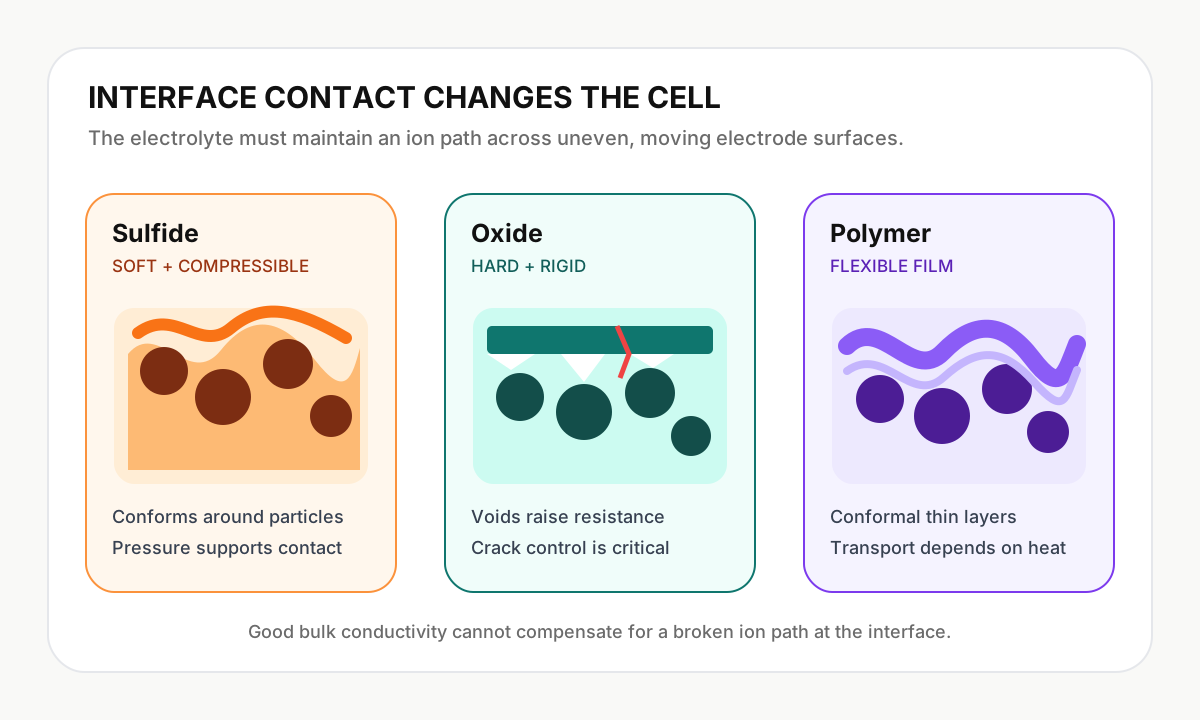
Solid-solid interfaces lose contact as materials move and react
Liquid electrolyte can wet porous structures; solids depend on physical contact at particle and layer interfaces. Voids, roughness, stripping/plating, active-material volume change, creep, fracture and interphase formation can reduce contact and increase impedance. External compression is one tool for maintaining that contact.
Pressure is not a chemistry-independent cure. Sulfides, oxides and polymers have different stiffness, deformability and fracture behavior. Lithium metal, silicon, graphite, alloy anodes and cathode composites also respond differently. Record the complete architecture before interpreting the value.
More pressure can improve contact and still create a worse practical cell
The 2024 eScience review describes how pressure can improve loose structures and ion/electron paths. Newer reviews also warn that excessive pressure can induce cracking or mechanical degradation. At the lithium interface, pressure can change deposition and creep behavior; in brittle layers it can concentrate stress around defects.
Therefore report a pressure sweep or justified selection rather than one best result. Include failed, shorted or mechanically damaged samples and pressure-uniformity evidence. A value that works on a small rigid pellet may not transfer to a large-area pouch.
- Contact and impedance can improve as voids close.
- Cracking, extrusion or shorting risk can grow under unsuitable load.
- Large area makes pressure uniformity and edge control harder.
- Fixture stiffness and cell swelling change pressure through cycling.
- High pressure can add hardware mass, volume and cost.
Compare pressure with temperature, current density and areal loading
Pressure values become misleading when high temperature, low current, thin electrodes or low areal capacity make the cell easier to cycle. Keep these fields beside the pressure: electrolyte and electrodes; separator thickness; cathode loading; lithium or anode excess; current density/C-rate; areal capacity; temperature; voltage window; rest; cycle count; retention; impedance; and sample number.
Use distributions, not selected curves. Report the force-control method and whether pressure is constant, displacement is fixed, springs are used, or the fixture relaxes. State sensor location, calibration and the area used to calculate pressure.
| Field | Question |
|---|---|
| Chemistry | Which electrolyte, cathode, anode, coatings and binders? |
| Geometry | What area, thickness, format, loading and layer count? |
| Electrochemistry | What current, capacity, voltage, temperature and rest protocol? |
| Mechanics | What load method, compliance, uniformity, calibration and pressure history? |
| Boundary | Which fixture, plate, spring and sensor mass/volume count in energy density? |
| Repetition | How many cells/lots, failures and distributions? |
Count pressure hardware in the cell-to-pack boundary
A laboratory fixture can be much heavier and stiffer than a practical module. If a result requires continuous pressure, explain how a module or pack will generate and maintain it across manufacturing tolerances, temperature, swelling, relaxation, ageing and service. Include plates, frames, springs, sensors, insulation, fasteners and spacing in mass and volume.
Do not publish cell-only gravimetric or volumetric energy density as a pack implication while excluding necessary compression hardware. Separate active-material, cell, module and pack boundaries and state what each number includes. Link this check to the claims-verification owner.
Low-pressure research tries to make contact practical, not eliminate mechanics
Recent reviews frame low-operating-pressure designs as a core scale-up direction. Strategies include particle and composite design, compliant interlayers, surface/coating control, three-dimensional hosts, alloy or anode-free approaches, cell architecture and controlled preload systems. The right approach depends on the failure mechanism.
“Low pressure” remains incomplete without a value, area, conditions and performance. Compare the lower-pressure cell with an appropriate control at the same loading, current, temperature and cycling protocol. Record whether fabrication pressure remained high even when operating pressure was reduced.
Use this checklist before accepting a pressure-based claim
Ask whether the value is fabrication, formation or operating pressure; when it begins and ends; how it is measured; whether it is uniform; which area was used; how it changes during cycling; what the electrodes, loading and temperature are; whether hardware is counted; how many cells were tested; and which failures occurred.
For supplier or development evaluation, include pressure data in the same sample request as conductivity, interface, manufacturing and cell evidence. The manufacturing guide shows where joining and formation controls enter the process.
Report the boundary before discussing the optimum
A defensible report begins with the complete boundary, then shows pressure-response data and limitations. It does not prescribe a universal pressure for EV cells, because chemistry, scale, design and safety constraints change the answer.
AntBattery can help organize the technical questions for a material or cell program. Mechanical fixture design, cell testing, H2S or other chemistry controls, and pack validation require qualified engineering and safety teams.
FAQs
What is stack pressure in a solid-state battery?
It is external compression maintained across the cell stack during formation or cycling to influence solid-solid contact and mechanical behavior.
Is fabrication pressure the same as operating pressure?
No. Fabrication pressure is used during material or cell preparation; operating pressure is maintained during electrochemical use.
Does higher pressure always improve a solid-state battery?
No. It can improve contact but may also create cracking, deformation, shorting risk or impractical hardware burden.
What pressure does an EV solid-state battery need?
There is no universal value. It depends on chemistry, electrodes, area, loading, current, temperature, architecture and practical compression design.
Should pressure hardware count in energy density?
Yes when the hardware is required for operation. State cell, module and pack boundaries separately.
Sources and further reading
- eScience — fabrication pressures and stack pressures in solid-state batteries
- Nature Energy — critical importance of stack pressure in batteries
- Advanced Materials — challenges and strategies of low-pressure all-solid-state batteries
- Energy Storage Materials — effects of external pressure on all-solid-state batteries
Related Blogs
Learn More About Battery
Related Products
Related product
Cylindrical Series
AB-21700 Semi Solid Cylindrical Cell
- Energy Density
- 300 Wh/kg
- Nominal Voltage
- 3.7 V
Prismatic Series
AB-100AH Semi Solid Prismatic Cell
- Energy Density
- 285 Wh/kg
- Nominal Voltage
- 3.65 V
Pouch Cell Series
AB-50AH Semi Solid Pouch Cell
- Energy Density
- 320 Wh/kg
- Nominal Voltage
- 3.7 V