The short answer: three anode architectures
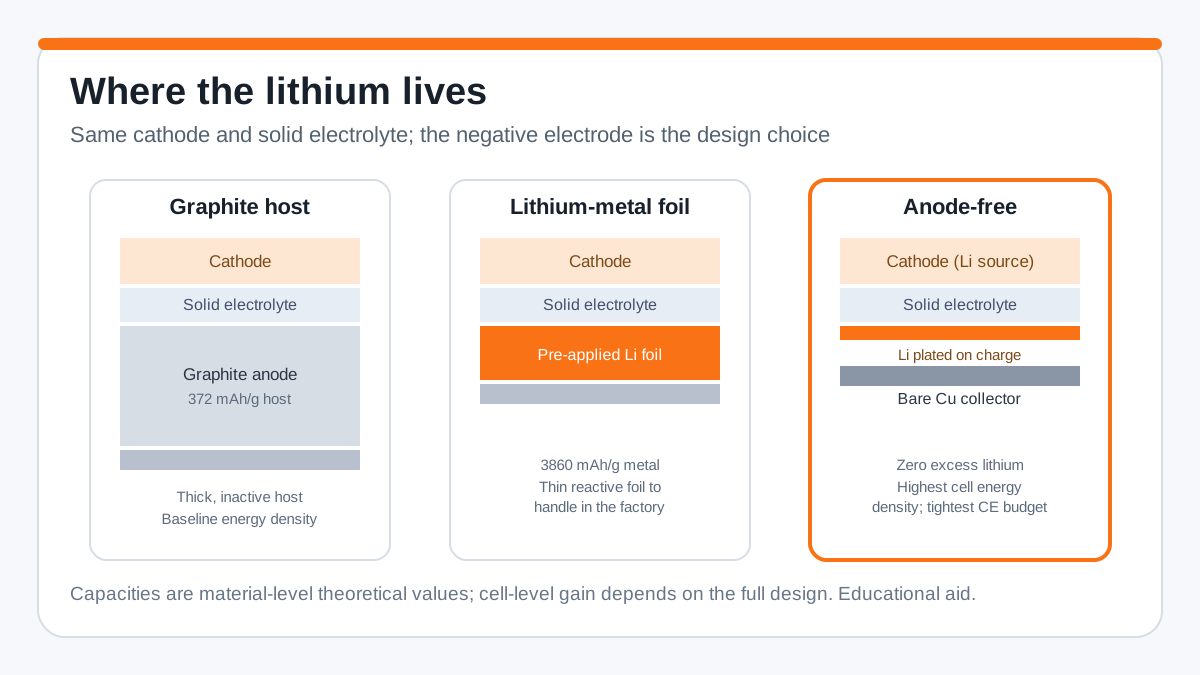
A solid-state cell can use one of three solid state battery anode architectures, and the choice is the single biggest lever on its energy density. A graphite host anode works as it does in a lithium-ion cell and gives no energy-density benefit by itself. A lithium metal anode replaces graphite with a thin lithium foil applied during manufacturing. An anode-free solid state battery, also called a zero-excess-lithium design, ships with only a bare current collector; the lithium-metal layer is plated in place from the cathode on the first charge and stripped back on every discharge.
The solid electrolyte is what makes the metal options practical, because it can mechanically resist the lithium filaments that short a liquid cell. Moving from graphite to lithium metal is where the roughly 40 percent higher energy per weight and 70 percent higher energy per volume come from. Anode-free adds a further gain and removes lithium-foil handling, but it also removes the lithium reservoir that hides inefficiency, so it demands the highest plating and stripping reversibility of the three.
If you first need the cell-level picture, start with how solid-state batteries work. This guide stays on the anode side: what each architecture commits you to, and what to check before comparing supplier data.
The three anode architectures and what each commits you to
Graphite host. The negative electrode is a graphite coating that stores lithium by intercalation, the same mechanism used in today's lithium-ion cells. A solid electrolyte paired with graphite can improve safety and packaging, but the anode still carries a thick layer of electrochemically inactive host material. Graphite's practical capacity is about 372 mAh/g. This is the least risky architecture to build and the least rewarding on energy density.
Lithium-metal foil. The graphite is replaced with a thin lithium-metal layer, applied as a foil or coating during assembly. Lithium metal has a theoretical specific capacity near 3860 mAh/g, close to ten times graphite, and it plates and strips rather than intercalates. The manufacturing cost is that lithium foil is soft, highly reactive and hard to handle in thin, uniform, wide formats.
Anode-free, or zero-excess lithium. The cell is assembled in the discharged state with no anode active material at all, just the anode-side current collector, usually copper. On the first charge, lithium that starts in the cathode is electroplated onto that collector, forming the lithium-metal anode in place. Because there is no pre-loaded lithium beyond what the cathode supplies, every lithium atom is doing charge-carrying work and none sits idle as a reservoir.
Why the anode, not the electrolyte, drives the energy-density jump
It is easy to assume the solid electrolyte is the source of the performance gain. It is not, directly. Conventional lithium-ion energy density has been flattening near 270 Wh/kg and 650 Wh/L, and that ceiling is set mainly by the capacity of the anode and cathode active materials, not the separator.
Swapping the electrolyte from liquid to solid mostly buys the permission to use a lithium-metal anode without the cell shorting immediately. The energy-density gain itself comes from deleting the graphite host. Analyses comparing a lithium-ion cell with a solid-state lithium-metal cell of the same chemistry put the improvement at roughly 40 percent more energy per unit weight and roughly 70 percent more per unit volume. Anode-free configurations push the volumetric figure further: one review notes that a bare-current-collector anode with no excess lithium offers the highest volumetric energy density, above 1500 Wh/L, of any cell configuration, because it carries zero inactive negative-electrode mass. QuantumScape has published a commercial target of 800 to 1000 Wh/L for its anode-free cells, versus around 700 Wh/L for the conventional cells it compares against.
Two cautions on these numbers. Material-level theoretical capacity is not cell-level energy density; the real gain depends on cathode loading, separator thickness, pressure hardware and packaging. And gravimetric and volumetric gains are not equal, so a spec sheet that quotes only the more flattering one is not describing the same cell. The electrolyte still decides whether the anode survives, which is where the electrolyte-type comparison picks up.
What anode-free actually means on the production line
Anode-free is a manufacturing statement before it is a chemistry statement. The cell leaves the line discharged, with the anode side being just a current collector. There is no lithium foil to laminate, no reactive metal to slit or wind, and the anode-side process step is closer to what a lithium-ion line already does.
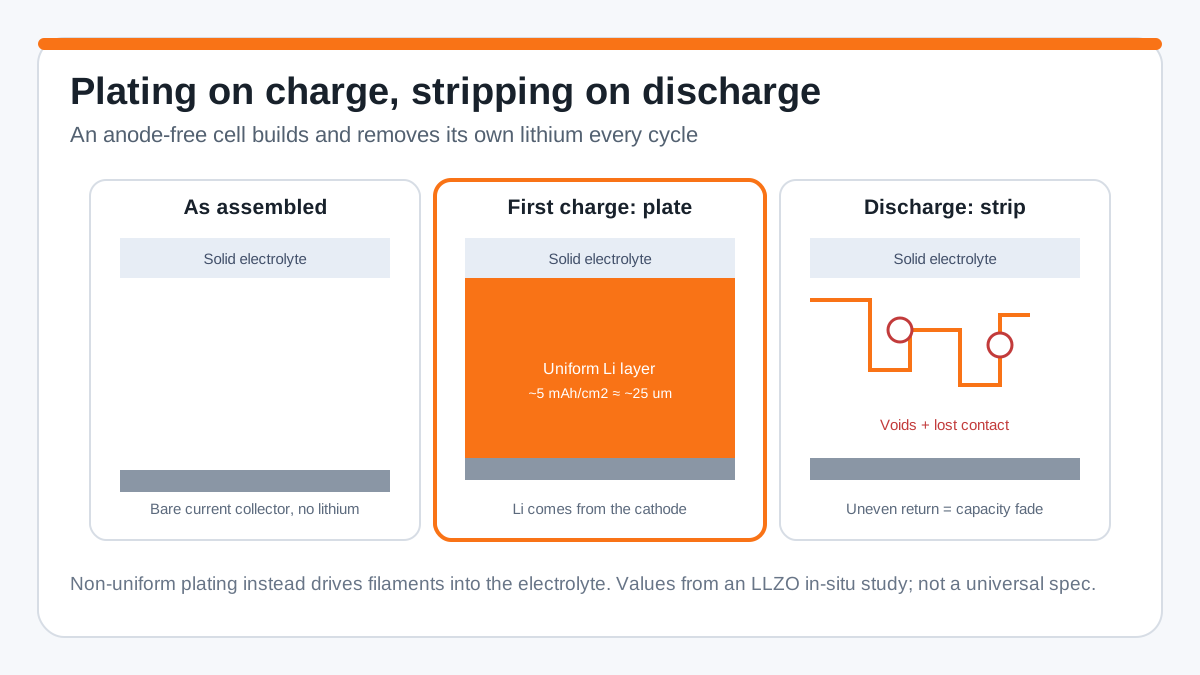
The lithium arrives electrochemically. A study of in-situ plated lithium-metal cells on an LLZO garnet electrolyte formed the anode on the first charge cycle by electroplating lithium contained within the cathode, and demonstrated roughly 5 mAh/cm2 of plated lithium, about 25 micrometres thick, without degrading the electrolyte. In that work the plating step used a low current density near 0.05 mA/cm2, the full cell cycled at 60 C and about 4 MPa of stack pressure, and it ran 50 cycles at a C/10 rate with near-100 percent coulombic efficiency after the first few cycles. The authors' framing of the manufacturing case is blunt: free-standing lithium foils may not be viable at scale because of the difficulty and cost of handling them.
That is the upside. The catch is that the same 25 micrometres of lithium now has to be re-plated evenly and stripped cleanly on every subsequent cycle, with no spare lithium anywhere in the cell to cover losses.
The failure modes you are buying with a metal anode
Reactivity and interphase. Lithium metal is chemically and electrochemically aggressive. It reacts with most electrolytes to consume lithium inventory, corrode the interface and build an irreversible solid-electrolyte interphase. Every one of those reactions is capacity that never comes back.
Non-uniform plating and stripping. On stripping, lithium can be removed unevenly, leaving voids at the collector-electrolyte interface and losing contact with part of the anode; that lost area shows up as capacity fade. On plating, uneven deposition concentrates current at high spots and grows lithium filaments that can propagate along grain boundaries in a solid electrolyte and eventually short the cell. Nanoscale imaging work also finds stripping is intrinsically asymmetric with respect to plating and leaves a persistent interfacial residual layer, so the electrode does not simply return to its previous state each cycle.
No lithium reservoir. A graphite or thick-foil cell carries excess lithium that masks small per-cycle losses for a long time. An anode-free cell does not, so its cycle life is set almost entirely by coulombic efficiency. Reviews note that anode-free cells fade quickly unless efficiency stays above about 99.9 percent, and that liquid-electrolyte anode-free cells typically manage fewer than 100 cycles. The value of the solid electrolyte is that anode-free solid-state cells have been demonstrated past 1000 cycles, and one 24-layer prototype has reported more than 1000 cycle-equivalents with over 95 percent energy retention.
Volume change. A lithium-metal anode expands and contracts by roughly 15 to 30 percent as it plates and strips, which drives microcracking, dendrite initiation and shorting if the cell and pack cannot accommodate the movement. How long a given design holds up under that cycling is the question in how long solid-state batteries last.
What changes in handling, pressure and cell spec
Lithium-foil handling. If the cell uses a pre-applied lithium anode, the supplier is handling thin reactive metal in a controlled atmosphere, which adds cost and yield risk. An anode-free cell removes that step, which is part of why anode-free is presented as the lower-cost, more scalable route.
Stack pressure. Metal anodes are pressure-sensitive. Maintaining even contact during stripping, and suppressing uneven plating, generally needs external pressure held across the cell; the in-situ study above used about 4 MPa. Whether that pressure is fixed, actively controlled or allowed to drift is a real variable, and the pack has to supply it uniformly without crushing layers.
Current density, areal capacity and temperature. Uniform plating gets harder as current density and areal capacity rise. Lab demonstrations of 5 mAh/cm2 at high efficiency exist, but the rate and temperature at which that was achieved matter; a cycle-life number quoted at low rate and elevated temperature does not transfer to fast charging at ambient. Thin lithiophilic seed layers such as silver, magnesium or tin on the current collector improve how evenly lithium nucleates and can raise efficiency, so ask what interlayer is doing that work.
What to ask a supplier before you compare anode data
An energy-density or cycle-life figure for a solid-state cell is only comparable inside a defined test. Before ranking samples, pin down the architecture and lithium budget, the reporting basis, the test conditions and the reversibility evidence.
Use the answers to sort each result into accept, needs clarification or not comparable, rather than ranking cells on a single headline number.
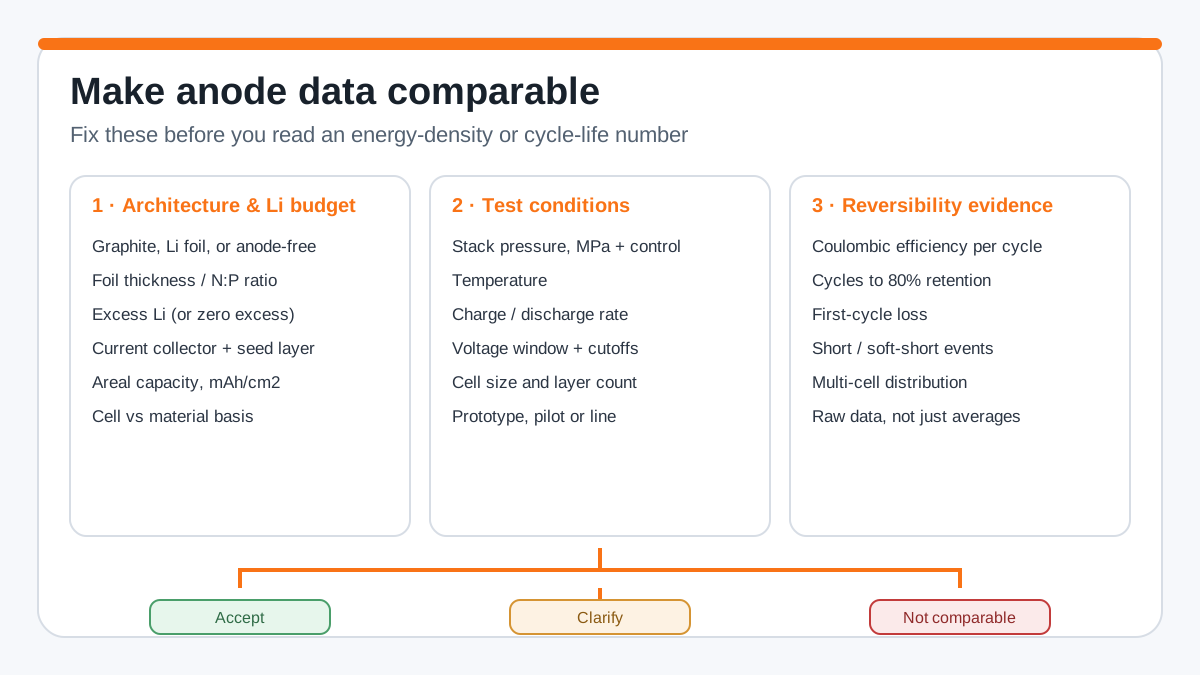
- Architecture and lithium budget: graphite, pre-applied lithium foil or anode-free; foil thickness or negative-to-positive capacity ratio; how much excess lithium, if any; current collector and any seed or interlayer.
- Basis: whether a quoted energy density is material-level or full-cell, gravimetric or volumetric.
- Test conditions: stack pressure and how it is controlled; temperature; charge and discharge rate; voltage window; cell size and layer count; prototype, pilot or production-representative cells.
- Reversibility evidence: coulombic efficiency per cycle rather than an average; cycles to 80 percent retention; first-cycle loss; any short or soft-short events; the spread across multiple cells; and access to raw cycling data.
Talk to us with your architecture in mind
If you are scoping solid-state cells for a program, bring your target energy density and basis, your usable temperature and pressure envelope, the cycle life and retention you need, and whether your pack can supply and hold stack pressure.
Review the battery product families for format and voltage context, then use the technical contact path to request samples and align on a test protocol. AntBattery can discuss a project-specific anode architecture and evidence package; no single cross-chemistry energy-density or cycle-life figure is implied by this article.
FAQs
What is the anode in a solid-state battery made of?
It depends on the design. It can be a conventional graphite host, a thin lithium-metal foil applied during manufacturing, or nothing at assembly time in an anode-free cell, where a lithium-metal layer is plated onto the bare current collector on the first charge.
Why use a lithium metal anode instead of graphite?
Lithium metal has close to ten times the specific capacity of graphite and carries no inactive host, so replacing graphite with lithium metal is the main source of the energy-density gain in a solid-state cell, on the order of 40 percent by weight and 70 percent by volume for comparable chemistries.
What does anode-free mean?
The cell is built with no anode active material, only the anode current collector. The lithium-metal anode forms in place during the first charge from lithium supplied by the cathode. It is also called a zero-excess-lithium design.
Is an anode-free solid state battery better than a lithium-metal foil anode?
Anode-free gives a further energy-density gain and removes lithium-foil handling from manufacturing, but it has no lithium reservoir, so its cycle life is far more sensitive to coulombic efficiency. Foil designs are more forgiving of small per-cycle losses.
Why do solid-state batteries need a solid electrolyte to use lithium metal?
A solid electrolyte can mechanically resist the lithium filaments that non-uniform plating produces. In a liquid cell those filaments grow freely and short the cell, which is why durable lithium-metal and anode-free cells are pursued in solid-state form.
What is the main failure mode of an anode-free cell?
Loss of cyclable lithium. Uneven stripping leaves voids and loses contact at the current collector, uneven plating grows filaments toward the electrolyte, and side reactions consume lithium. With no reservoir, those losses translate directly into capacity fade.
Does an anode-free cell still need stack pressure?
Yes. Maintaining even contact during stripping and suppressing uneven plating generally requires external pressure held across the cell, supplied uniformly by the pack.
Sources and further reading
- Heubner et al., Advanced Functional Materials 31, 2106608 (2021) - From Lithium-Metal toward Anode-Free Solid-State Batteries (abstract consulted; full text paywalled)
- Enabling lithium-free manufacturing of pure lithium metal solid-state batteries through in situ plating, Nature Communications 11, 5201 (2020) - open access
- Anode-Less (Anode-Free) Batteries: From Fundamental Principles to Practical Pathways Toward Solid-State Implementation - open-access review, PMC13027634 (2025)
- QuantumScape - Solid-State Battery Technology (manufacturer statement, accessed 2026-09-06)
- Solid-state batteries: Hype, hopes, and hurdles - Physics Today feature (accessed 2026-09-06)
- Nanoscale imaging reveals critical plating and stripping mechanisms in anode-free lithium and sodium solid-state batteries - arXiv:2603.00998 (abstract consulted)
Related Blogs
Learn More About Battery
Related Products
Related product
Prismatic Series
AB-100AH Semi Solid Prismatic Cell
- Energy Density
- 285 Wh/kg
- Nominal Voltage
- 3.65 V
Pouch Cell Series
AB-50AH Semi Solid Pouch Cell
- Energy Density
- 320 Wh/kg
- Nominal Voltage
- 3.7 V
Cylindrical Series
AB-21700 Semi Solid Cylindrical Cell
- Energy Density
- 300 Wh/kg
- Nominal Voltage
- 3.7 V