The short answer: the number is a size, not a spec
A cylindrical cell format is a dimensional label and nothing more. An 18650 is roughly 18 mm in diameter and 65 mm long. A 21700 is roughly 21 × 70 mm. A 4680 is 46 × 80 mm. The digits are the measurements, and there can be minor dimensional variation between manufacturers.
That label tells you nothing about the chemistry inside, the capacity, or how much current the cell will take. Two cells sharing a format can differ in all three. So the useful question is not which format wins, but what the extra size actually buys you.
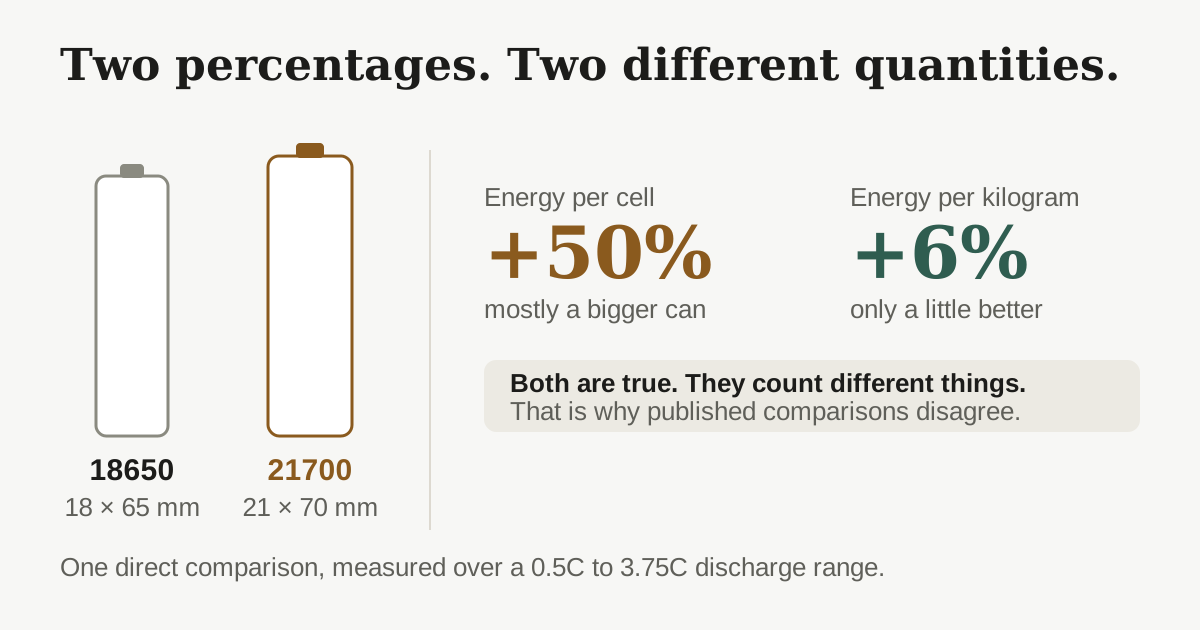
The answer splits in two, and that split is why the advice you have already read contradicts itself. Per cell, a 21700 holds about 50% more than an 18650. Per kilogram, it is worth about 6%. Both figures come from the same measurement, and they are not in conflict — they simply count different things.
Summary. A bigger can holds more: the measured capacity ratio of 1.53 is consistent with the 1.52 ratio of cathode areas, so the gain tracks electrode area. Per kilogram the improvement is small, about 6%. Choose on fit, current and what the datasheet actually states.
If you are still choosing between package types rather than between cylindrical sizes, settle that choice first. This article starts once you have settled on a round can.
Per cell: about 50% more, and the reason is geometry
A direct comparison published in the Journal of Power Sources put 18650 and 21700 cells through the same electrochemical, thermal and geometric tests. It found that capacity and energy per cell increase by about 50% from 18650 to 21700 for discharge in the range of 0.5C to 3.75C. At 0.5C and 20 °C ambient the measured capacity ratio was 1.53 ± 0.01.
The interesting part is what that number lines up with. The same paper reports the cathode areas: 767.2 cm² for the 18650 and 1164.0 cm² for the 21700. That is a ratio of 1.52. The capacity ratio of 1.53 and the electrode-area ratio of 1.52 are, within measurement error, the same number.
Scroll the diagram horizontally to read every label.
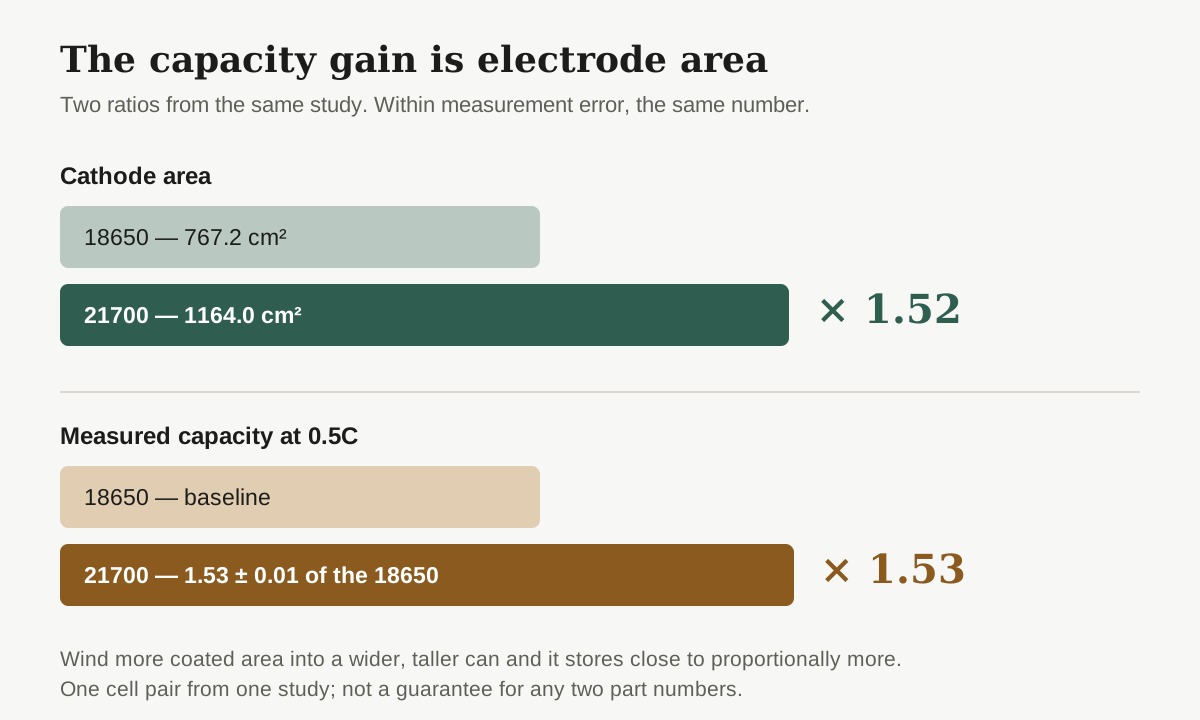
So most of the extra energy is extra electrode. Wind more coated area into a wider, taller can and it stores close to proportionally more. That is a real and useful gain, and it is mostly a geometric one rather than a change in how well the cell uses its own mass.
One caution on scope. This is one cell pair from one study. Not every 18650 and every 21700 on the market will land on 1.53, because the figure depends on what each manufacturer actually wound into the can. Treat it as the shape of the difference, not a guarantee about two specific part numbers.
Per kilogram: about 6%, which is why the advice contradicts itself
Now weigh the cells. The same direct comparison reports that specific energy increases by about 6% when changing format from 18650 to 21700. An earlier estimate by the same authors, based on cylinder volumes rather than measurement, put the increase at about 2%.
Both of those are a long way from 50%, and that gap is the whole story. A 21700 stores about half again as much energy as an 18650, and it takes almost proportionally more cell to do it. You get substantially more per cell. You get very little more per kilogram.
This is where most published comparisons go wrong. Some quote the per-cell figure and call the 21700 dramatically better. Others quote the specific-energy figure and call the difference marginal. At least one industry FAQ prints both claims in the same list without reconciling them. They are all describing the same cells; they are just not saying which quantity they mean.
Scope of the table below. Every figure in it comes from the same direct comparison of one 18650 and one 21700, measured over a 0.5C to 3.75C discharge range.
| What is measured | Change | Condition |
|---|---|---|
| Capacity and energy per cell | about +50% | discharge 0.5C to 3.75C; ratio 1.53 ± 0.01 at 0.5C |
| Cathode area | +52% (767.2 to 1164.0 cm²) | geometric, from the same study |
| Specific energy (per kilogram) | about +6% | same cell pair, same study |
| Earlier volume-based estimate of specific energy | about +2% | calculated from cylinder volumes, not measured |
Which figure you should care about depends on what constrains your design. If the enclosure has room and you want fewer parts, the per-cell number is the one that matters. If you are fighting for mass — a drone, a handheld tool, anything that has to be carried — then 6% is your real budget, and switching format is not the lever you were hoping for.
Note the condition attached to the 50% figure: it was measured over a 0.5C to 3.75C discharge range. Outside that window the comparison simply was not made. If your application draws harder than that, the honest answer is that this study does not cover you, and you need the cell’s own rate data.
Can you swap one for the other?
Mechanically, no. A 21700 is 3 mm wider and 5 mm longer than an 18650. It will not drop into an 18650 holder, sleeve or spring contact, and nothing about the format is designed to make it.
At pack level the answer is more specific than a flat no. Battery Power Tips says moving from 18650 to 21700 means about one third fewer cells for the same total energy and that the percentage of space in the voids between cells stays about the same. It also says the pack is at least 5 mm taller than the 18650 equivalent, which is why simple retrofitting will not usually be possible. The source does not give complete external pack dimensions, so those points do not establish identical pack volume.
Bigger is not automatically denser: what the 4680 measured
If a bigger can gave you a better cell, the largest format would win outright. It does not. A peer-reviewed study published in Batteries in June 2023 measured 19 cylindrical cells from four manufacturers across four formats — 18650, 20700, 21700 and 4680 — rather than quoting datasheet figures.
On the Tesla 4680, which is 46 mm in diameter and 80 mm high, making it 5.5 times the volume of a 21700 and eight times that of an 18650, the measured gravimetric energy density came out at 224.8 Wh/kg. The authors call that “relatively small compared to many cells studied in this paper, even though the electrode coating of the electrodes is significantly larger than all other cells”.
They also measured its thermal behaviour, and gave the comparison. At room temperature in a climate chamber, the 18650 and 21700 cells with classical tab designs showed surface temperature rises between 1.2 °C and 5.3 °C. The 4680 rose 8.2 °C, which the paper reads as the quasi-tabless design not being sufficient to compensate for the poor surface-to-volume ratio of large formats — it notes that a 4680 has only half the surface-to-volume ratio of an 18650. Heat has further to travel out of a big cylinder, and a clever current-collector geometry only partly offsets that.
Two qualifications matter here. This was a Generation 1 cell measured for a paper published in June 2023, so it describes that cell at that time and not the state of the format today. And the study’s per-format averages — 264.5 Wh/kg for 21700 cells against 192.5 Wh/kg for 18650 cells — span different models, vintages and chemistries, so they are not a like-for-like measure of what the format itself contributes. The like-for-like number remains the roughly 6% from the direct comparison above.
What the number on the datasheet is worth
The same 2023 study is unusually useful for a second reason: it measured cells whose datasheets were also available. For the NCR2070C, the datasheet specifies 569 Wh/L and 214 Wh/kg. The authors measured 562.52 Wh/L and 200.72 Wh/kg.
The measured gravimetric figure came in below the published one, by about 13 Wh/kg. The paper notes that a measured energy density may differ from a manufacturer’s specification because of its own unified testing conditions. The two pairs above work out to a 1.1% shortfall on the volumetric figure and 6.2% on the gravimetric one, which is our arithmetic on the paper’s numbers rather than a figure it states. It is also one cell in one study, so it does not show that datasheets generally overstate. What it does show is that a published energy-density figure and a measured one are different kinds of number, and that treating them as interchangeable is a real way to get a pack design wrong.
Scroll the diagram horizontally to read every label.
Apply that test to this site. Our catalogue lists one cylindrical cell, the AB-21700 semi-solid: 3.7 V nominal, 5.5 Ah, 300 Wh/kg, more than 1,200 cycles, –20 °C to 60 °C. Multiply the first two and you get 3.7 × 5.5 = 20.35 Wh of nominal energy per cell, which is arithmetic from published figures rather than measured delivered energy.
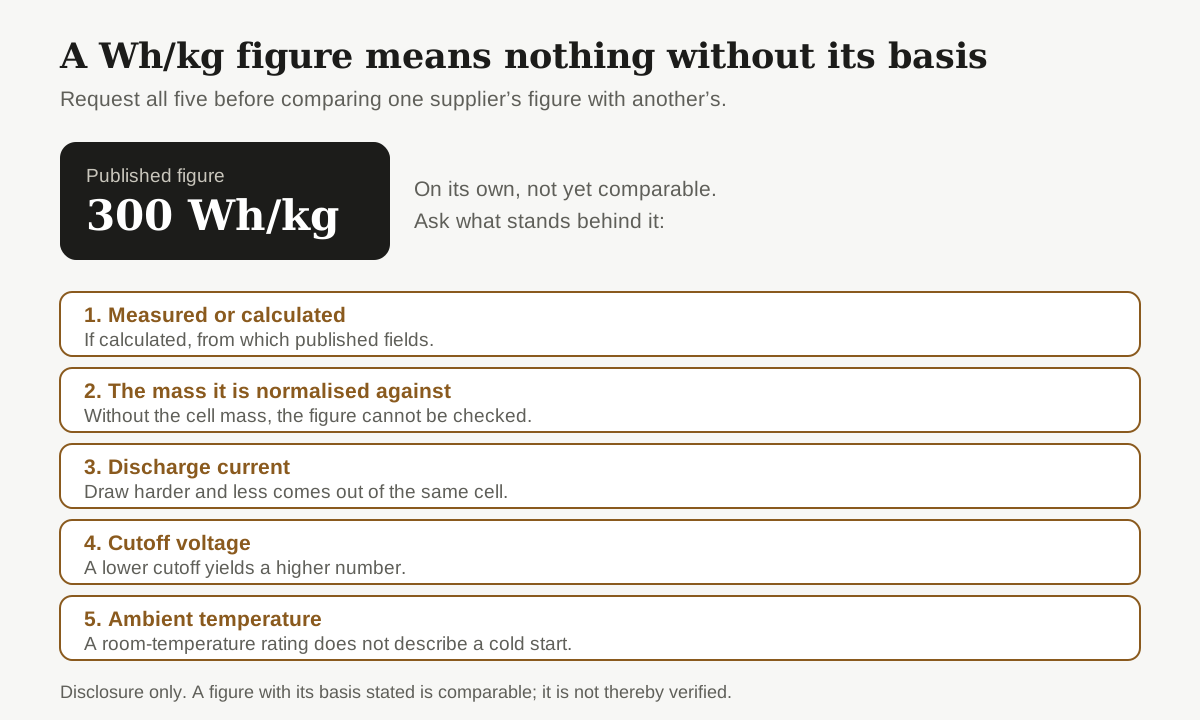
That listing does not state the discharge current, the cutoff voltage or the ambient temperature behind the rated capacity. It does not publish the cell mass, and it does not say whether the energy-density figure is measured or calculated. You can work the mass backwards — 20.35 Wh at 300 Wh/kg implies about 68 g — but that is an inference from two published numbers, not a specification. Without a published cell mass and test basis, the 300 Wh/kg catalogue figure cannot be checked here or compared like-for-like with the conventional cells in the study. Request those basis fields from any supplier before treating the number as a measured result.
For the wider version of this check, applied to energy-density and cycle-life claims generally rather than to one figure, see the claims-verification checklist.
What to send a supplier
Once you know which format fits the envelope, the questions that decide between individual cells are the ones about basis:
- Is the energy-density figure measured or calculated? If calculated, from what.
- What mass is it normalised against? Without it a watt-hours-per-kilogram figure cannot be checked.
- Discharge current the rated capacity was measured at
- Cutoff voltage the rating discharged to
- Ambient temperature of the rating
And state your own side, so the first answer is a useful one:
- Energy needed per cell, or per pack if you have not fixed the cell count
- Envelope limits, and in particular the height you have available
- Continuous and peak current
- The cutoff voltage your system will enforce
- Your operating temperature range
- Whether a figure has to be measured or may be calculated
A supplier who answers all five basis questions above gives you numbers you can line up against another supplier’s. Without them you have figures that look comparable and are not. When you are ready to compare against a real cell, the cylindrical cell category shows what we currently publish — and, as the section above says, the five basis fields are not yet part of it.
FAQs
Can I charge 21700 with an 18650 charger?
Only if the charger physically accepts the larger cell and is rated for it. A 21700 is 3 mm wider and 5 mm longer, so it will not sit in a bay sized for an 18650. Some chargers have adjustable or multi-format bays, but the format label itself is only a size and does not tell you the correct charging parameters. Those come from the cell datasheet.
Are 18650 and 21700 batteries interchangeable?
Not mechanically. The 21700 will not fit an 18650 holder, sleeve or spring contact. At pack level, an industry FAQ says a 21700 pack storing the same energy needs about one third fewer cells and has about the same percentage of void space between cells, while coming out at least 5 mm taller. It does not provide complete pack dimensions, so it does not establish identical pack volume.
What are the disadvantages of 18650 batteries?
Mainly that each cell holds less. Against a 21700 the same design needs roughly half again as many cells for the same stored energy, and every additional cell is another interconnect to make. Per kilogram the disadvantage is much smaller: a direct comparison measured only about a 6% specific-energy difference between the formats. The 18650 remains the better fit where the envelope is tight or existing tooling and holders already suit it.
Sources and further reading
- Journal of Power Sources (2020) — 18650 vs. 21700 Li-ion cells: a direct comparison of electrochemical, thermal, and geometrical properties
- Batteries (2023, 9(6), 309) — Design, Properties, and Manufacturing of Cylindrical Li-Ion Battery Cells: A Generic Overview
- Battery Power Tips — cylindrical Li-ion formats FAQ (dimensions and pack-level figures)
Ask for the basis, not just the number
Send the energy you need per cell or per pack, your envelope limits including available height, continuous and peak current, the cutoff voltage your system will enforce and your operating temperature range. Ask a supplier whether its energy-density figure is measured or calculated, and what mass it is normalised against.
Request a quote