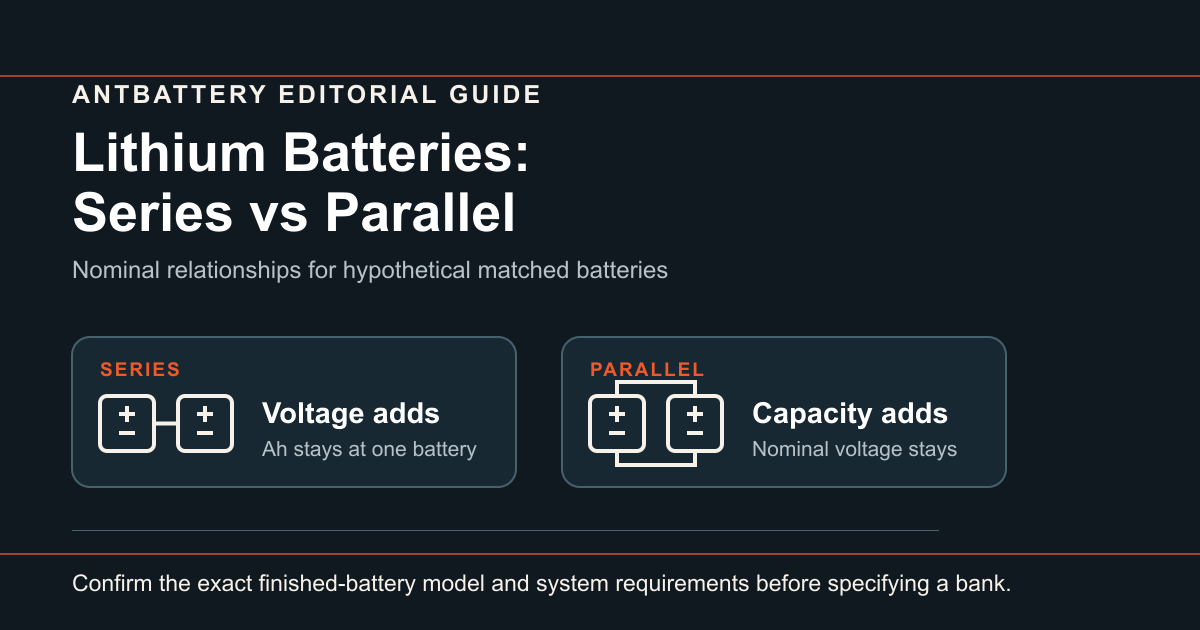
The short answer: series changes voltage; parallel changes capacity
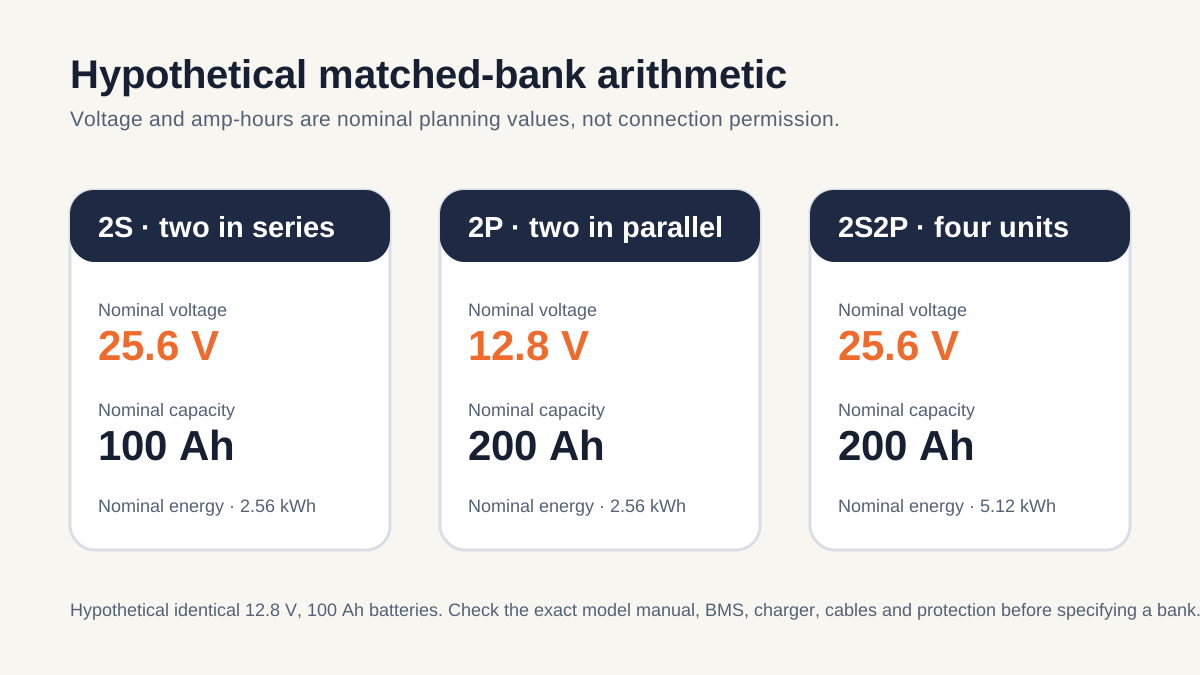
Consider identical, hypothetical 12.8 V, 100 Ah batteries that are approved for the arrangement being compared. Two in series (2S) produce a nominal 25.6 V, 100 Ah bank; two in parallel (2P) produce 12.8 V, 200 Ah. Each contains about 2.56 kWh of nominal energy because voltage multiplied by amp-hours gives watt-hours. Four arranged as two matched 2S strings in parallel (2S2P) would be 25.6 V, 200 Ah, or about 5.12 kWh nominal. Real usable energy depends on the battery specification, operating window, temperature, rate and system losses. None of these values describes an AntBattery product.
| Arrangement of hypothetical matched 12.8 V, 100 Ah batteries | Nominal voltage | Nominal capacity | Nominal energy |
|---|---|---|---|
| Two in series (2S) | 25.6 V | 100 Ah | 2.56 kWh |
| Two in parallel (2P) | 12.8 V | 200 Ah | 2.56 kWh |
| Four in two parallel 2S strings (2S2P) | 25.6 V | 200 Ah | 5.12 kWh |
Illustrative nominal values only. The battery manual and system design determine which connections, unit counts, voltage windows and usable capacity are actually allowed.
Scroll the diagram horizontally to read every label.
Begin with the equipment's voltage range, power and energy requirement. A label such as “12 V” or “48 V” describes a class, not the full charging range or an installation approval. The AntBattery product overview gives commercial context once those system requirements are clear.
What a series connection changes
In a matched series string, nominal voltages add. The same current flows through each battery, so Ah does not add. A higher-voltage load may be served by a series arrangement only if the exact finished batteries are approved for it. The charger and equipment must accept the entire operating voltage range, rather than just the nominal number.
One battery can reach its protection limit earlier than another when state of charge, age, condition, capacity or temperature differ. Each finished battery may have its own BMS, but that does not establish how the whole string will behave when a unit disconnects. Ask the maker for the permitted series count, required matching and monitoring, and the charger and load response to a BMS opening. The general Power-Sonic series and parallel explainer supports the voltage relationship and cautions that lithium series use requires BMS attention; it does not approve a particular model.
Do not assume two finished 12 V batteries are a valid 24 V system just because their nominal voltages add. Compare an explicitly approved series system with a purpose-built 24 V pack, then check the actual specification and service boundary of each option.
What a parallel connection changes
In a compatible parallel bank, nominal voltage remains the same while matched branch Ah ratings add. At a given load, more usable capacity can extend runtime, but twice the labeled Ah does not promise twice the real runtime. Temperature, discharge rate, BMS limits, battery condition and system losses matter.
Matching labels alone do not prove that current divides equally among branches. Cable path, internal resistance, state of charge and battery condition can differ. Treat branch balance, pre-connection matching, cables, fuses and commissioning as questions for the exact battery manual and system designer. If one branch opens, check whether the remaining bank can safely carry the load instead of assuming it can.
Combined Ah is not an unrestricted current rating. Cells, BMS, interconnects and external protection constrain each branch. The BB10012/BB10012H manual from Battle Born illustrates why the model matters: it describes series and parallel arrangements, an internal BMS, matching considerations and parallel cable/protection requirements for those named batteries. Its permission and limits do not apply to AntBattery or another model.
When both voltage and capacity must increase
A series-parallel bank uses matched series strings as parallel branches. The hypothetical 2S2P example above gives 25.6 V and 200 Ah nominal from four 12.8 V, 100 Ah units. That result assumes compatible units and approved architecture. The manufacturer and system designer must specify how strings are matched, protected and monitored, and how many strings are allowed.
A factory-integrated pack may contain cells in series and parallel under one designed protection and thermal system. That does not mean separately purchased finished batteries, each with its own BMS, may be connected in the same pattern. Ask whether a supplier's series/parallel statement describes bare cells, an integrated pack, battery modules or independently protected finished batteries.
Choose the architecture from the equipment backward
Record the equipment's minimum and maximum DC voltage, continuous and short-duration power, charger output range, expected operating temperature and available installation space. Estimate nominal energy from voltage times Ah, then use the selected model's documented limits to estimate usable energy. Voltage, energy and deliverable current are separate selection checks.
For a hypothetical 24 V-class load drawing 600 W for two hours, the load needs 1.2 kWh before conversion losses or reserve. At 25.6 V nominal, 600 W corresponds to about 23.4 A. A hypothetical 25.6 V, 100 Ah bank contains 2.56 kWh nominal. That arithmetic does not prove the load's full voltage range, starting current, charger profile, usable energy or a two-battery arrangement is compatible.
| Project need | Direction to compare | Documentation to confirm |
|---|---|---|
| Higher equipment voltage | Approved series system or one higher-voltage pack | Operating voltage window, charger and model-specific series permission |
| More energy at the existing voltage | Approved parallel system or larger single pack | Parallel permission, branch protection and current behavior |
| Both higher voltage and more energy | Approved series-parallel system or integrated pack | String matching, protection, monitoring and service plan |
| Simpler maintenance boundary | One correctly specified integrated pack | Model-specific energy, current, connections and communications |
The 24 V collection and 48 V collection are voltage-class starting points, not evidence that a particular multi-battery configuration is stocked or approved.
Seven checks before approving a lithium bank
- Written permission: Does the current manual or written application approval explicitly permit this exact model and revision in series, parallel or both? How many units?
- Matching: Are chemistry, model, capacity, age/condition and operating range compatible under the maker's instructions?
- Initial condition: What state-of-charge or terminal-voltage matching must be completed before connection?
- Protection: What does each BMS protect, which external devices are needed, and what happens when a unit disconnects?
- Charging: Does the charger cover the complete voltage window and the model's lithium charging requirements, including temperature restrictions?
- Current paths: Are cables, connectors, busbars and overcurrent devices sized and arranged for continuous load, peaks and faults?
- Operations: How will the bank be monitored, isolated and serviced without silently mixing unlike units later?
Scroll the diagram horizontally to read every label.
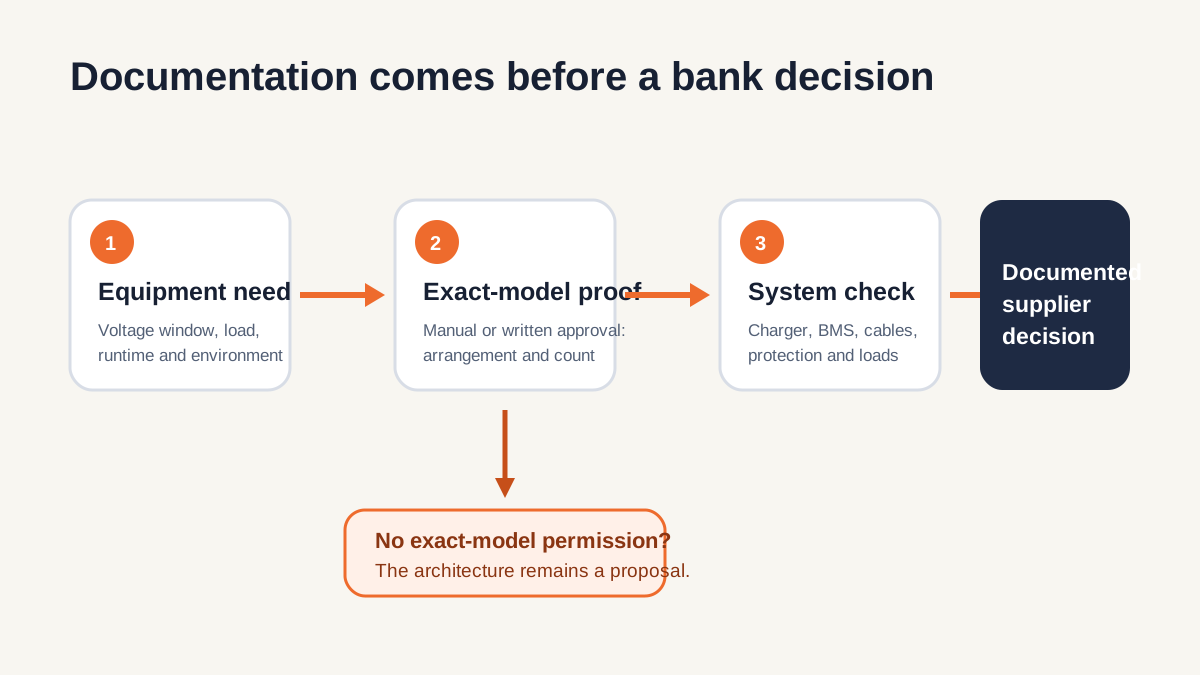
If a document or answer is unavailable, the architecture remains a proposal. A qualified designer or installer should specify the installation and protection using the exact manuals and applicable rules. This article cannot supply missing product approval.
What to send a battery supplier
Send the equipment and charger models, accepted voltage window, continuous and peak loads, runtime or usable-energy target, duty cycle, ambient temperature, enclosure space, connector and communication needs, and desired number of serviceable modules. Ask the supplier to name the proposed battery model, permitted series/parallel count, BMS fault behavior, current limits, protection approach and commissioning instructions in writing.
An integrated pack may be a better option than connecting finished batteries. Compare the choices on usable energy, monitoring, serviceability and documented compatibility. If you want AntBattery to assess a project, use the existing quote form with those requirements; the examples here do not establish available stock or a supported bank.
FAQs
What document confirms that finished lithium batteries may be connected in series or parallel?
Ask for the current manufacturer manual or written application approval for the exact model and revision. It should specify the permitted arrangement and unit count, required matching, charger and protection setup, and any monitoring or commissioning steps. A nominal-voltage match or generic connection diagram is not permission.
Sources and further reading
Discuss a documented battery requirement
Use the existing quote form to share the equipment voltage range, charger and load model, continuous and peak current, usable-energy target, temperature and installation constraints for a custom cell or pack enquiry.
Request a quote